


Once billed as merely a challenge to the government, human trafficking has snowballed to the point of "threatening national security" amid a surge in the number of foreigners who go missing after arriving in Taiwan, immigration experts said yesterday, adding that the crisis will likely worsen as the government fumbles in its efforts to fight it.
Speaking to immigration officials and experts at the International Conference on Human Trafficking in Taipei yesterday, US Deputy Assistant Attorney General Grace Becker called such trafficking the "largest human rights violation in today's world."
The problem is set to further intensify, she added, as the number of people traversing international borders to find work doubles annually, as it has for the past seven years.
Local charity workers said such trends mean the country must heed Becker's advice to foster a progressive attitude in handling trafficked foreigners, many of whom drop off the government's radar and become sex slaves known only to the underworld.
Traveling with US Department of Justice officials yesterday, Becker said the key to fighting human trafficking is to "empower" trafficked people and overlook the crimes -- especially prostitution -- that they were forced or swindled into committing by traffickers.
Earning the victims' trust, Becker added, typically leads to their divulging information that allows authorities to root out the "big fish," the traffickers.
"We believe in the US, like I'm sure you do in Taiwan, that treating victims with care exemplifies our highest values," she said.
But the charities helping exploited foreign laborers and prostitutes say that treating trafficked foreigners with care is exactly what Taiwan isn't doing.
Le My-nga, policy and planning director at the Vietnamese Migrant Workers and Brides Office in Taoyuan County, said local immigration authorities "still criminalize [trafficked] victims" and "aren't addressing the root causes of human trafficking."
"They're still in damage control mode," she said, referring to the attitude of immigration officials since 2005, when the US added Taiwan to a "watch list" for countries that aren't doing enough to combat human trafficking.
American Institute in Taiwan (AIT) official Brad Parker, who reports to Washington on the country's human trafficking situation, said Taiwan was put on the "Tier 2 Watch List" in the State Department's annual Trafficking in Human Persons report because "Taiwan, after being made aware of its human trafficking problem, hadn't made any significant corrections for two years."
"There was a sense in Washington that Taiwan wasn't actively addressing the problem," he added.
The 2005 Kaohsiung riot involving hundreds of Thai laborers who set fire to their dormitory after being pushed to breaking point by local employers was a watershed moment for Washington, which put Taiwan on the Tier 2 Watch List shortly after the incident, Parker said.
"That got our attention. We began digging deeper after that," he said.
Two years later, the dirt the US dug up on Taiwan's trafficking situation continues to mount, said Peter O'Neill, chaplain of the Hsinchu Catholic Diocese, which runs a "Migrant Concern Desk."
O'Neill lamented the lack of legal counsel for trafficked laborers after they run away from exploitive employers and get collared by police for breaking the terms of their labor agreement.
Local judges too often deport the laborers without any lawyers present, O'Neill said.
In 2002, the number of "unaccounted for" Southeast Asian immigrants in Taiwan -- common victims of trafficking -- totaled 8,135, Taitung County Police Department official Chen Ming-an (
They came here on labor or marriage visas but then vanished, he said, adding that most women among those missing foreigners went underground, almost always against their will, to sell sex.
Fast forward to last year: the figure for missing Indonesians, Filipinos, Thais, Vietnamese and Mongolians was 16,142, nearly double the number just four years earlier, while the number of prostitution arrests involving foreign women soared from 41 in 2002 to nearly 200 last year, Chen said.
Such conditions, Becker told interior ministry officials, give rise to "modern day slavery," the "most pernicious form [of which] is the trafficking of women and children into a dark world of sexual servitude where virgin rape ... abuse and disease amount to a virtual death sentence for the young and vulnerable."

More than half of the bamboo vipers captured in Tainan in the past few years were found in the city’s Sinhua District (新化), while other districts had smaller catches or none at all. Every year, Tainan captures about 6,000 snakes which have made their way into people’s homes. Of the six major venomous snakes in Taiwan, the cobra, the many-banded krait, the brown-spotted pit viper and the bamboo viper are the most frequently captured. The high concentration of bamboo vipers captured in Sinhua District is puzzling. Tainan Agriculture Bureau Forestry and Nature Conservation Division head Chu Chien-ming (朱健明) earlier this week said that the
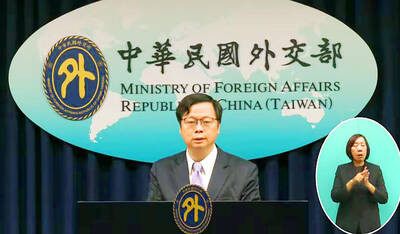
NAMING SPAT: The foreign ministry called on Denmark to propose an acceptable solution to the erroneous nationality used for Taiwanese on residence permits Taiwan has revoked some privileges for Danish diplomatic staff over a Danish permit that lists “Taiwan” as “China,” Eric Huang (黃鈞耀), head of the Ministry of Foreign Affairs’ Department of European Affairs, told a news conference in Taipei yesterday. Reporters asked Huang whether the Danish government had responded to the ministry’s request that it correct the nationality on Danish residence permits of Taiwanese, which has been listed as “China” since 2024. Taiwan’s representative office in Denmark continues to communicate with the Danish government, and the ministry has revoked some privileges previously granted to Danish representatives in Taiwan and would continue to review
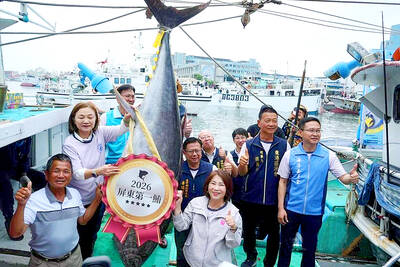
The first bluefin tuna of the season, brought to shore in Pingtung County and weighing 190kg, was yesterday auctioned for NT$10,600 (US$333.5) per kilogram, setting a record high for the local market. The auction was held at the fish market in Donggang Fishing Harbor, where the Siaoliouciou Island-registered fishing vessel Fu Yu Ching No. 2 delivered the “Pingtung First Tuna” it had caught for bidding. Bidding was intense, and the tuna was ultimately jointly purchased by a local restaurant and a local company for NT$10,600 per kilogram — NT$300 ,more than last year — for a total of NT$2.014 million. The 67-year-old skipper
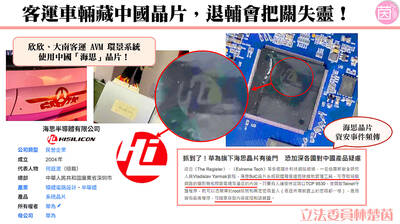
BREACH OF CONTRACT: The bus operators would seek compensation and have demanded that the manufacturer replace the chips with ones that meet regulations Two bus operators found to be using buses with China-made chips are to demand that the original manufacturers replace the systems and provide compensation for breach of contract, the Veterans Affairs Council said yesterday. Democratic Progressive Party Legislator Michelle Lin (林楚茵) yesterday said that Da Nan Bus Co and Shin-Shin Bus Co Ltd have fielded a total of 82 buses that are using Chinese chips. The bus models were made by Tron-E, while the systems provider was CYE Electronics, Lin said. Lin alleged that the buses were using chips manufactured by Huawei subsidiary HiSilicon Co, which presents a national security risk if the


 RSS
RSS