


Loved ones and democracy activists gathered yesterday to pay tribute to Deng Nan-jung (
"My heart aches. No matter how strong I want to be ... tears still run like water down my face," said Yeh Chu-lan (葉菊蘭), Deng's widow and former acting Kao-hsiung mayor at a commemorative event hosted by the Deng Liberty Foundation (鄭南榕基金會) at Chinpaoshan Cemetery (金寶山) in Taipei County.
On April 7, 1989, Deng, then editor-in-chief of Freedom Era Weekly (
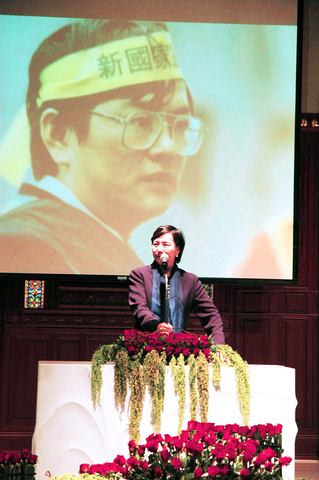
PHOTO: CNA
Among the more than 100 people attended the ceremony was Democratic Progressive Party (DPP) Chairman Yu Shyi-kun.
Questioning whether Taiwanese trust the nation's political parties, government, politicians and media, Yu said that Deng's self-immolation was the result of his being true to his belief in democracy.
Yu added that as Taiwan searches for a new Taiwanese democracy, Deng's example helped people believe, stay true to their word and behave in an upright manner, which Yu said was the kind of person Taiwan required today.
Yeh thanked everyone for attending the service and said that Deng had made her feel their family was the proudest and happiest one in Taiwan.
Yeh added that while Taiwan had left the white terror behind over the past 18 years to become a country that enjoys freedom of expression, it is also necessary to consider the responsibilities that this freedom implies.
Born in Taiwan in 1947 to a Chinese father, Deng publicly argued for Taiwan independence on numerous occasions during the 1980s -- a time when vocal supporters of independence were often charged with sedition.
"I am the child of a mainlander and I advocate Taiwan independence," he once said.
After failing to win his philosophy diploma from National Taiwan University because he refused to take courses on the philosophies of Sun Yat-sen (
A follower of liberalism, Deng held a deep belief in freedom of expression and established Freedom Era Weekly in 1984 in pursuit of what he called "100 percent freedom of expression."
To prevent the magazine from being banned or suspended by the Chinese Nationalist Party (KMT) regime, Deng registered licenses under 18 different names such as "a spare tire."
The magazine lasted five years and eight months and finally closed six months after Deng's death.
The magazine achieved fame in the 1980s, when the country was under martial law, for its reports on the KMT's corrupt practices and articles that challenged the authority of late president Chiang Ching-kuo (
As a result of its outspokenness, the magazine broke the record for the number of times a publication had been banned or suspended.
Yesterday's ceremony ended with Reverend Kao Chun-ming (

NATIONAL SECURITY: Authorities are working to confirm the identities of the military personnel involved and investigating possible illegal conduct and regulatory violations Authorities are probing possible national security implications after Kinmen police and immigration officers on Sunday found a Chinese woman allegedly posing as a tourist while engaging in prostitution involving more than 10 military personnel. The woman, surnamed Chen (陳), has since been deported, authorities said, adding that investigators are still working to confirm the identities of those implicated, as the records only listed code names and aliases. The case stemmed from a report received by the Kinmen District Prosecutors’ Office on Friday last week from the Jinhu Precinct of the Kinmen County Police Bureau. On Sunday, police, along with the National Immigration

GLOBALGIVING: ‘ Caving to external pressure is not acceptable for an organization that has cultivated justice reform and human rights for 30 years,’ one NGO said A slew of non-government organizations (NGOs) have withdrawn from the GlobalGiving fundraising platform after it announced it would use “Chinese Taipei” instead of “Taiwan” from next month. The Taiwan Good Rice Association wrote on Facebook on Friday that it was informed on April 28 via a teleconference call of the change, which was made because the platform wanted to operate in China. Taiwan Good Rice is to terminate all cooperative relationships with GlobalGiving in response to the platform’s “unilateral and non-negotiable” decision to remove references to Taiwan, the NGO said. “Taiwan is in the official name of Taiwan Good Rice Association and the

HEAVY WEATHER: Typhoon Jangmi is due to crash straight into the Ryukyus as airlines look to shift flights to larger aircraft or cancel flights to Okinawa entirely Taiwan’s international air carriers announced flight adjustments over the weekend as Typhoon Jangmi is forecast to hit the Ryukyu Islands today and tomorrow. The Central Weather Administration (CWA) upgraded Jangmi from a tropical storm to a typhoon at 8am yesterday, with the eye located 580km south of Naha city. It was moving north at 19kph. Today, China Airlines’ CI-120, CI-121, CI-122 and CI-123 flights between Taoyuan and Naha, Okinawa, have been canceled as well as CI-132 and CI-133 between Kaohsiung and Naha. EVA Air’s BR-112, BR-113, BR-186 and BR-185 flights between Taoyuan and Naha are also canceled. Low-cost carrier Tigerair Taiwan canceled IT-230,
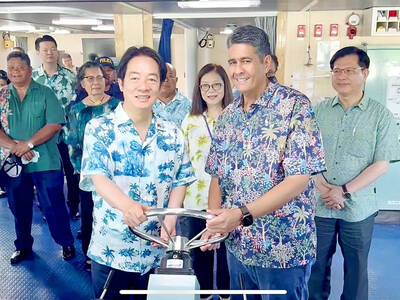
MULTIPRONGED APPROACH: China has sought to pressure Palau across a number of fronts, but the island nation has staunchly resisted overtures to ditch Taiwan Palau has been firm in backing Taiwan despite Chinese pressure that uses tourism economics, cyberattacks and criminal infiltration as tools to threaten the Pacific ally into renouncing its recognition of Taiwan as a sovereign state. The Presidential Office yesterday announced that Vice President Hsiao Bi-khim (蕭美琴) would visit Palau from Saturday to Wednesday next week at the invitation of Palauan President Surangel Whipps Jr. Whipps in April said in an interview that China had outspokenly asked Palau to “denounce Taiwan.” “And we have said: ‘We have no enemies, but nobody tells us who our friends are,’” he said. Whipps has told reporters multiple times


 RSS
RSS