


Research into paranormal activity supported by the head of the nation's most prominent university has drawn the ire of members of its physics department, who accuse their chief of violating scientific ethics.
Shortly after National Taiwan University (NTU) president Lee Si-chen (李嗣涔) reportedly announced last year that the university's electrical engineering department had achieved a breakthrough in research on extrasensory perception (ESP), physics professor Yang Hsin-nan (楊信男) sent an assistant to the campus library to locate a paper discussing the findings.
Yang could have used a bit of ESP himself, because Lee has blocked access to the paper, authored by an NTU student, for 10 years.
"By the author's request, public access to this thesis is restricted until the year 2016," library staff reportedly told the assistant.
Further piquing Yang's curiosity were alleged changes to the thesis' outline on the department's Web site, including the removal of references to Lee's research into ESP.
The full version under lock and key at the library, meanwhile, has been edited down to 60 pages from its original 70, former director of Academia Sinica's Institute of Physics Tsong Tien (鄭天佐) confirmed yesterday.
Previous references in the thesis to Lee's papers on psychokinesis -- the ability to move objects with one's mind -- and clairvoyance are gone, Tsong said.
Academics yesterday slammed Lee for authorizing the block, saying that he had violated an academic tradition of openly exchanging information.
Tsong said that blocking access to research papers for a few years while their authors seek patents for the ideas contained within is a common practice.
"But to deny access for 10 years, and in the meantime try to secretly revise or destroy part of the thesis is in violation of scientific ethics," Yang added.
The director of Academia Sinica's physics institute, Wu Maw-kuen (
Wu added that denying access is sometimes required in cases regarding national security.
"I had a similar experience while working in the US. About 20 years ago, I was contacted by the CIA, which was concerned that my work on high-temperature superconductors had national security implications. They restricted public access to my research, but then lifted the blocks after examining [my] work," Wu said.
Speaking to the Taipei Times yesterday, Lee admitted to authorizing the block, but said he had done so to protect the author's ideas while the author seeks a patent for them.
"These critics are the same professors who have been unhappy with my own research for a decade," Lee said, referring to Yang, Tsong and others.
Appointed president of the nation's premier university in 2005, Lee has come under constant fire from colleagues in the "hard sciences" for his research into the paranormal.
A leading figure in the university's Star Trek and ESP student clubs, Lee made numerous academic enemies by holding classes on ESP before being promoted to president of NTU.
Lee said the hostility his colleagues harbored toward his "spiritual" research had sparked the current debate on the "top-secret thesis."
"I haven't done anything illegal or improper," he added.
When asked how scientists viewed Lee's research, Tsong said:
"We forbid quacks from practicing medicine, but we let a fake scientist lead the most important university in the nation."
Yangmingshan National Park authorities yesterday urged visitors to respect public spaces and obey the law after a couple was caught on a camera livestream having sex at the park’s Qingtiangang (擎天崗) earlier in the day. The Shilin Police Precinct in Taipei said it has identified a suspect and his vehicle registration number, and would summon him for questioning. The case would be handled in accordance with public indecency charges, it added. The couple entered the park at about 11pm on Thursday and began fooling around by 1am yesterday, the police said, adding that the two were unaware of the park’s all-day live

Fast food chain McDonald's is to raise prices by up to NT$5 on some products at its restaurants across Taiwan, starting on Wednesday next week, the company announced today. The prices of all extra value meals and sharing boxes are to increase by NT$5, while breakfast combos and creamy corn soup would go up by NT$3, the company said in a statement. The price of the main items of those meals, if ordered individually, would remain the same. Meanwhile, the price of a medium-sized lemon iced tea and hot cappuccino would rise by NT$3, extra dipping sauces for chicken nuggets would go up
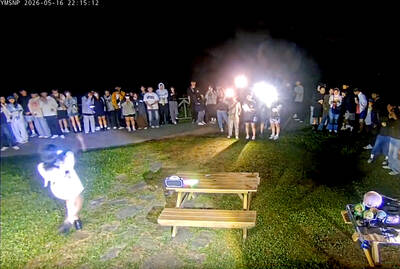
Yangmingshan National Park’s Qingtiangang (擎天崗) nature area has gone viral after a park livestream camera observed a couple in the throes of intimate congress, which was broadcast live on YouTube, drawing large late-night crowds and sparking a backlash over noise, bright lights and disruption to wildlife habitat. The area’s livestream footage appeared to show a couple engaging in sexual activity on a picnic table in the park on Friday last week, with the uncensored footage streamed publicly online. The footage quickly spread across social media, prompting a tide of visitors to travel to the site to “check in” and recreate the

Minister of Digital Affairs Lin Yi-ching (林宜敬) yesterday cited regulatory issues and national security concerns as an expert said that Taiwan is among the few Asian regions without Starlink. Lin made the remarks on Facebook after funP Innovation Group chief executive officer Nathan Chiu (邱繼弘) on Friday said Taiwan and four other countries in Asia — China, North Korea, Afghanistan and Syria — have no access to Starlink. Starlink has become available in 166 countries worldwide, including Ukraine, Malaysia, the Philippines and Vietnam, in the six years since it became commercial, he said. While China and North Korea block Starlink, Syria is not


 RSS
RSS