


Taiwan's assistance in training the Solomon Islands police force is based on mutual cooperation agreements reached during the first Taiwan-Pacific Allies Summit held last September, the Ministry of Foreign Affairs (MOFA) said yesterday.
The ministry made the remarks in response to a story in the Sydney Morning Herald on Tuesday which said that 12 Solomon Islands police officers had been sent to Taiwan for special training.
The article said that Solomon Islands Prime Minister Manasseh Sogavare had criticized the Australian government for interfering in the nation's internal affairs after he refused to continue to be guarded by armed Australian officers.
All police officers on the islands were disarmed in 2003 when Australia led a regional intervention force to restore order after years of ethnic violence.
Of the 314 police officers from the Pacific region deployed in the Solomons, 230 are Australian, the Australian newspaper said.
Ministry Spokesman David Wang (
Taiwan's help in maintaining social order and safety in the Solomon Islands was one part of the plan that was reached in the Palau Declaration signed during the first Taiwan-Pacific Allies Summit on Sept. 4 last year when President Chen Shui-bian (陳水扁) attended the summit along with seven of the nation's oceanic allies, Wang said.
According to the fourth article of the declaration, it was agreed to enhance cooperation in many fields and the first area was "law enforcement training."
It noted that "additional or expanded programs were needed to detect and prevent money laundering and the financing of terrorism, international trafficking of persons, illegal border crossings and customs irregularities.
"Cooperation shall be coordinated to improve the practical training of each country's law enforcement or other relevant personnel and administration, relating both to land and sea," it said.
"This training [of the Solomons police force] is based on the goal of maintaining social order and preventing terrorism. We are by no means interfering in any country's domestic affairs," Wang said.
Wang also said that the ministry would request its representative in Australia correct "inaccurate reporting," he added.
Wang had no comment on whether the Australian government had pressured Taiwan to drop a firearms component from the training course, which was also mentioned in the Herald's report.

More than half of the bamboo vipers captured in Tainan in the past few years were found in the city’s Sinhua District (新化), while other districts had smaller catches or none at all. Every year, Tainan captures about 6,000 snakes which have made their way into people’s homes. Of the six major venomous snakes in Taiwan, the cobra, the many-banded krait, the brown-spotted pit viper and the bamboo viper are the most frequently captured. The high concentration of bamboo vipers captured in Sinhua District is puzzling. Tainan Agriculture Bureau Forestry and Nature Conservation Division head Chu Chien-ming (朱健明) earlier this week said that the
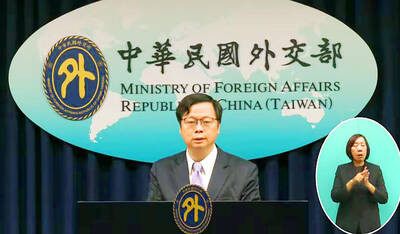
NAMING SPAT: The foreign ministry called on Denmark to propose an acceptable solution to the erroneous nationality used for Taiwanese on residence permits Taiwan has revoked some privileges for Danish diplomatic staff over a Danish permit that lists “Taiwan” as “China,” Eric Huang (黃鈞耀), head of the Ministry of Foreign Affairs’ Department of European Affairs, told a news conference in Taipei yesterday. Reporters asked Huang whether the Danish government had responded to the ministry’s request that it correct the nationality on Danish residence permits of Taiwanese, which has been listed as “China” since 2024. Taiwan’s representative office in Denmark continues to communicate with the Danish government, and the ministry has revoked some privileges previously granted to Danish representatives in Taiwan and would continue to review
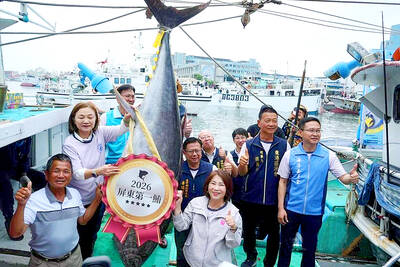
The first bluefin tuna of the season, brought to shore in Pingtung County and weighing 190kg, was yesterday auctioned for NT$10,600 (US$333.5) per kilogram, setting a record high for the local market. The auction was held at the fish market in Donggang Fishing Harbor, where the Siaoliouciou Island-registered fishing vessel Fu Yu Ching No. 2 delivered the “Pingtung First Tuna” it had caught for bidding. Bidding was intense, and the tuna was ultimately jointly purchased by a local restaurant and a local company for NT$10,600 per kilogram — NT$300 ,more than last year — for a total of NT$2.014 million. The 67-year-old skipper
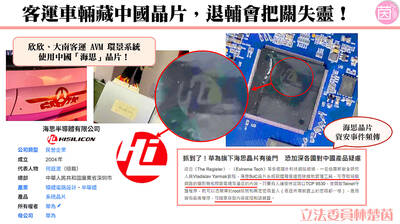
BREACH OF CONTRACT: The bus operators would seek compensation and have demanded that the manufacturer replace the chips with ones that meet regulations Two bus operators found to be using buses with China-made chips are to demand that the original manufacturers replace the systems and provide compensation for breach of contract, the Veterans Affairs Council said yesterday. Democratic Progressive Party Legislator Michelle Lin (林楚茵) yesterday said that Da Nan Bus Co and Shin-Shin Bus Co Ltd have fielded a total of 82 buses that are using Chinese chips. The bus models were made by Tron-E, while the systems provider was CYE Electronics, Lin said. Lin alleged that the buses were using chips manufactured by Huawei subsidiary HiSilicon Co, which presents a national security risk if the


 RSS
RSS