


Some supporters of Taiwan in Congress are voicing apprehension over the likely election of South Korean Foreign Minister Ban Ki-moon as the next UN secretary-general, in view of the generally pro-China policy he has pursued in his current post.
In a "straw poll" last week, Ban received 14 of 15 votes from members of the Security Council, and is widely expected to be elected in a final vote on Sept. 28.
While the poll was secret, Japan is widely believed to have cast the single negative vote, in view of the increasingly strained relations between Tokyo and Seoul.
Alarm bells rang among Taiwan supporters here after Ban's ministry rejected a visa for the Dalai Lama in June to attend the 2006 Gwangju Summit of Nobel Laureates in Seoul at the invitation of the Kim Dae-jung Presidential Library. Ban rejected the visa after Beijing expressed its "displeasure" over the visit by the Dalai Lama, the 1989 Peace Prize winner.
In an interview with a Korean Internet news site, Ban admitted that he prevented the Dalai Lama's visit after Beijing asked him not to let the Tibetan leader in. He said any future visa decision would be made only after considering "the greater framework of Sino-Korean relations."
Some of Taiwan's Washington backers fear that Ban's action will presage a tough stance toward Taiwan if Ban accedes to the top UN office. This, they feel, could affect efforts by Taipei to gain participation in the UN and other international organizations such as the WHO and Taiwan's overall drive to break out of the diplomatic and economic isolation that Beijing has imposed on it.
concern
Some congressional concern may be vented next Wednesday, a day before the UN vote, when the House International Relations Committee holds a hearing on US-South Korean relations. At least one committee member, sources say, may ask administration officials questions about Ban and his attitudes toward China and Taiwan.
Some in Congress feel that Ban's policies will echo those of the late WHO Director-General and fellow Korean, Lee Jong-wook, who died in May. Lee consistently opposed Taiwan's bid to gain observer status in the annual World Health Assembly (WHA) held in Geneva in the spring.
Congressional sources recall a meeting in March 2004, as preparations for that year's WHA meeting were underway, in which a congressional staff delegation met with Lee in Geneva to present a letter from international relations committee chairman Henry Hyde and ranking Democrat Tom Lantos urging observer status for Taiwan.
At the meeting between Lee and the staffers, which came as the SARS epidemic was raging in Asia, the US group failed in its efforts to convince Lee to allow Taiwan to participate in the WHA. Two months later, Lee traveled to Beijing where he publicly announced that Taiwan would "never" take part in WHA activities, the sources recall.
The South Korean government has followed a strict one-China policy since establishing diplomatic relations in 1992 and scrapping its ties with Taipei. It has also moved closer to Beijing in recent years as ties with Japan have come under increasing strain over Prime Minister Koizumi's visits to the Yasukuni shrine, and as rising sensitivity over issues related to Japan's occupation of Korea in World War II.
"Every time Koizumi visits the shrine, it drives South Korea into the arms of the Chinese," one congressional staffer familiar with East Asia issues, said.
That policy has also strained relations with the US.
For the past three years, Seoul has balked at a US plan that could allow US forces stationed in Korea to be sent, if need be, to the Taiwan Strait in case of a Chinese military attack on Taiwan and a consequent US-China conflict.
That policy, part of what the Pentagon calls "strategic flexibility," has been rejected by Seoul because the government is worried that it could lead to South Korea becoming unwittingly involved in a US-China war.
new agreement
Early this year, Ban and Secretary of State Condoleezza Rice signed a new agreement in Washington on overall bilateral ties, including a provision easing Seoul's objection to the US plan, but which would require the US to seek Korean permission before moving any US troops from the peninsula.
It provides that Seoul "shall not be involved in a regional conflict in Northeast Asia against the will of the Korean people."
Seoul's attitude contrasts with that of Japan toward a potential Taiwan Strait conflict. Last year, Tokyo altered its security policy to regard a cross-strait blow-up as a matter of mutual security concern with Washington, signaling a possible willingness to aid the US in countering China's attack.
If elected, Ban would be the first Asian UN secretary-general since Burma's U Thant retired in 1971.
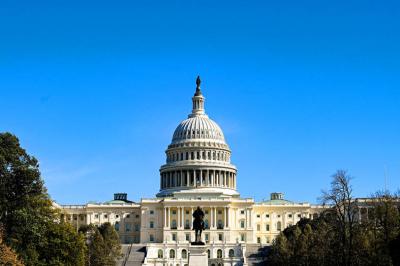
The US House of Representatives yesterday passed the PROTECT Taiwan Act, which stipulates that Washington would exclude China from participating in major global financial organizations if its actions directly threaten Taiwan’s security. The bill, proposed by Republican US Representative Frank Lucas, passed with 395 votes in favor and two against. It stipulates that if China’s actions pose any threat to Taiwan’s security, economic or social systems, the US would, “to the maximum extent practicable,” exclude China from international financial institutions, including the G20, the Bank for International Settlements and the Financial Stability Board. The bill makes it clear that China
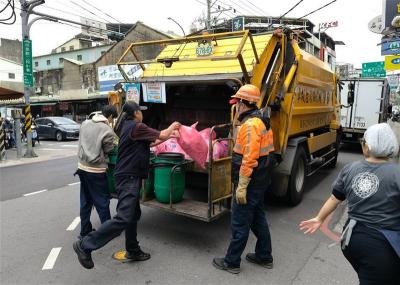
Garbage and recycling schedules are to vary from Saturday through Sunday next week over the Lunar New Year holiday period. The following collection information is from the governments of the six special municipalities. Taipei Regular service: Sunday to Monday next week. No service: Tuesday to Thursday next week. Extra service: Friday next week. Regular service resumes: Saturday next week. New Taipei City Extra service: Sunday. Adjusted collection time: Monday next week — garbage collection is to begin in the morning and end at 6pm. No service: Tuesday to Thursday next week. Regular service resumes: Friday next week. Note: Garbage can be dropped off at 70
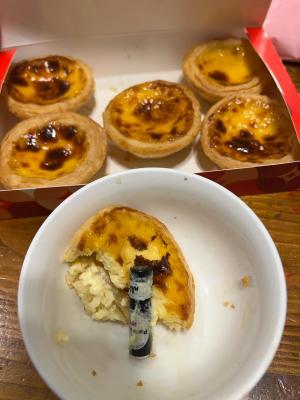
A KFC branch in Kaohsiung may be fined between NT$60,000 and NT$200 million (US$1,907 and US$6.37 million), after a customer yesterday found an entire AAA battery inside an egg tart, the Kaohsiung Department of Health said today. The customer was about to microwave a box of egg tarts they had bought at the fast-food restaurant’s Nanzih (楠梓) branch when they checked the bottom and saw a dark shadow inside one of them, they said in a Threads post. The customer filmed themself taking the egg tart apart to reveal an entire AAA battery inside, which apparently showed signs of damage. Surveillance footage showed
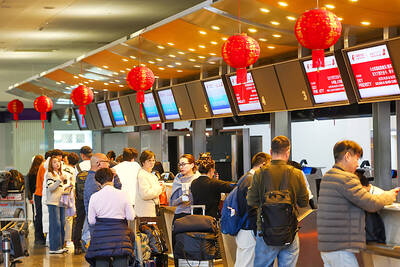
GROUP EFFORT: The number of inbound travelers rose 11 to 12 percent last month, with a significant increase in tourists from Europe and North America, an official said The government aims to attract 9.4 million visitors this year, the Tourism Administration said yesterday, citing last year’s success in diversifying tourist markets. Taiwan last year drew about 8.57 million international arrivals, 72.3 percent of pre-COVID-19 levels. By contrast, the nation had about 18.94 million outbound tourists last year, surpassing the pre-COVID-19 level of 17.1 million. The estimated tourism revenue deficit was about NT$700.9 billion (US$22.22 billion). Taoyuan International Airport Corp expects more than 160,000 passengers to pass through the nation’s largest airport daily during the Lunar New Year holiday, which begins on Saturday. As of Jan. 30, the nation’s average hotel occupancy rate


 RSS
RSS