


Democratic Progressive Party (DPP) legislator yesterday lashed out at the Taipei City Government for allowing an "indefinite, round-the-clock" sit-in to be staged in front of the Presidential Office to unseat President Chen Shui-bian (
A group led by former DPP chairman Shih Ming-teh (施明德) has filed an application with the city government for the right to stage a demonstration on the boulevard in front of the Presidential Office between Aug. 23 and Sept. 17 to pressure Chen to step down over alleged corruption.
Although an open-ended 24-hour demonstration has never been permitted before, Taipei Mayor Ma Ying-jeou (馬英九), who is also chairman of the Chinese Nationalist Party (KMT), has hinted that this application was approved because the country's public assembly law does not set any time limit on protest activities.
DPP Legislator Wang Shih-cheng (
Chaotic
He ridiculed Ma by asking him whether all people who apply to hold demonstrations or sits-in in Taipei would be allowed to conduct them indefinitely and round-the-clock from here on.
Wang said Ma should bear responsibility for whatever might occur during the sit-in.
DPP Legislator Lin Kuo-ching (林國慶) criticized Ma for "letting Taiwan's capital become a chaotic place where there is no justice and people cannot tell right from wrong."
Ma yesterday denied that the city government had given Shih special treatment by relaxing restrictions on the normal protest deadline of 10pm, stressing that the Assembly and Parade Law (集會遊行法) does not stipulate any protest deadline.
"I haven't made any promises to anyone on the matter ? The approval of the Shih Ming-teh camp's sit-in was based on legal proc-edure," Ma said, adding that the power to approve the protest resided with the public works bureau and the police department.
"I have nothing to do with the department's decision [to grant the protest permit]," he said.
In response to the People First Party's (PFP) criticism that Ma has allowed Shih's sit-in to be staged round-the-clock, but two years ago ordered local police to disperse the anti-Chen protest led by former KMT chairman Lien Chan (連戰) and PFP Chairman James Soong (宋 楚瑜) in the wake of the 2004 presidential election, KMT Spokesman Huang Yu-chen (黃玉振) said that the police dispersed the crowd because of violent acts at the scene.
"What the police were trying to stop is violence, not the protest," he said.
Special treatment
As a symbolic gesture to protest Shih's "special treatment," Taiwan Solidarity Union's (TSU) Taipei mayoral candidate Clara Chou (
Chou said her rally, which will be staged from Aug. 28 to Sept. 26 in front of the Taipei City Hall, is aimed at protest against the city government's ignorance of the plight of unemployed residents and other disadvantage groups.
The public works bureau said it will grant the permit if no other groups applied to stage a protest in the same area, but noted that final approval resides with the police department.

Kenting National Park service technician Yang Jien-fon (楊政峰) won a silver award in World Grand Prix Photography Awards Spring Season for his photograph of two male rat snakes intertwined in combat. Yang’s colleagues at Kenting National Park said he is a master of nature photography who has been held back by his job in civil service. The awards accept entries in all four seasons across six categories: architectural and urban photography, black-and-white and fine art photography, commercial and fashion photography, documentary and people photography, nature and experimental photography, and mobile photography. Awards are ranked according to scores and divided into platinum, gold and
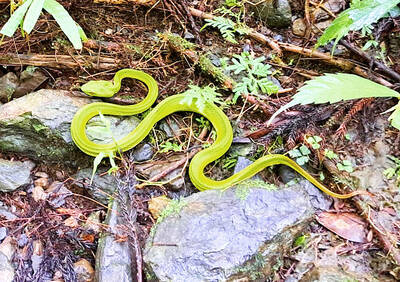
More than half of the bamboo vipers captured in Tainan in the past few years were found in the city’s Sinhua District (新化), while other districts had smaller catches or none at all. Every year, Tainan captures about 6,000 snakes which have made their way into people’s homes. Of the six major venomous snakes in Taiwan, the cobra, the many-banded krait, the brown-spotted pit viper and the bamboo viper are the most frequently captured. The high concentration of bamboo vipers captured in Sinhua District is puzzling. Tainan Agriculture Bureau Forestry and Nature Conservation Division head Chu Chien-ming (朱健明) earlier this week said that the
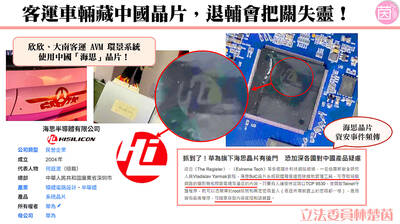
BREACH OF CONTRACT: The bus operators would seek compensation and have demanded that the manufacturer replace the chips with ones that meet regulations Two bus operators found to be using buses with China-made chips are to demand that the original manufacturers replace the systems and provide compensation for breach of contract, the Veterans Affairs Council said yesterday. Democratic Progressive Party Legislator Michelle Lin (林楚茵) yesterday said that Da Nan Bus Co and Shin-Shin Bus Co Ltd have fielded a total of 82 buses that are using Chinese chips. The bus models were made by Tron-E, while the systems provider was CYE Electronics, Lin said. Lin alleged that the buses were using chips manufactured by Huawei subsidiary HiSilicon Co, which presents a national security risk if the

The National Immigration Agency has banned two Chinese from returning to Taiwan, after they published social media content it described as disrespectful to national sovereignty. The agency imposed a two-month ban on a Chinese man surnamed Liang (梁) and a permanent ban on a woman surnamed Yang (楊), an influencer with 23 million followers, in October last year and last week respectively. Minister of the Interior Liu Shyh-fang (劉世芳) yesterday said on the sidelines of a legislative meeting that Chinese visitors to Taiwan are required to comply with the rules and regulations governing their entry permits. The government has handled the ban and


 RSS
RSS