

A government critique of a US Department of State report on human trafficking in Taiwan was based on last year's version of the annual report, and not on this year's, the critique's chief author said yesterday.
A study by the US' Government Accountability Office (GAO) criticizing the State Department's methodology was detailed yesterday by the Taipei Times ("Report Puts US' Sex-Trade Rebuke of Taiwan in Doubt," page 1).
The article reported that the GAO study was based on this year's report.
However, the chief author of the GAO study, Thomas Melito, said yesterday that it was based primarily on last year's report. He said that the GAO looked at this year's report, but not in as much detail as the earlier report, after comments were made by agencies mentioned in the GAO study.
The GAO study criticized the politicization of process by which the state department chose to categorize countries' efforts to combat human trafficking.
Many of the criticisms made of Taiwan in last year's report were repeated in this year's report. For instance, the reports in both years concluded that, "Taiwan authorities do not fully comply with the minimum standards for the elimination of trafficking; however, they are making significant efforts to do so."
Taiwan was placed on the Tier 2 Watch List this year because it "failed to show evidence of increasing efforts" to address trafficking, wording absent from last year's report.
Last year's report also placed somewhat greater emphasis on trafficking to Taiwan from China, as opposed to from Southeast Asia.

The donation of offshore patrol vessel Kinmen to the Philippines includes provisions that protect Taiwanese fishers and facilitate security cooperation across the First Island Chain, officials said yesterday. The comment was made during the Cabinet’s comprehensive administrative report at the legislature after Chinese Nationalist Party (KMT) Legislator Hsu Yu-chen (許宇甄) expressed concerns about the decision to give a ship to a country whose coast guard had in 2013 fired on a Taiwanese trawler and killed its captain without provocation. The Cabinet should lay out the safeguards that have been established to prevent the Philippine government from using the Kinmen to harass, expel
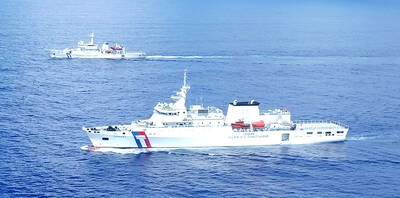
‘FRIENDSHIP FLEET’: A CGA official is scheduled to meet with the president of the Pacific nation, while one of the ships is to host a banquet and National Day event Two Coast Guard Administration (CGA) patrol vessels have docked at Malakal Harbor in Palau as part of an expedition exercise and diplomatic visit, during which a senior official is expected to meet with Palauan President Surangel Whipps Jr, the agency said yesterday. The two vessels, the 4,000-tonne-class Chiayi and the 1,000-tonne-class Penghu, set sail for Palau from Taiwan last week and arrived on Tuesday at Malakal Harbor, the CGA’s Fleet Branch said in a statement. The journey marks the second time the CGA has dispatched a “friendship fleet” to another country, after it sent its first-ever goodwill fleet, comprising the Hualien and
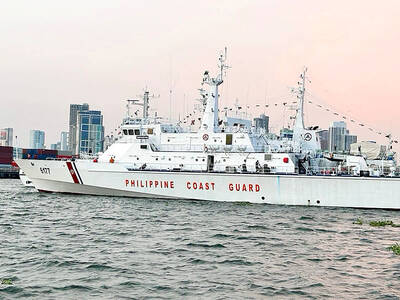
A patrol vessel donated by the Coast Guard Administration (CGA) to the Philippines was commissioned into the Philippine Coast Guard (PCG) on Friday, a Philippine non-governmental organization said. The CGA on Sept. 16 confirmed media reports that Taiwan had donated a retired 500-tonne patrol vessel to the Philippines. The Manila-based We Protect Our Seas (WPS) foundation, which served as an intermediary in the transfer, said that the vessel was formerly the CGA’s 500-tonne petrol vessel Kinmen (CG123). The WPS, in a statement issued on Friday, said the vessel, renamed as the BRP Sarangani, had been commissioned into the PCG the
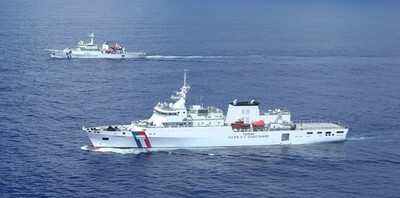
The Coast Guard Administration (CGA) today said that two of its patrol vessels have docked at Palau's Malakal Harbor as part of an expedition exercise and diplomatic visit, during which a senior official is expected to meet with the Palauan president. The two vessels, the 4,000-tonne-class Chiayi (嘉義) and the 1,000-tonne-class Penghu (澎湖), set sail for Palau from Taiwan last week and arrived at Malakal Harbor yesterday, the CGA's Fleet Branch said in a statement. The journey marked the second time the CGA has dispatched a "Friendship Fleet" to another country, after it sent its first-ever goodwill fleet, comprising the Hualien (花蓮)


 RSS
RSS