


Numerous members of the US Congress came to the defense of President Chen Shui-bian (陳水扁) and Taiwan on Wednesday as US Deputy Secretary of State Robert Zoellick testified before a hearing of the House International Relations Committee on US policy toward China.
The issue of the response to Chen's request for transit stops in the US during his recent trip to Costa Rica and Paraguay played a surprisingly large role in the two-and-a-half-hour hearing, which was called to deal primarily with China's role as a rising power in Asia and the US response to it.
In answers to questions about Chen, Zoellick seemed to say that the limits placed on the president -- he was offered stopovers only in Anchorage, Alaska, or Honoloulu, Hawaii -- were in retaliation for what the US administration considers Chen's reneging on the so-called "five-noes" promises he made in his two inauguration addresses, along with his efforts to fight Washington's "one-China" policy.

PHOTO: HUANG PO-LANG, TAIPEI TIMES
Cross-strait war
At another point, as Zoellick was giving an animated defense of the US transit action, he seemed to link it with the fear that Chen's recent actions could provoke a war in the Taiwan Strait between the US and China.
"There are big stakes here where lives could be lost," he said.
"This is the balance ... we want to be supportive of Taiwan while not encouraging those that try to move toward independence. Because let me be very clear: independence means war. And that means American soldiers ..." he said before being interrupted by a questioner.
Zoellick had harsh words for Chen's decision to mothball the National Unification Council and guidelines without warning Washington beforehand.
"What President Chen has said to us is that his word is good, and that the things he has committed to the United States he has followed up on," Zoellick said.
"But in the business that I'm in, it's very important, if people do give their word, that they keep it," he said.
"What is going on is an effort to kind of erode [Chen's promises], and -- sort of at the edge -- sand it off. And frankly, I think it's a good thing for US diplomacy to hold people to their terms and words."
Following up, Zoellick said that while the US supports Taiwan's participation in the global system, "if it keeps trying to revisit the question that the United States made in the late 1970s about a one-China policy, I think it's going to keep hitting into a wall."
"We're not going to change that 30-year-old [`one-China'] system," he said.
Dana Rohrabacher, a co-chairperson of the Congressional Taiwan Caucus and a member of a six-member congressional delegation that met Chen in Costa Rica, slammed the administration for its "disgraceful" treatment of Chen.
"For us to throw ourselves on the ground in order to curry favor with a dictatorship [China] by mistreating a democratically elected leader doesn't lend itself to the type of respect from the dictatorship that will lead us to ... positive things," Rohrabacher said.
Another delegation member, Diane Watson, said that the delegation's leader, Dan Burton, planned to ask the Bush administration to make an apology to Chen for "not treating him with the proper protocol." Watson said Chen said he felt that Taiwan was disrespected and that he was personally hurt by the refusal of an overnight transit stop.
Thomas Tancredo, a leading congressional supporter of Taiwan, pointed out that Congress some years ago enacted a law that explicitly authorizes Chen and other high-ranking Taiwanese leaders to visit the US, and that subsequent resolutions supported that position.
He said the administration should have used that law in explaining to Beijing why it offered a better transit arrangement to Chen.
Tancredo accused the administration of "snubbing" Chen by first not granting him a transit visa until the last minute and then limiting him to a brief stopover in Anchorage or Honolulu.
He also said that Chen's "five-noes" pledge was predicated on China's not using force "or the threat of force" against Taiwan.
"And then China passed the `Anti-Secession' Law, which did exactly that: it said that it would use force," Tancredo said, defending the reasoning behind Chen's decision on the National Unification Council.
Interpretation
In response, Zoellick said that he interpreted Chen's inaugural pledge as meaning that the "five noes" would apply as long as China "doesn't use force to attack," adding that "China hasn't used force to attack."
He downplayed the effect of the Anti-Secession Law, saying only that it was "not a wise step."
At one point during the hearing, Zoellick said that a "colleague" of his met with Chen in Costa Rica just as the president was leaving and "talked about how we [the US] can continue to have a strong and good relationship with Taiwan."
The State Department refused to identify the "colleague."
In Taipei, legislators across party lines reacted strongly yesterday to Zoellick's remark that "Taiwanese independence means war."
Chinese Nationalist Party (KMT) Legislator John Chiang (
Chiang urged the government to consider Zoellick's remarks as a stringent caution for advancing Taiwanese independence and to take them seriously.
Democratic Progressive Party (DPP) Legislator Lin Cho-shui (林濁水) demanded Chen should earnestly review the matter of the transit arrangements after his return.
Lin said Chen's past rash advances in pushing the issue of Taiwanese independence had made the goal of "de jure independence" even more difficult to achieve.
Meanwhile, Ministry of Foreign Affairs Spokesman Michel Lu (
He also would not comment on what was said by American Institute in Taiwan Director Stephen Young in a speech to the American Chamber of Commerce in Taipei, during which Young quoted Zoellick's remarks about the dangers of Taiwanese independence.
Additional reporting by Shih Hsiu-chuan


China has reserved offshore airspace in the Yellow Sea and East China Sea from March 27 to May 6, issuing alerts usually used to warn of military exercises, although no such exercises have been announced, the Wall Street Journal (WSJ) reported yesterday. Reserving such a large area for 40 days without explanation is an “unusual step,” as military exercises normally only last a few days, the paper said. These alerts, known as Notice to Air Missions (Notams), “are intended to inform pilots and aviation authorities of temporary airspace hazards or restrictions,” the article said. The airspace reserved in the alert is
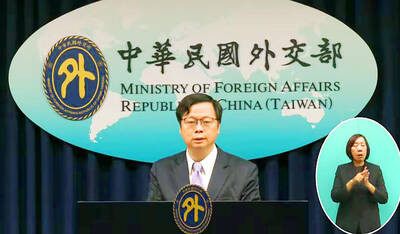
NAMING SPAT: The foreign ministry called on Denmark to propose an acceptable solution to the erroneous nationality used for Taiwanese on residence permits Taiwan has revoked some privileges for Danish diplomatic staff over a Danish permit that lists “Taiwan” as “China,” Eric Huang (黃鈞耀), head of the Ministry of Foreign Affairs’ Department of European Affairs, told a news conference in Taipei yesterday. Reporters asked Huang whether the Danish government had responded to the ministry’s request that it correct the nationality on Danish residence permits of Taiwanese, which has been listed as “China” since 2024. Taiwan’s representative office in Denmark continues to communicate with the Danish government, and the ministry has revoked some privileges previously granted to Danish representatives in Taiwan and would continue to review

More than 6,000 Taiwanese students have participated in exchange programs in China over the past two years, despite the Mainland Affairs Council’s (MAC) “orange light” travel advisory, government records showed. The MAC’s publicly available registry showed that Taiwanese college and university students who went on exchange programs across the Strait numbered 3,592 and 2,966 people respectively. The National Immigration Agency data revealed that 2,296 and 2,551 Chinese students visited Taiwan for study in the same two years. A review of the Web sites of publicly-run universities and colleges showed that Taiwanese higher education institutions continued to recruit students for Chinese educational programs without
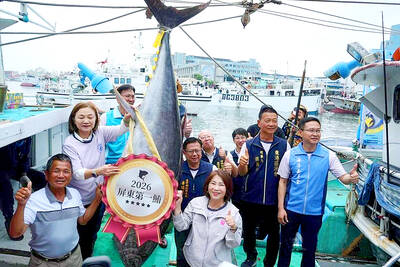
The first bluefin tuna of the season, brought to shore in Pingtung County and weighing 190kg, was yesterday auctioned for NT$10,600 (US$333.5) per kilogram, setting a record high for the local market. The auction was held at the fish market in Donggang Fishing Harbor, where the Siaoliouciou Island-registered fishing vessel Fu Yu Ching No. 2 delivered the “Pingtung First Tuna” it had caught for bidding. Bidding was intense, and the tuna was ultimately jointly purchased by a local restaurant and a local company for NT$10,600 per kilogram — NT$300 ,more than last year — for a total of NT$2.014 million. The 67-year-old skipper


 RSS
RSS