


Hundreds of fruit farmers took to the streets yesterday to protest against the government's policy on land rehabilitation, arguing that they were not responsible for the deforestation that has led to numerous landslides.
"It's not that we don't support the idea of rehabilitating deforested land, but the government's policy will deprive us of our livelihoods," said Wu Lian-hsin (吳連興), president of the Taiwan Yuan-ken Association, a farmers' interest group.
After a sit-in demonstration outside the legislature drew no reaction from governmental officials, the association yesterday sent a fax to the press stating that they would set fire to themselves in protest.
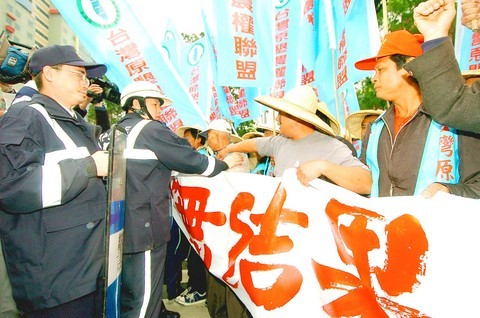
PHOTO: WANG MIN-WEI, TAIPEI TIMES
The protesters brought two barrels of gasoline with them to yesterday's protest and some farmers poured substantial amounts of the fuel onto the street, tainting the air with fumes.
A violent scuffle occurred when the police attempted to seize cigarette-lighters from the protesters. A man by the name of Wu Lian-hsin said that the protest would last for at least a week if the government failed to answer the farmers' grievances.
In an attempt to address the landslide problem, the government passed regulations two years ago prohibiting the planting of fruit on land above 500m in elevation. Under the new regulations, farmers who lease their land from the Council of Agriculture's Forestry Bureau are required to replace fruits growing above that elevation with trees, and to plant at least 600 trees per hectare.
"In the past, we were allowed to plant fruits. We won't be able to make a living by growing only trees," said Yang Shou-ching (楊淑青), who grows persimmon in Taichung County's Dongshih Township (東勢鎮).
"The cost of growing trees is about ten times higher than the output value, and farmers receive a subsidy of less than NT$20,000 (US$615) per year. Without further subsidization, how can we support our families?" said Wu Jin-tsai (
The Taiwan Yuan-ken Association is asking the Forestry Bureau to reconsider its plan to unilaterally remove any fruit still grown above 500m after April 6.
"The move would affect 300,000 fruit farmers, not to mention workers in related industries such as packaging and fertilizer production," Wu Lian-hsin said.
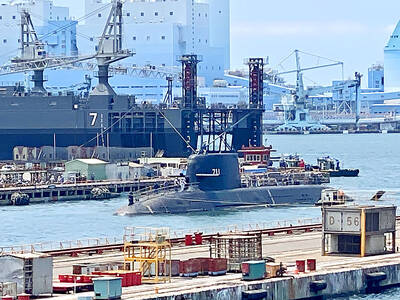
AGING: While Japan has 22 submarines, Taiwan only operates four, two of which were commissioned by the US in 1945 and 1946, and transferred to Taiwan in 1973 Taiwan would need at least 12 submarines to reach modern fleet capabilities, CSBC Corp, Taiwan chairman Chen Cheng-hung (陳政宏) said in an interview broadcast on Friday, citing a US assessment. CSBC is testing the nation’s first indigenous defense submarine, the Hai Kun (海鯤, Narwhal), which is scheduled to be delivered to the navy next month or in July. The Hai Kun has completed torpedo-firing tests and is scheduled to undergo overnight sea trials, Chen said on an SET TV military affairs program. Taiwan would require at least 12 submarines to establish a modern submarine force after assessing the nation’s operational environment and defense

A white king snake that frightened passengers and caused a stir on a Taipei MRT train on Friday evening has been claimed by its owner, who would be fined, Taipei Rapid Transit Corp (TRTC) said yesterday. A person on Threads posted that he thought he was lucky to find an empty row of seats on Friday after boarding a train on the Bannan (Blue) Line, only to spot a white snake with black stripes after sitting down. Startled, he jumped up, he wrote, describing the encounter as “terrifying.” “Taipei’s rat control plan: Release snakes on the metro,” one person wrote in reply, referring
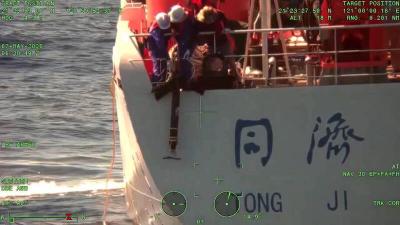
The coast guard today said that it had disrupted "illegal" operations by a Chinese research ship in waters close to the nation and driven it away, part of what Taipei sees a provocative pattern of China's stepped up maritime activities. The coast guard said that it on Thursday last week detected the Chinese ship Tongji (同濟號), which was commissioned only last year, 29 nautical miles (54km) southeast of the southern tip of Taiwan, although just outside restricted waters. The ship was observed lowering ropes into the water, suspected to be the deployment of scientific instruments for "illegal" survey operations, and the coast
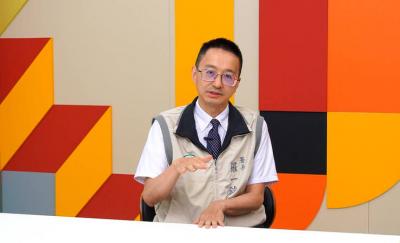
Taiwan’s two cases of hantavirus so far this year are on par with previous years’ case numbers, and the government is coordinating rat extermination work, so there should not be any outbreaks, Centers for Disease Control (CDC) Director-General Philip Lo (羅一鈞) said today in an interview with the Liberty Times (the Taipei Times’ sister newspaper). An increase in rat sightings in Taipei and New Taipei City has raised concerns about the spread of hantavirus, as rats can carry the disease. In January, a man in his 70s who lived in Taipei’s Daan District (大安) tested positive posthumously for hantavirus, Taiwan’s


 RSS
RSS