


The keys to addressing a potential worldwide influenza pandemic include early response, cooperation between countries and preparation, Department of Health (DOH) officials said yesterday in a briefing on discussions that took place at a World Health Organization (WHO) meeting in Japan.
After receiving a last-minute invitation, Taiwanese officials were able to attend the meeting on bird flu in Tokyo last Thursday and Friday.
It was the eighth WHO meeting relating to bird flu in three months, and 130 representatives from 22 countries were present.
The head of the Center for Disease Control (CDC), Steve Kuo (郭旭崧), who was one of the three representatives to attend the meeting, said the nation's invitation to the meeting reflected the emphasis on international cooperation and closing any loopholes.
"Notions people have that the danger is over if a bird flu pandemic hasn't hit by March or April are misguided. This is just the beginning and we are preparing for a fight lasting at least three to five years," Kuo said.
Chief of the Division of Infectious Diseases at National Taiwan University Hospital Chang Shan-chwen (張上淳) said there was a consensus that the key to preventing the spread of infection was detection, quarantine and giving medicine to people the sick had come into contact with.
A controversial issue that arose at the meeting centered on the stockpiling and use of Tamiflu, with officials debating whether stockpiles of the drug should be used for treatment or prevention.
Kuo said that the pharmaceutical company Roche has donated 300,0000 courses of Tamiflu, 150,0000 of which are stored in Switzerland, and 150,0000 of which are stored in the US.
Asian countries expressed concern that there was no stockpile in Asia, the hot zone for bird flu.
According to Kuo, Japan said it would donate 50,0000 courses of Tamiflu to the Asia region, regardless of the fact that decisions about stockpiling in Asia had not been finalized.
EU members said that arguments about where to stockpile medication were muddying the issue and that the important issue was how countries would deliver medication to affected areas -- which may be very remote -- and the early detection of cases.
Chang said at present it takes an average of 16.7 days for bird flu cases to be reported to the WHO, with over half of the cases taking more than 14 days to be reported. One goal was to have the cases reported within two weeks.
Another issue discussed was the need for China to be "transparent" about human bird flu cases, unlike what happened during the SARS outbreak.
Kuo said that while China has been very open regarding its bird flu status up until now, there could be no guarantee that the government would have knowledge of all bird flu cases given the country's size.
Kuo also reported that Taiwan received 80,000 doses of Tamiflu from Roche the day before yesterday, and that by the end of June the nation should have reached its target of having enough Tamiflu to supply 10 percent of the population, or 2.3 million courses.
Also see story:

FUKUOKA SITUATION: Japanese media reported that the pathogen is expected to be identified by the summer, while the CDC downplayed the idea that it was hMPV A “mysterious cold-like illness” reported in Japan’s Fukuoka Prefecture does not seem to be a new disease, but Japanese authorities have been asked about the situation, the Centers for Disease Control (CDC) said yesterday. The Fukuoka Prefectural Medical Association on Wednesday told a news conference that a “mystery cold” that has become a hot topic on social media is “highly likely to be caused by some kind of viral infection,” Japan’s KBC News reported. “Many people are experiencing symptoms starting with a sore throat, followed by a runny nose, phlegm and a severe cough,” KBC News reported, citing association officials. Health authorities are

Nvidia Corp CEO Jensen Huang (黃仁勳) arrived in Taiwan yesterday ahead of upcoming AI and technology events, saying he plans to meet with clients and Taiwan Semiconductor Manufacturing Co Chairman C.C. Wei (魏哲家) during his visit. After landing at Taipei Songshan Airport, Huang posed for photos with fans and handed out Yakult drinks to reporters and supporters waiting at the scene, saying he has “a lot to do” during the trip. Asked about reports that Nvidia’s planned headquarters site in Taipei’s Beitou Shilin Technology Park could break ground on May 27, Huang said that if the company holds an event, he would

Carrefour Taiwan is to begin using a new name from the start of July, but it cannot divulge the name until then, the chairman of the supermarket chain's parent company said today. President Chain Store Co chairman Lo Chih-hsien (羅智先) was asked by reporters after a shareholders' meeting to confirm whether the company has settled on a new name for the supermarket brand. In March, the government-registered name of two Carrefour Taiwan branches was quietly changed to "Le Chia Kang" (樂家康) in Chinese, raising speculation that has been selected as the name. Lo said that because of local regulations and contractual obligations, the
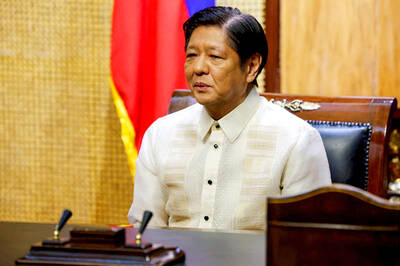
The Philippines would likely be involved in any conflict over Taiwan due to its proximity to the democracy claimed by China, President Ferdinand Marcos Jr said, reiterating a stance that risks angering Beijing. “In the Philippines, we do not have a choice because Taiwan is so close to the Philippines and we have almost 200,000 Filipino nationals living and working in Taiwan,” Marcos said in an interview with Japanese media in Manila on Monday. The Philippine leader’s comments come ahead of a state visit to Japan next week, where he is to meet with Japanese Prime Minister Sanae Takaichi to discuss security


 RSS
RSS