


In an effort to step up defenses against bird flu, the Environmental Protection Administration (EPA) has implemented measures to regulate staff and to provide training for them throughout the country.
The bird flu virus, which has swept its way through parts of Europe and Southeast Asia in recent months, has led to mass cullings and left affected bird farms desolate.
With human cases of bird flu being discovered in Indonesia, Thailand, Vietnam and China, and a mortality rate of approximately 50 percent, EPA officials said that even though Taiwan is still a bird flu-free zone, the nation's defenses need to be strengthened.
This is especially true in view of the increasing numbers of migratory birds which will be passing through this area in the next few months.
The head of the EPA's division of environment sanitation and toxic substance management, Liu Ruei-hsiang (
Up until now, Taiwan has taken the work of defending against bird flu seriously, stockpiling Tamiflu as well as ingredients to produce Tamiflu, requesting "coercive authorization" to produce Tamiflu, tightening up defenses against bird smuggling, providing funds for farmers to put up wire fencing, increasing sampling of migratory birds for the HN virus family, holding conferences to increase the flow of information and holding large-scale drills.
Alerting the public about safety precautions has also been a top priority, with booklets and leaflets being produced by the DOH, information lines established and notices being put up accross major parks in Taipei. The Council of Labor Affairs (CLA) has also translated information booklets on bird flu into English, Vietnamese, Thai and Indonesian.
Asked how regulating staff actions could prevent the spread of bird flu, Liu said, "In the event that there are human cases of bird flu in Taiwan, discarded materials used by patients may be infected with the virus. If these discarded materials are not managed properly then the infection could spread."
Liu added that the EPA also had a role to play in dealing with the disposal of animals infected with the HN virus, which if managed improperly could lead to the spread of the disease.
Measures that the EPA has taken to increase staff awareness include producing a handbook on regulations relating to staff procedures, holding training sessions -- particularly in relation to sanitation procedures -- and giving talks around the nation.
The EPA has also invested in the protection of its staff and has 4,000 protection suits in stock.
EPA officials urged the public to take precautions and to call 0800-0666666 to alert officials of any suspicious discarded materials.
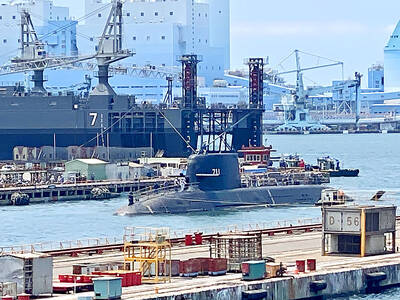
AGING: While Japan has 22 submarines, Taiwan only operates four, two of which were commissioned by the US in 1945 and 1946, and transferred to Taiwan in 1973 Taiwan would need at least 12 submarines to reach modern fleet capabilities, CSBC Corp, Taiwan chairman Chen Cheng-hung (陳政宏) said in an interview broadcast on Friday, citing a US assessment. CSBC is testing the nation’s first indigenous defense submarine, the Hai Kun (海鯤, Narwhal), which is scheduled to be delivered to the navy next month or in July. The Hai Kun has completed torpedo-firing tests and is scheduled to undergo overnight sea trials, Chen said on an SET TV military affairs program. Taiwan would require at least 12 submarines to establish a modern submarine force after assessing the nation’s operational environment and defense

A white king snake that frightened passengers and caused a stir on a Taipei MRT train on Friday evening has been claimed by its owner, who would be fined, Taipei Rapid Transit Corp (TRTC) said yesterday. A person on Threads posted that he thought he was lucky to find an empty row of seats on Friday after boarding a train on the Bannan (Blue) Line, only to spot a white snake with black stripes after sitting down. Startled, he jumped up, he wrote, describing the encounter as “terrifying.” “Taipei’s rat control plan: Release snakes on the metro,” one person wrote in reply, referring
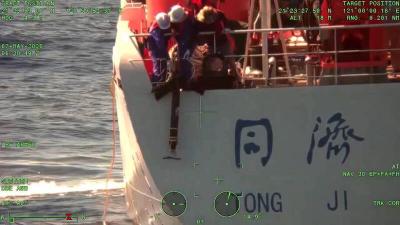
The coast guard today said that it had disrupted "illegal" operations by a Chinese research ship in waters close to the nation and driven it away, part of what Taipei sees a provocative pattern of China's stepped up maritime activities. The coast guard said that it on Thursday last week detected the Chinese ship Tongji (同濟號), which was commissioned only last year, 29 nautical miles (54km) southeast of the southern tip of Taiwan, although just outside restricted waters. The ship was observed lowering ropes into the water, suspected to be the deployment of scientific instruments for "illegal" survey operations, and the coast

Taiwan’s two cases of hantavirus so far this year are on par with previous years’ case numbers, and the government is coordinating rat extermination work, so there should not be any outbreaks, Centers for Disease Control (CDC) Director-General Philip Lo (羅一鈞) said today in an interview with the Liberty Times (the Taipei Times’ sister newspaper). An increase in rat sightings in Taipei and New Taipei City has raised concerns about the spread of hantavirus, as rats can carry the disease. In January, a man in his 70s who lived in Taipei’s Daan District (大安) tested positive posthumously for hantavirus, Taiwan’s


 RSS
RSS