


High-ranking Taiwanese military officials were paid an estimated US$20 million in commissions to endorse the controversial French frigate deal in 1991, a Democratic Progressive Party (DPP) lawmaker said yesterday.
DPP Legislator Hsu Kuo-yung (
Hsu said that former premier Hau Pei-tsun (
Between Sept. 2 and Sept. 17, 1989, six high-ranking military officials, including Kuo Li-heng, former vice admiral Lei Hsueh-ming (雷學明), former captain Kang Shih-chun (康世淳) and former commander Cheng Chih-po (程志波), proposed a change of plans after a trip to France, Hsu said.
The defense ministry accepted a proposal on Oct. 5, 1989, to purchase Lafayette-class frigates from France on the recommendation of Kuo Li-heng, Lei, Kang, Cheng, former vice admiral Yao Neng-chun (姚能君), former rear admiral Wang Chin-sheng (王琴生) and former captain Hsuan Peng-lai (宣蓬萊).
Hsu said yesterday that navy captain Yin Ching-feng (
Hsu said that Andrew Wang (汪傳浦), an agent for Thomson-CSF, the French company that sold the frigates to Taiwan, filed a defamation suit on Aug. 17, 2001, against Hsieh Tsung-min (謝聰敏), then an advisor to the president, who had allegedly accused Wang of killing Yin. Because Wang had asked for NT$20 million in compensation and reportedly said he would donate the money to Yin's bereaved family if he wins the suit, Hsu argued that the NT$20 million would equal Yin's kickback.
The DPP has claimed that the Chinese Nationalist Party (KMT) used a woman named Liu Li-li (劉莉莉) to distribute US$100 million to officials from the Chinese Communist Party and People's Liberation Army.
People First Party Legislator Lin Yu-fang (
Lin said he has personally talked with Hao, who denied that he knows Liu.
Lin called on the DPP to produce proof, as Hao is considering filing a lawsuit if the DPP fails to offer a satisfactory explanation.

The Ministry of Finance this afternoon announced the winning numbers for the March-April uniform invoice lottery. The winning number for the NT$10 million (US$318,060) special prize is 19531471, and the winning number for the NT$2 million grand prize is 85941329. Three numbers were drawn for the NT$200,000 first prize: 07225810, 20231230 and 83518781. Those with receipts matching the last seven digits of any of the first-prize numbers will win the NT$40,000 second prize, while those matching the last six digits will win the NT$10,000 third prize. Those whose receipts match the last five digits of the first-prize numbers can claim the NT$4,000 fourth prize,

SIX SUBSIDIES: The monthly allowance for older farmers is to increase to NT$10,000, and NT$5,000 is to be given to homemakers under the national pension system, Lai said The government is to implement major welfare policies for disadvantaged groups, including raising the monthly allowance for older farmers to NT$10,000 and providing homemakers with NT$5,000 per month, President William Lai (賴清德) said yesterday. Lai made the remarks during a visit to Wangling Temple in Chiayi County, saying that the planned increases were being introduced amid economic growth and an increase in tax revenue. Touting a policy, in which the government plans to provide a monthly allowance of NT$5,000 for every child under the age of 18 in a bid to address Taiwan’s low birthrate, Lai said that if received for the
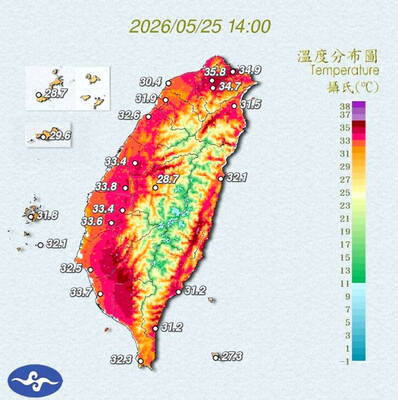
STAY COOL: The HPA recommended that people stay hydrated, use air-conditioning or fans while indoors, wear loose-fitting clothes and walk in the shade while outdoors Employers must implement measures such as installing cooling equipment, and providing drinking water and rest breaks for outdoor workers starting from Monday next week, the Taipei Department of Labor said on Sunday. Employers who fail to comply could face fines of NT$30,000 to NT$300,000 under the Occupational Safety and Health Act (職業安全衛生法), the department said. Businesses in Taipei employing fewer than 100 workers, as well as registered self-employed workers with labor insurance coverage, could receive on-site assessments and guidance from occupational safety consultants to help them apply for central government subsidies to implement or improve heat-protection measures, it said. Under the Ministry of
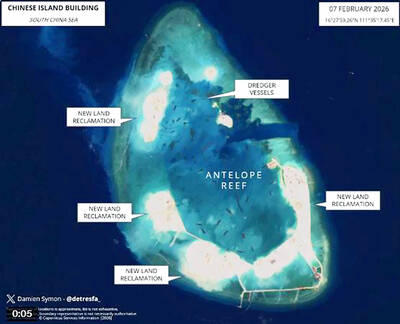
ISOLATION: The outposts would serve as support and backup bases, forcing US forces to either face China head-on or reroute, increasing travel time and operational costs China’s outposts in the South China Sea could be used to delay and constrain foreign forces during a conflict in the Taiwan Strait, giving Beijing a critical window to carry out amphibious landing and blockade operations, a report said. The Chinese Communist Party’s (CCP) forward operating bases on islands and reclaimed features in the South China Sea could delay foreign forces long enough for the Chinese People’s Liberation Army (PLA) to secure a key 48-to-72-hour window in the Taiwan Strait, a report commissioned by the Mainland Affairs Council found. The report, conducted by the Institute for National Defense and Security Research, examined


 RSS
RSS