


Former president Lee Teng-hui (
He made the statement in Taoyuan after attending the closing ceremony for the Lee Teng-hui School's special program for Japanese professors and students.
When asked if he was planning to visit Japan next April, Lee said, "Yes, I'm planning [the trip], and I want to go there, too. But I wonder if other people would let me go."
Lee did not say who "other people" were, but it is generally considered that he meant China, which has pressured the Japanese government not to allow him to visit Japan.
Lee intends to visit Tokyo and pay a visit to a scenic spot in northeast Japan called Okunohosomichi. In an interview with the Japanese press, Lee has also mentioned that he wanted to visit the Yasukuni Shrine to perform a memorial service for his brother, who is enshrined there, according to a friend of Lee's, speaking on condition of anonymity.
At present, most of the newly appointed members of Japanese Prime Minister Junichiro Koizumi's Cabinet are friendly to Taiwan, which provides Lee with a good opportunity to revisit Japan, the friend said.
Lee has visited Japan twice in the past five years -- in April 2001 and last December -- and the spring is an advantageous time for Lee to go back to Japan, after his successful visit to the US last month.
"Although Lee's plan to visit Japan is not confirmed yet, the direction is quite sure and the plan will definitely move ahead," the friend said.

FUKUOKA SITUATION: Japanese media reported that the pathogen is expected to be identified by the summer, while the CDC downplayed the idea that it was hMPV A “mysterious cold-like illness” reported in Japan’s Fukuoka Prefecture does not seem to be a new disease, but Japanese authorities have been asked about the situation, the Centers for Disease Control (CDC) said yesterday. The Fukuoka Prefectural Medical Association on Wednesday told a news conference that a “mystery cold” that has become a hot topic on social media is “highly likely to be caused by some kind of viral infection,” Japan’s KBC News reported. “Many people are experiencing symptoms starting with a sore throat, followed by a runny nose, phlegm and a severe cough,” KBC News reported, citing association officials. Health authorities are

Nvidia Corp CEO Jensen Huang (黃仁勳) arrived in Taiwan yesterday ahead of upcoming AI and technology events, saying he plans to meet with clients and Taiwan Semiconductor Manufacturing Co Chairman C.C. Wei (魏哲家) during his visit. After landing at Taipei Songshan Airport, Huang posed for photos with fans and handed out Yakult drinks to reporters and supporters waiting at the scene, saying he has “a lot to do” during the trip. Asked about reports that Nvidia’s planned headquarters site in Taipei’s Beitou Shilin Technology Park could break ground on May 27, Huang said that if the company holds an event, he would

The Ministry of Finance this afternoon announced the winning numbers for the March-April uniform invoice lottery. The winning number for the NT$10 million (US$318,060) special prize is 19531471, and the winning number for the NT$2 million grand prize is 85941329. Three numbers were drawn for the NT$200,000 first prize: 07225810, 20231230 and 83518781. Those with receipts matching the last seven digits of any of the first-prize numbers will win the NT$40,000 second prize, while those matching the last six digits will win the NT$10,000 third prize. Those whose receipts match the last five digits of the first-prize numbers can claim the NT$4,000 fourth prize,
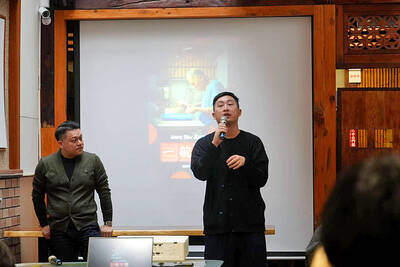
Taiwan Travelogue (臺灣漫遊錄), which earlier this week became the first Taiwanese novel to win the International Booker Prize, is to be adapted into a television series through a Taiwan-Japan coproduction, producer Chang Chen-yu (張辰漁) said yesterday. Chang, a producer at World Softest Production Film Co, wrote on Facebook that the company had been searching for projects with international appeal that retain a strong Taiwanese identity after colleagues and Japanese partners strongly recommended the novel. After reading the book, Chang said he immediately decided to pursue the screen rights. “A great story has the power to transcend time and borders, and connect countless people,”


 RSS
RSS