


The Ministry of Education's (MOE) decision this month to first ban public-school restrictions on permissible hairstyles and later lift those on shoes and socks for secondary-school students, sparked debate on whether students should be given total freedom over their appearance.
While many schools hesitated to carry out the new policy, the lifting of the hair and dress regulations has officially put an end to an outdated era and granted students the right to determine their own hairstyles and appearance.
Looking back at the history of the country's hair and dress regulations, the ban on students' hairstyles and dress was first introduced in 1969 by the ministry, and is now considered to be a relic of authoritarianism. According to hair-regulation criteria between 1969 and 1978, as provided by the MOE, secondary-school boys were required to sport crew cuts, there had to be no hair on their temples and strange hairstyles were not allowed. Girls' hair, on the other hand, had to be ear-length and neither dyed nor permed.
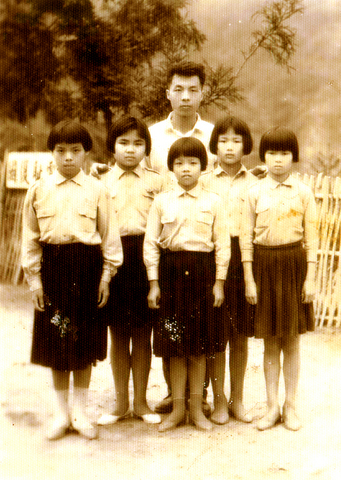
TAIPEI TIMES FILE PHOTO BY CHEN CHING-MIN
The ministry in 1984 issued an official dress code for secondary-school students. While there was no detailed requirements, the ministry requested that students' clothes be "neat," "simple" and "graceful."
Six months before the then-ruling Chinese Nationalist Party lifted martial law in 1987, the MOE banned hair regulations at secondary schools. The announcement stated that secondary-school students' hairstyles should be "simple, neat and easy to freshen up." But "schools can draw up their own regulations based on the above principles and opinions from teachers, students and parent representatives."
Schools continued to enforce strict rules, and rushing to get haircuts or preparing white shoes and socks the night before their schools' appearance-checkup day has remained a school memory for most Taiwanese people.
"Our director of student affairs once cut a student's hair during a hair checkup in front of everybody, because he used styling gel on his hair. My teacher even asked a barber to come to school and give each of us a haircut to make sure our hairstyles conformed to school rules," said Jimmy Chuang (
Jimmy said that while the school informed them about the MOE's policy, hair regulations continued to be enforced even though students were allowed to sport their hair a little longer. Every month at schools' morning rally, the director of student affairs or instructors would do a routine hair and dress checkup. Students who failed the checkup would be punished with points deducted from their grades.
"Having to get a haircut at least once a month was a hassle. But I think most of my male classmates felt OK with the crew-cut hairstyle," Chuang said.
"Girls hated the hair regulations more because their prescribed hairstyle gave them `watermelon heads,' and it was not pretty," he said. Years after the ministry's first official ban on hair regulations, secondary-school boys no longer need to sport the crew-cut hairstyle and girls can wear their hair to at least shoulder-length.
But most schools never gave up the authority to exercise proper discipline regarding students' appearance. It seems that most of the schools decided to stick to their guns when education officials this time around chose to stand firmly on the side of students' hairstyle rights when the legitimacy of the regulations was questioned by students in a protest last month.
Many secondary-school principals were surprised at Education Minister Tu Cheng-sheng's (
Some schools' principals called the changes a "travesty of education in the guise of democracy." A number of them vowed to maintain existing regulations.
Tan Guang-ding (
"But I do not agree that hair regulations are a violation of students' human rights. Students come to school to receive an education and proper discipline. Schools' authority over students' hairstyles should not be denied," Tan said.
Facing a cool response from school principals, Vice Minister of Education Fan Sun-lu (
Fan called on schools to give students the right to choose their own hairstyles, given that this is a democratic society.
"This was consistent with the idea that schools aim at teaching students to be responsible members of society by making decisions for themselves and thinking on their own," she said.
As many school principals hesitated to give up their authority over students' hair, however, hairstyle rights advocates may need to continue their fight until students can express themselves through various hairstyles without any restraints.

Yangmingshan National Park authorities yesterday urged visitors to respect public spaces and obey the law after a couple was caught on a camera livestream having sex at the park’s Qingtiangang (擎天崗) earlier in the day. The Shilin Police Precinct in Taipei said it has identified a suspect and his vehicle registration number, and would summon him for questioning. The case would be handled in accordance with public indecency charges, it added. The couple entered the park at about 11pm on Thursday and began fooling around by 1am yesterday, the police said, adding that the two were unaware of the park’s all-day live

Fast food chain McDonald's is to raise prices by up to NT$5 on some products at its restaurants across Taiwan, starting on Wednesday next week, the company announced today. The prices of all extra value meals and sharing boxes are to increase by NT$5, while breakfast combos and creamy corn soup would go up by NT$3, the company said in a statement. The price of the main items of those meals, if ordered individually, would remain the same. Meanwhile, the price of a medium-sized lemon iced tea and hot cappuccino would rise by NT$3, extra dipping sauces for chicken nuggets would go up
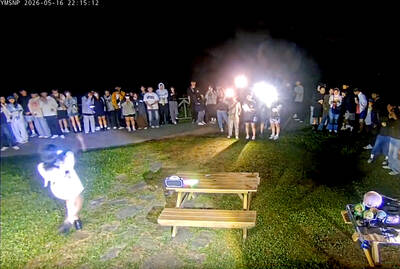
Yangmingshan National Park’s Qingtiangang (擎天崗) nature area has gone viral after a park livestream camera observed a couple in the throes of intimate congress, which was broadcast live on YouTube, drawing large late-night crowds and sparking a backlash over noise, bright lights and disruption to wildlife habitat. The area’s livestream footage appeared to show a couple engaging in sexual activity on a picnic table in the park on Friday last week, with the uncensored footage streamed publicly online. The footage quickly spread across social media, prompting a tide of visitors to travel to the site to “check in” and recreate the

Minister of Digital Affairs Lin Yi-ching (林宜敬) yesterday cited regulatory issues and national security concerns as an expert said that Taiwan is among the few Asian regions without Starlink. Lin made the remarks on Facebook after funP Innovation Group chief executive officer Nathan Chiu (邱繼弘) on Friday said Taiwan and four other countries in Asia — China, North Korea, Afghanistan and Syria — have no access to Starlink. Starlink has become available in 166 countries worldwide, including Ukraine, Malaysia, the Philippines and Vietnam, in the six years since it became commercial, he said. While China and North Korea block Starlink, Syria is not


 RSS
RSS