


Taiwan will get a rare, first-hand glimpse of 1,500-year-old kung fu skills after a group of fighting monks from the world-famous Songshan Shaolin Temple in China's Henan Province arrived on Thursday.
The 19-member delegation, which will depart Sept. 1, began the first leg of its tour in Chiayi County yesterday. Other events will take place in Kaohsiung City, Taichung County, Hsinchu City and Ilan. During their visit the monks will share their skills with other martial-arts professionals and offer free demonstrations to the general public.
Shaolin kung fu, which features flying fists and acrobatic moves, is regarded by many as the most venerable of the Chinese martial arts. Dating from the year 495, Shaolin kung fu has in recent years been popularized by martial-arts movies starring the likes of Jet Lee (李連杰).
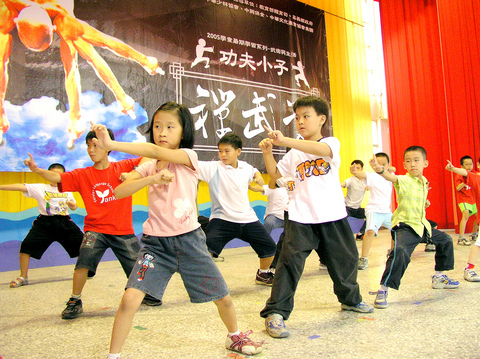
PHOTO: YANG KUO-TANG, TAIPEI TIMES
Its appeal has spread across the globe: the US rap group Wu-Tang Clan was so smitten by kung fu movies that they referred to their home New York City borough of Staten Island as "Shaolin" in their lyrics. More recently, Hong Kong movie star Stephen Chow's (
Now, Shaolin kung fu is being considered for inclusion in UNESCO's list of "Masterpieces of the Oral and Intangible Heritage of Humanity."
If accepted, it will become the third Chinese performance art after kunqu (崑曲) musical theater and guqin (古琴) music to be include on the list. Kunqu is considered as one of China's oldest living operatic traditions, while guqin is believed to be one of the oldest Chinese stringed musical instruments.
In addition to the 19 members who are here, the organizer is trying to bring over 23 more, including the head monk of the temple, Shi Yongxin (
Conflicting accounts
The monks' visit comes after weeks of wrangling between event organizers and the government over details of the visit.
Shi Yanci (
The change to the troupe's itinerary has caused the size of the group to shrink and has delayed its schedule.
The ups and downs have also clearly led to miscommunication between the handlers, with event organizers now saying one thing and sponsors saying another.
According to Andrew Lin (
But Chu Han-kuang (
Chu said that his company has been a long-time donor to local cultural and musical performance groups and that it spends about NT$20 million in sponsorships out of their NT$4.9 billion annual revenue.
In addition to encouraging public interest in the martial arts, Chu said that his company will directly benefit from the Shaolin monks' visit.
They have arranged to have 100 of the company's trainers learn advanced martial arts skills from the monks. The trainers will then pass on their newly acquired fighting skills to the company's security guards.
Serene routine
Shi Yanci joined the Shaolin Temple at the age of 16 but did not become a monk until 2000. The native of Liaoling said he was inspired by a kung fu movie, Shaolin Temple, featuring Jet Lee.
He is the head of the Kongxiang Temple (
Shi Yongzhi (釋永智), the troupe's guiding master, looked serene when he was performing the final routine -- the qixingquan (七星拳), or "seven-star" routine performed primarily with the arms and fists, at the legislature on Friday.
The troupe visited the lawmaking body to offer a treat to the media before kicking off their tour yesterday.
Shi Yongzhi, a 40-year-old native of Henan, joined the Shaolin temple at the age of 17 after hearing about Shaolin kung fur for years.
"I live so close to the Shaolin Temple that I gradually developed an interest in learning more about Shaolin kung fu and Buddhism," he said.
Although he is the first son in his five-member family, Shi Yongzhi was spared from fulfilling the traditional familial duties of the first son because his younger brother could do the job.
Deputy group leader Shi Xingdu (
Being the first child and first son in his family, he was torn between filial piety and individual passion.
His parents tried to prevent him from becoming a monk through various means.
Their campaign started as emotional appeals, but quickly escalated into a full-blown family feud. After months of bitter argument, however, his parents gave in.
He left his home in Hubei and came to the temple to learn Shaolin kung fu 12 years ago.
After completing the kung fu training at the temple in 1998, he went to the UK to study philosophy at the University of Manchester for a year.
He now supervises instruction in Buddhism for about 50 monks residing at the temple and is in charge of discipline.
They do not use corporal punishment, he said.
"I remember one day when I was teaching a Buddhism course, one of the students repeatedly ignored my warnings and kept on talking," he said. "I eventually had to ask him to leave the classroom and go burn incense sticks and repent in front of the Buddha."
Comparing pupils 12 years ago and their contemporary counterparts, he said that he has seen many more children spoiled by their parents of late.
Financial woes
Spoiled children, however, are not the temple's biggest concern. It's more worried about insufficient funding and the abuse of the temple's name.
The temple has several sources of funding, mainly ticket sales and private donations.
Situated in the heart of the Sungshan Shaolin scenic area, the temple received 30 yuan (US$3.70) out of each 100 yuan ticket sale, while the Chinese government gets the remaining 70 yuan.
The ticket price was raised to 100 yuan from 40 yuan in May, over the temple's protests. Temple authorities were afraid that a higher ticket price might scare off potential visitors.
The temple attracts huge numbers of domestic visitors and tens of thousands of foreign guests a year.
In a bid to establish more control over the use of their name for commercial purposes, the temple has registered with the Chinese government to make Shaolin a domestically recognized trademark.
Shi Xingdu will be going to Peking University to study Buddhism next month and plans to return to the temple after the two-year graduate program ends.
Full day
For monks living at the Shaolin Temple, the day begins at 4am and ends at 9:30pm.
The morning session officially begins at 6am with a one-hour kung fu practice. It is followed by breakfast and daily chores such as laundry and housekeeping.
The "cultural" courses start at exactly 8:30am when pupils learn a wide range of subjects from history, geology, Chinese language and Buddhism to Chinese medicine and English.
Lunch is served at 11:30am, followed by a two-hour afternoon nap. The young pupils then practice their kung fu fighting skills from 2pm to 4pm.
That practice is followed by a 90-minute recitation of the Buddha's sermons. After a 6pm dinner, the evening practice of kung fu begins. All monks must be in bed by 9:30pm, when the lights are turned out.
Once a week the monks are allowed to travel down the mountainside to purchase necessary items or take a hot shower.
Modern technology such as television is not available in the temple, although pupils are allowed to make short telephone calls if absolutely necessary.
There are no summer or winter vacations, but the monks get to go home during the Lunar New Year.
The group is scheduled to return to Taipei next Sunday, when they will perform at the Taipei Arena on Nanking East Road. They will continue their demonstrations until Aug. 27.
Admission for all of the activities is free.

FUKUOKA SITUATION: Japanese media reported that the pathogen is expected to be identified by the summer, while the CDC downplayed the idea that it was hMPV A “mysterious cold-like illness” reported in Japan’s Fukuoka Prefecture does not seem to be a new disease, but Japanese authorities have been asked about the situation, the Centers for Disease Control (CDC) said yesterday. The Fukuoka Prefectural Medical Association on Wednesday told a news conference that a “mystery cold” that has become a hot topic on social media is “highly likely to be caused by some kind of viral infection,” Japan’s KBC News reported. “Many people are experiencing symptoms starting with a sore throat, followed by a runny nose, phlegm and a severe cough,” KBC News reported, citing association officials. Health authorities are

Nvidia Corp CEO Jensen Huang (黃仁勳) arrived in Taiwan yesterday ahead of upcoming AI and technology events, saying he plans to meet with clients and Taiwan Semiconductor Manufacturing Co Chairman C.C. Wei (魏哲家) during his visit. After landing at Taipei Songshan Airport, Huang posed for photos with fans and handed out Yakult drinks to reporters and supporters waiting at the scene, saying he has “a lot to do” during the trip. Asked about reports that Nvidia’s planned headquarters site in Taipei’s Beitou Shilin Technology Park could break ground on May 27, Huang said that if the company holds an event, he would

The Ministry of Finance this afternoon announced the winning numbers for the March-April uniform invoice lottery. The winning number for the NT$10 million (US$318,060) special prize is 19531471, and the winning number for the NT$2 million grand prize is 85941329. Three numbers were drawn for the NT$200,000 first prize: 07225810, 20231230 and 83518781. Those with receipts matching the last seven digits of any of the first-prize numbers will win the NT$40,000 second prize, while those matching the last six digits will win the NT$10,000 third prize. Those whose receipts match the last five digits of the first-prize numbers can claim the NT$4,000 fourth prize,
Taiwan Travelogue (臺灣漫遊錄), which earlier this week became the first Taiwanese novel to win the International Booker Prize, is to be adapted into a television series through a Taiwan-Japan coproduction, producer Chang Chen-yu (張辰漁) said yesterday. Chang, a producer at World Softest Production Film Co, wrote on Facebook that the company had been searching for projects with international appeal that retain a strong Taiwanese identity after colleagues and Japanese partners strongly recommended the novel. After reading the book, Chang said he immediately decided to pursue the screen rights. “A great story has the power to transcend time and borders, and connect countless people,”


 RSS
RSS