


A recent survey of bras conducted by the Consumers' Foundation (消基會) revealed that a significant number of brands provided inadequate information on the labels.
Of 30 bras tested by the foundation, 17 were found to have incomplete information on the label, and 10 contained some kind of bleaching agent, used to enhance the whiteness of the material.
According to the foundation's secretary-general, Terry Huang (黃怡騰), bras include a wide range of materials in the lace trimmings, embroidered decoration, and shoulder straps, and information about all of these should be provided on the label.
Many manufacturers are failing to comply with these labeling standards -- Manjiao, Miki, Peyheyi, and Dunni Rous are considered among the worst offenders.
Huang added that in some cases, the labels did not even include details about the materials used, so not only are consumers unaware of what they are wearing, there are also no care or washing instructions.
According to the foundation, this information is just as important as having ingredients listed on food products, since the material comes into close contact with the skin.
Man-made fibers are more likely to cause sweating and itchy skin, whereas natural fibers allow air to flow more easily, and make perspiration less of a problem. If there is too much lace in a bra it can also be harmful to the skin, as it does not absorb moisture very easily.
The last few years have seen the increasing popularity of see-through shoulder straps, and not only do these not absorb moisture, they can harm the skin over time through rubbing.
By law, manufacturers are required to provide information on the label for each part of the product, and failure to do so could result in a fine, or even closure.
The advice given by the foundation to the manufacturers, then, is to ensure that all necessary and required information is provided on the label.
The advice the foundation gives to consumers is to purchase according to the SAFE principle: Safety, Aesthetics, Fashion and Environment.

Yangmingshan National Park authorities yesterday urged visitors to respect public spaces and obey the law after a couple was caught on a camera livestream having sex at the park’s Qingtiangang (擎天崗) earlier in the day. The Shilin Police Precinct in Taipei said it has identified a suspect and his vehicle registration number, and would summon him for questioning. The case would be handled in accordance with public indecency charges, it added. The couple entered the park at about 11pm on Thursday and began fooling around by 1am yesterday, the police said, adding that the two were unaware of the park’s all-day live

Fast food chain McDonald's is to raise prices by up to NT$5 on some products at its restaurants across Taiwan, starting on Wednesday next week, the company announced today. The prices of all extra value meals and sharing boxes are to increase by NT$5, while breakfast combos and creamy corn soup would go up by NT$3, the company said in a statement. The price of the main items of those meals, if ordered individually, would remain the same. Meanwhile, the price of a medium-sized lemon iced tea and hot cappuccino would rise by NT$3, extra dipping sauces for chicken nuggets would go up
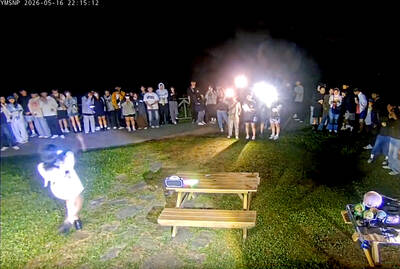
Yangmingshan National Park’s Qingtiangang (擎天崗) nature area has gone viral after a park livestream camera observed a couple in the throes of intimate congress, which was broadcast live on YouTube, drawing large late-night crowds and sparking a backlash over noise, bright lights and disruption to wildlife habitat. The area’s livestream footage appeared to show a couple engaging in sexual activity on a picnic table in the park on Friday last week, with the uncensored footage streamed publicly online. The footage quickly spread across social media, prompting a tide of visitors to travel to the site to “check in” and recreate the

Minister of Digital Affairs Lin Yi-ching (林宜敬) yesterday cited regulatory issues and national security concerns as an expert said that Taiwan is among the few Asian regions without Starlink. Lin made the remarks on Facebook after funP Innovation Group chief executive officer Nathan Chiu (邱繼弘) on Friday said Taiwan and four other countries in Asia — China, North Korea, Afghanistan and Syria — have no access to Starlink. Starlink has become available in 166 countries worldwide, including Ukraine, Malaysia, the Philippines and Vietnam, in the six years since it became commercial, he said. While China and North Korea block Starlink, Syria is not


 RSS
RSS