


The Taiwan Solidarity Union (TSU) yesterday pledged that its protest against Chinese Nationalist Party (KMT) Chairman Lien Chan's (連戰) upcoming trip to China will be peaceful.
"We will call on our supporters to be rational and stage the demonstration peacefully," said TSU lawmaker David Huang (黃適卓). "We'd also like to see the New Party reciprocate and ask its supporters to refrain from being provocative and deliberately inciting violence, or they will have to shoulder the political responsibility."
The TSU has called on its supporters to bring eggs to CKS International Airport to "see off" Lien on Tuesday, when he leaves the country for his eight-day trip.
In a bid to thwart the TSU's plan, the New Party has vowed to launch a counter-protest, saying that it does not rule out the possibility of mobilizing gravel trucks and bulldozers in its cause.
Although Huang said that he is not certain how many people will eventually turn up, his party has so far booked five 45-person buses and he believes that more than 1,000 people will participate.
In a bid to test Lien's political stance and his "psychological state" to see whether he is fit for making the trip, Huang posed eight questions, which he says he hopes Lien will answer openly.
"If he receives a failing grade, we'll be certain that he will jeopardize Taiwan's national interests and fall into the snare of China's unification schemes during his trip," he said.
Those questions are: Do you think the relationship between Taiwan and China is a domestic affair or an international one? What do you think of China's proposal that it will help us enter the World Health Assembly (WHA) as a "social group"? Who do you think has the final say on the future of Taiwan? Do you dare to ask Hu to push for China's democratization? Do you dare to express the concern of the international community over China's poor human rights record and suppression of religious freedom? What do you plan to say to Hu regarding its missiles targeted at Taiwan? How do you react to Hu's reiteration of the "one China" policy? What will you say to Hu about the "Anti-Secession" Law?
When asked to speculate on what score Lien would get on the test, Huang said that he suspects Lien would score zero out of a possible 100.
TSU Legislator Tseng Tsan-teng (曾燦燈) said that his party is most concerned about the transparency of Lien's talks with Chinese authorities during his visit.
"The public is still being kept in the dark about what issues he will discuss with Chinese authorities," he said. "It is not impossible that Chinese President Hu Jintao (胡錦濤) will promise Lien the position of head of the Taiwan special administrative region."
If that is the case, Tseng said that he is afraid that the pan-blue camp's "soft coup" attempted after last year's presidential election may eventually become a genuine one.
Tseng also expressed his apprehension over Lien's "swaying" political stance.
Tseng said that when Lien was running for the presidency last year, he sprawled on the ground and kissed it to signify his love for this land.
But after losing the election his attitude quickly changed as he leaned toward Beijing's "one China" principle.
"It is natural for us as well as the people of Taiwan to question his position on the nation's sovereignty," Tseng said.

SECURITY: Starlink owner Elon Musk has taken pro-Beijing positions, and allowing pro-China companies to control Taiwan’s critical infrastructure is risky, a legislator said Starlink was reluctant to offer services in Taiwan because of the nation’s extremely high penetration rates in 4G and 5G services, the Ministry of Digital Affairs said yesterday. The ministry made the comments at a meeting of the legislature’s Transportation Committee, which reviewed amendments to Article 36 of the Telecommunications Management Act (電信管理法). Article 36 bans foreigners from holding more than 49 percent of shares in public telecommunications networks, while shares foreigners directly and indirectly hold are also capped at 60 percent of the total, unless specified otherwise by law. The amendments, sponsored by Chinese Nationalist Party (KMT) Legislator Ko

The eastern extension of the Taipei MRT Red Line could begin operations as early as late June, the Taipei Department of Rapid Transit Systems said yesterday. Taipei Rapid Transit Corp said it is considering offering one month of free rides on the new section to mark its opening. Construction progress on the 1.4km extension, which is to run from the current terminal Xiangshan Station to a new eastern terminal, Guangci/Fengtian Temple Station, was 90.6 percent complete by the end of last month, the department said in a report to the Taipei City Council's Transportation Committee. While construction began in October 2016 with an
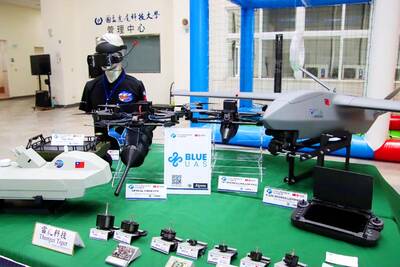
NON-RED SUPPLY: Boosting the nation’s drone industry is becoming increasingly urgent as China’s UAV dominance could become an issue in a crisis, an analyst said Taiwan’s drone exports to Europe grew 41.7-fold from 2024 to last year, with demand from Ukraine’s fight against Russian aggression the most likely driver of growth, a study showed. The Institute for Democracy, Society and Emerging Technology (DSET) in a statement on Wednesday said it found that many of Taiwan’s uncrewed aerial vehicle (UAV) sales were from Poland and the Czech Republic. These countries likely transferred the drones to Ukraine to aid it in its fight against the Russian invasion that started in 2022, it said. Despite the gains, Taiwan is not the dominant drone exporter to these markets, ranking second and fourth

Japanese Prime Minister Sanae Takaichi’s comment last year on Tokyo’s potential reaction to a Taiwan-China conflict has forced Beijing to rewrite its invasion plans, a retired Japanese general said. Takaichi told the Diet on Nov. 7 last year that a Chinese naval blockade or military attack on Taiwan could constitute a “survival-threatening situation” for Japan, potentially allowing Tokyo to exercise its right to collective self-defense. Former Japan Ground Self-Defense Force general Kiyofumi Ogawa said in a recent speech that the remark has been interpreted as meaning Japan could intervene in the early stages of a Taiwan Strait conflict, undermining China’s previous assumptions


 RSS
RSS