


With just three days away from the World Tuberculosis (TB) Day on March 24, the Center for Disease Control yesterday pledged to halve the number of TB patients in a decade, hoping to avert a resurgence of the killer disease in Taiwan.
The respiratory illness still rages in Taiwan, even with the life-saving development of penicillin and other antibiotics over the past 50 years. Every year, 15,000 people are infected with TB and 1,300 patients die from it. On average, TB takes a life every six hours, according to the center's statistics.
"Tuberculosis is still the top killer disease [in Taiwan], responsible for nearly 70 percent of deaths of communicable diseases. In fact, TB has never left us," said Wu Yi-chun (
In the later half of 20th century, there were a steady decline in deaths from the chronic respiratory illness. The development of new antibiotics and raised public awareness had driven the TB mortality rate from 300 people in every 100,000 people in the forties to 6 people in every 100,000 since the 1990s. But the decline began to level out in recent years.
This is partly because the development of drug-resistant strains of the disease has outpaced the drug development.
"Drug-resistant TB affects about 1,000 to 2,000 people each year. It is an alarming ten-fold jump in ten years," Wu said.
Many patients, who suffer from nausea, itchiness and other side-effects of TB drugs, tend to skip medication or simply put a stop to their six-month treatment. Whenever patients fail to take their antibiotics properly, TB bacteria build up a tolerance to the medication and renders the disease ever more difficult to treat.
Another factor in the rising TB trend is lax health procedures for immigrants and a lack of health care for foreign workers. Visitors or workers arriving from underdeveloped countries where TB is more prevalent get little medical attention in Taiwan. Every year, Taiwan deports 300 to 400 foreign workers back to their home countries because they are infected with TB.
"As people travel and trade freely across borders, there are more and more channels of TB transmission," Wu said.
In an effort to control a possible TB epidemic, health officials planned to broaden screening programs of high risk groups, such as Aboriginal people and the elderly.
"Aboriginal people, who are four times more likely to get TB and six times more likely to die from it, do not have easy access to medical care. They don't get chest X-rays frequently enough," said the center's deputy director, Lin Ting (
The center has sent ambulances to remote mountain villages to give X-ray tests. Since last September, the health officials also started to pay for the treatment of TB-infected Aboriginals, and give them NT$600 a day as reimbursements for their in the hospital.
The center also urged those above the age of 40 to get a chest X-ray to check for TB at least once a year.
"The elderly above the age of 65 account for half of total TB patients. The mortality rate increases with age. About 83 percent of TB-induced deaths occur among to the elderly," Wu said.
Because TB can lie dormant in the body for many years and strike when the immune system weakens, patients may not be aware that they have TB and thus, it is not threated early enough, health officials said.
"A person with TB does not necessarily feel ill. TB symptoms -- including fatigue, lingering cough, weight loss, night sweats and coughing up blood -- are sometimes mistaken for lung cancer or other diseases. That could mean a missed chance to treat TB patients," Wu said.

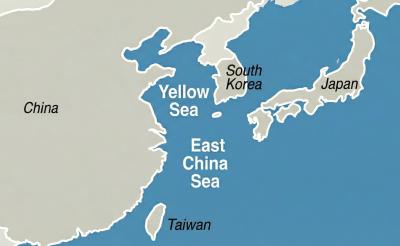
China has reserved offshore airspace in the Yellow Sea and East China Sea from March 27 to May 6, issuing alerts usually used to warn of military exercises, although no such exercises have been announced, the Wall Street Journal (WSJ) reported yesterday. Reserving such a large area for 40 days without explanation is an “unusual step,” as military exercises normally only last a few days, the paper said. These alerts, known as Notice to Air Missions (Notams), “are intended to inform pilots and aviation authorities of temporary airspace hazards or restrictions,” the article said. The airspace reserved in the alert is

NAMING SPAT: The foreign ministry called on Denmark to propose an acceptable solution to the erroneous nationality used for Taiwanese on residence permits Taiwan has revoked some privileges for Danish diplomatic staff over a Danish permit that lists “Taiwan” as “China,” Eric Huang (黃鈞耀), head of the Ministry of Foreign Affairs’ Department of European Affairs, told a news conference in Taipei yesterday. Reporters asked Huang whether the Danish government had responded to the ministry’s request that it correct the nationality on Danish residence permits of Taiwanese, which has been listed as “China” since 2024. Taiwan’s representative office in Denmark continues to communicate with the Danish government, and the ministry has revoked some privileges previously granted to Danish representatives in Taiwan and would continue to review
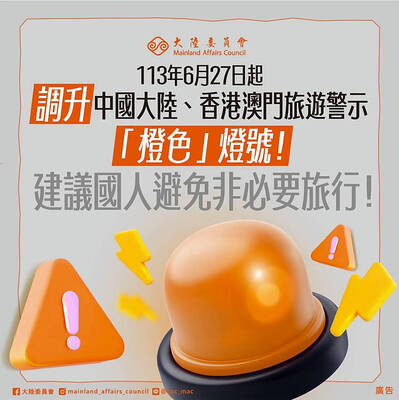
More than 6,000 Taiwanese students have participated in exchange programs in China over the past two years, despite the Mainland Affairs Council’s (MAC) “orange light” travel advisory, government records showed. The MAC’s publicly available registry showed that Taiwanese college and university students who went on exchange programs across the Strait numbered 3,592 and 2,966 people respectively. The National Immigration Agency data revealed that 2,296 and 2,551 Chinese students visited Taiwan for study in the same two years. A review of the Web sites of publicly-run universities and colleges showed that Taiwanese higher education institutions continued to recruit students for Chinese educational programs without
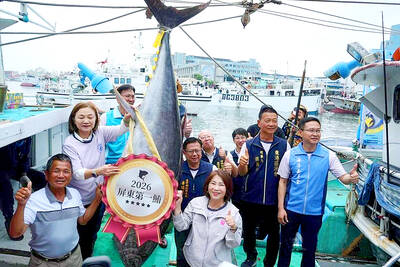
The first bluefin tuna of the season, brought to shore in Pingtung County and weighing 190kg, was yesterday auctioned for NT$10,600 (US$333.5) per kilogram, setting a record high for the local market. The auction was held at the fish market in Donggang Fishing Harbor, where the Siaoliouciou Island-registered fishing vessel Fu Yu Ching No. 2 delivered the “Pingtung First Tuna” it had caught for bidding. Bidding was intense, and the tuna was ultimately jointly purchased by a local restaurant and a local company for NT$10,600 per kilogram — NT$300 ,more than last year — for a total of NT$2.014 million. The 67-year-old skipper


 RSS
RSS