

While airline representatives confirmed that they had been officially authorized to handle cross-strait charter flights for the upcoming Lunar New Year, the Mainland Affairs Council (MAC) yesterday maintained silence on the matter, saying only that "contact had been made."
With the Lunar New Year around the corner, it remains an open question whether cross-strait charter flights will materialize to accommodate the estimated 500,000 Taiwanese businesspeople returning home for the holidays.
MAC Vice Chairman Chiu Tai-san (
"The two sides have already begun to communicate on the matter," he said yesterday.
However, Chiu refused to confirm whether the government had formally authorized the Taipei Airlines Association to represent the government in possible negotiations with China over the charter flights. The council stated last month that it would authorize the association to engage in talks as soon as "China's stance becomes clear."
"Is it really important whether we've authorized the association? That's not the main point here," Chiu said.
While the MAC has sought to keep a low profile on the matter, the association yesterday told the media that it had been delegated by the government to engage in negotiations, but refrained from saying when such talks would take place or with whom they would meet.
"We are bound to confidentiality by our agreement with the government," association Secretary-General Solo Su (
Su denied the veracity of an article by the local Chinese-language newspaper the China Times that said Su and association Chairman Michael Lo (樂大信) had left for Beijing yesterday to negotiate the details of cross-strait charter flights.
"I'm still in Taipei, right?" Su said yesterday.
The China Daily had reported that the Beijing representative offices of several local carriers had been expecting to meet with Lo yesterday.
With the Lunar New Year less than five weeks off, Su said that time was of the essence.
"There will indeed be a lot of pressure on the airline carriers, and they're worried about whether there will be market demand for the charter flights as the holiday approaches," he said.
However, Su said that as long as both sides were willing to cooperate, the matter could be resolved quickly.
While cross-strait flights took place in February 2003, the prospects for this year looked bleak until Beijing's Taiwan Affairs Office (TAO) put the issue back on the table on Monday.
Whether cross-strait talks will be held and whether flights will be direct and reciprocal has yet to be determined, but observers have said the flights are an indicator of the direction cross-strait exchanges might take in the future, as well as being a possible forerunner to the "three links" with China.
Meanwhile, in their efforts to facilitate cross-strait charter flights for Taiwanese working in China, the Chinese Nationalist Party (KMT) said yesterday that it is preparing to send a small delegation to Beijing on Sunday to talk to Chinese authorities.
The delegation hopes to facilitate reciprocal direct charter flights with no stopovers from Shanghai, Beijing and Guangzu.
Given its preliminary contacts with the MAC and the Chinese authorities, KMT Legislator and Central Policy Committee executive director Tseng Yung-chuan (曾永權) said yesterday that the KMT has high hopes that at least two of its objectives will be achieved.
"We think it is very possible that we will be able to have flights with no stopovers and from multiple locations. It's probably too late, however, to arrange [the technical details for] two-sided flights, since that touches upon cross-strait issues" Tseng told the Taipei Times yesterday.
The delegation plans to leave for Beijing on Jan. 9 and is slated to return the following day.
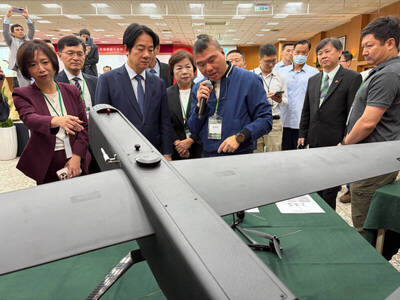
Two executives of drone supplier Jiin Ming Industry Co (錦明實業) have been detained and held incommunicado over the company's alleged use of prohibited China-made chips and camera lenses in drones supplied under recent military contracts, the Taoyuan District Prosecutors' Office said today. In a statement, prosecutors said they raided the offices of Jiin Ming — headquartered in Taoyuan — as well as those of its subsidiaries and its suppliers on Thursday last week. The raids followed a report that the company had breached its procurement contracts by putting the prohibited components into drones delivered to the military. During the raids, prosecutors summoned
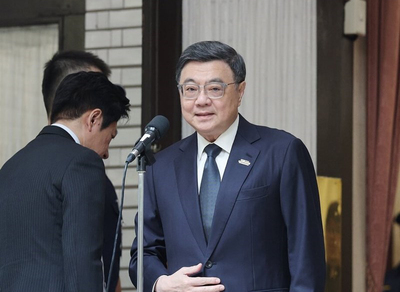
The government would continue monitoring online rumors that a pneumonic plague outbreak has spread from Russia into China and could enhance existing quarantine measures, Premier Cho Jung-tai (卓榮泰) said today. During a legislative meeting, Democratic Progressive Party Legislator Wang Ting-yu (王定宇) said rumors were circulating that the disease had spread across several Chinese provinces. He asked Cho whether the government was prepared to prevent the disease from spreading to Taiwan, given the frequent exchanges between Taiwan and China, and how concerned the government was about the alleged outbreak. The Ministry of Health and Welfare implemented border quarantine measures after briefing the Executive Yuan

South Korean boy band BigBang drew 120,000 fans to three concerts at Taipei Dome from Friday through yesterday, as the band thanked them for their support over their 20-year career. The Taipei Dome concerts were part of BigBang's "2026-2027 World Tour XX: Cosmos." Friday's concert was BigBang's first performance in Taiwan in 11 years. During the encore, group leader G-Dragon (GD) shouted "I love you" in Chinese and said he was especially happy to perform in Taiwan with bandmates Taeyang and Daesung. "Taipei, I'm very grateful to you all," GD said in Chinese, asking fans to wait for the band's return. Daesung thanked
A Chinese People's Liberation Army (PLA) Navy aircraft carrier group was being monitored after entering the western Pacific, the Ministry of National Defense said today, after Beijing yesterday criticized Taiwan for using a water cannon against a Chinese fishing boat near the Pratas Islands (Dongsha Islands, 東沙群島). A Chinese naval task group led by the aircraft carrier Liaoning (遼寧) yesterday sailed to the western Pacific for training, Chinese state-run Xinhua news agency quoted the PLA Navy as saying. “The drill is part of the annual routine training plan aimed at testing and improving the troops’ combat readiness and enhancing their ability to


 RSS
RSS