


Senior Presidential Adviser Koo Kwang-ming (
"The unfriendly attitude displayed by the US in response to Taiwan's move to rectify its name suggests that the US has forgotten the original ideals and dreams it upheld when it was first founded," Koo said.
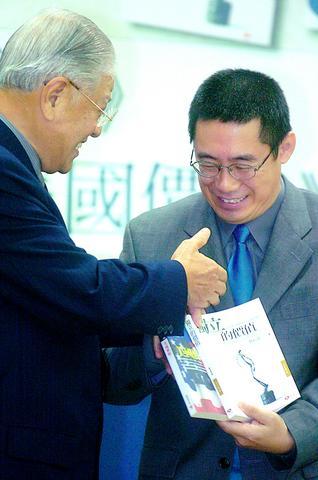
PHOTO: SEAN CHAO, TAIPEI TIMES
Koo made the remark yesterday at the launch of a new book by Chinese dissident and writer Cao Chang-ching (
US State Department Spokesman Adam Ereli on Monday said Chen's name-change plan would alter the "status quo" and thus the US does not support "changes of terminology for government-controlled enterprises or economic and cultural offices abroad" as Chen had proposed.
"Taiwan is a small country while the US is a big one. The big one will remain oblivious if the small one keeps on seeking approval from the big one," Koo said.
Koo said Taiwan must stand its ground on the name-rectification issue despite US opposition.
"As long as Taiwan holds fast to its stance, the US will change," Koo said.
Ruan Ming (
Ruan is a former special assistant to the late general secretary of the Communist Party of China Hu Yaoban (
"Why is that you [the US] can call Taiwan by the name Taiwan, yet allow not Taiwan to call itself Taiwan?" Ruan said.
The two books presented by Cao yesterday were titled Value of Independence (
Ruan, who has been a citizen of Taiwan for two years, suggested to Cao that he might want to give his new books to the US as a present to remind the US of its original values.
Senior Presidential Adviser Peng Ming-min (
"These people should feel ashamed" in contrast to the reality and truth about Taiwan's status Cao has grasped, Peng said.
Peng, who is widely regarded as the godfather of the nation's independence movement, said he hopes Cao's books will help inspire and educate people in Taiwan.
With the legislative elections less than two days away, former president Lee Teng-hui (
Unlike many Chinese dissidents who call for democratic reforms in China yet appear hesitant when it comes to the issue of Taiwan independence, Cao, a New York-based political commentator, advocates Taiwan's right to self-determination.
Lee expressed gratitude for Cao's support of Taiwan independence and said Cao's independent judgment originates in his believe in the value of liberty and democracy.
While praising Cao's persistence in believing the "truth," Lee criticized the "no truth, no president" slogan of the pan-blue camp as "a truth that had been manufactured, a remnant of the party-state consciousness."
Aside from Lee and the several senior presidential advisors, Cao was also joined by other guests such as National Policy Advisor Alice King (
While Cao has written hundreds of articles for leading journals in the US, Taiwan and Hong Kong pushing the cause of independence for Tibet, Taiwan and Xinjiang, and endorsing democratic reforms in China, this was the first time he has released his books in Taiwan.
In the book titled The Value of Independence, Cao conveys his views on Taiwan independence and outlines his long-held stance on Tibet and Xinjiang's right to self-determination.
American Values details his observations of the US values gathered during his 18-year stay in the country.

The military has spotted two Chinese warships operating in waters near Penghu County in the Taiwan Strait and sent its own naval and air forces to monitor the vessels, the Ministry of National Defense (MND) said. Beijing sends warships and warplanes into the waters and skies around Taiwan on an almost daily basis, drawing condemnation from Taipei. While the ministry offers daily updates on the locations of Chinese military aircraft, it only rarely gives details of where Chinese warships are operating, generally only when it detects aircraft carriers, as happened last week. A Chinese destroyer and a frigate entered waters to the southwest
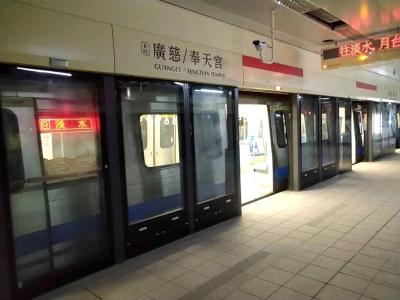
The eastern extension of the Taipei MRT Red Line could begin operations as early as late June, the Taipei Department of Rapid Transit Systems said yesterday. Taipei Rapid Transit Corp said it is considering offering one month of free rides on the new section to mark its opening. Construction progress on the 1.4km extension, which is to run from the current terminal Xiangshan Station to a new eastern terminal, Guangci/Fengtian Temple Station, was 90.6 percent complete by the end of last month, the department said in a report to the Taipei City Council's Transportation Committee. While construction began in October 2016 with an
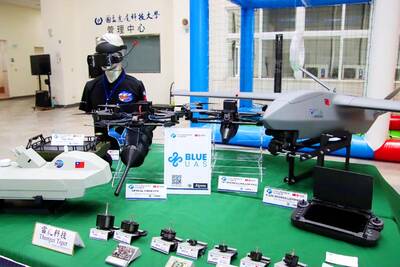
NON-RED SUPPLY: Boosting the nation’s drone industry is becoming increasingly urgent as China’s UAV dominance could become an issue in a crisis, an analyst said Taiwan’s drone exports to Europe grew 41.7-fold from 2024 to last year, with demand from Ukraine’s fight against Russian aggression the most likely driver of growth, a study showed. The Institute for Democracy, Society and Emerging Technology (DSET) in a statement on Wednesday said it found that many of Taiwan’s uncrewed aerial vehicle (UAV) sales were from Poland and the Czech Republic. These countries likely transferred the drones to Ukraine to aid it in its fight against the Russian invasion that started in 2022, it said. Despite the gains, Taiwan is not the dominant drone exporter to these markets, ranking second and fourth
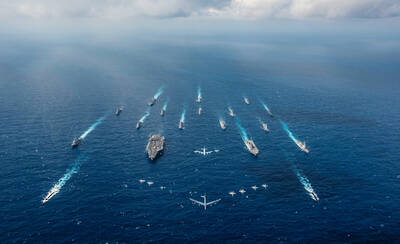
Japanese Prime Minister Sanae Takaichi’s comment last year on Tokyo’s potential reaction to a Taiwan-China conflict has forced Beijing to rewrite its invasion plans, a retired Japanese general said. Takaichi told the Diet on Nov. 7 last year that a Chinese naval blockade or military attack on Taiwan could constitute a “survival-threatening situation” for Japan, potentially allowing Tokyo to exercise its right to collective self-defense. Former Japan Ground Self-Defense Force general Kiyofumi Ogawa said in a recent speech that the remark has been interpreted as meaning Japan could intervene in the early stages of a Taiwan Strait conflict, undermining China’s previous assumptions


 RSS
RSS