


Taiwan's de facto ambassador to Washington, David Lee (
He said the window could begin after next week's legislative elections are completed.
That election would complete a year of important political changes in all three parties involved -- Taiwan, China and the US -- and usher in a period free of elections.
Such electoral periods focus attention on domestic, rather that foreign affairs, and tend to limit the scope for discussion of sensitive issues, Lee said.
Over the past year, he noted, the US and Taiwan have gone through both presidential and legislative elections, and, in China, President Hu Jintao (
That made this year "a difficult year" in cross-strait relations, said Lee, whose title is representative of the Taipei economic and Cultural Representative Office in Washington.
"But in 2005 and 2006, we hope that we will see some window of opportunity to resume dialogue across the Taiwan Strait," Lee said in a luncheon address at a George Washington University symposium on Taiwan and Cross-Strait Relations in Washington on Friday.
With Hu and premier Wen Jiabao (
Such talks could be in the spirit of the 1992 Hong Kong formula in which both sides "set aside all controversial issues and instead engaged in discussions of substance."
While Washington has shunned the idea of acting as a mediator for such talks, Lee said that Washington "will probably choose to play the role of facilitator."
Lee also addressed the lingering concern in Washington over President Chen Shui-bian's (
He recalled that in the late 1980s and the 1990s, Taiwan was lauded "as an emerging democracy, a shining example of ... economic prosperity and democratization."
However, in the past four months since he arrived in Washington in late July to replace Chen Chien-jen (
"In recent months, I have heard some criticism, blaming Taiwan for some of regional tensions, which I do not share," he said.
Lee conceded that many people in Washington feel that Taiwan's political "growing pains" are continuing.
He responded that "you have to realize that it has not been very easy, it has been a long way for Taiwan to reach where we are. The most important thing for us is to stick with the goal of democratization ... However, in the meantime, we have to do something to help alleviate some of the concerns, and the issues that exist between Washington and Taipei."
He also noted that "there is still a lot of concern in official Washington as well as in the think tanks and the academic community" about Chen's plans for constitutional reform.
"After the legislative election, the government will work with the US government, we will work with the people in the think tanks and the academic community to let you know better how we are going to approach constitutional reform." Lee said.
Lee described the Washington channels of communication between Taiwan and the US "efficient and effective."
While he does not have the authority to call the secretary of state, he does on several occasions called senior US officials in the middle of the night to relate important messages he receives from Taiwan.
"In the wee hours, they all talk with me and they all give me an initial reaction from the administration," he said.
On one occasion, he called an official deeply involved in US policy toward Taiwan in the middle of the night.
That official was on his honeymoon, but he still returned the phone call.
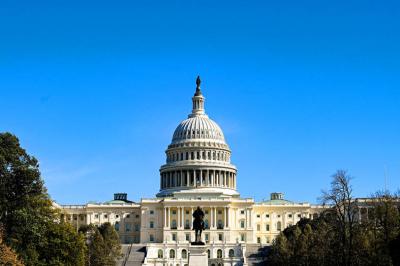
The US House of Representatives yesterday passed the PROTECT Taiwan Act, which stipulates that Washington would exclude China from participating in major global financial organizations if its actions directly threaten Taiwan’s security. The bill, proposed by Republican US Representative Frank Lucas, passed with 395 votes in favor and two against. It stipulates that if China’s actions pose any threat to Taiwan’s security, economic or social systems, the US would, “to the maximum extent practicable,” exclude China from international financial institutions, including the G20, the Bank for International Settlements and the Financial Stability Board. The bill makes it clear that China
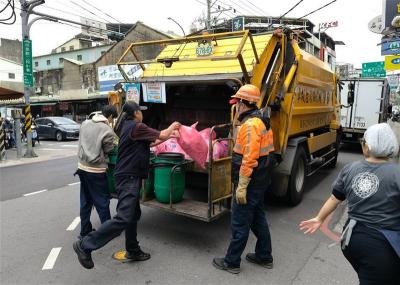
Garbage and recycling schedules are to vary from Saturday through Sunday next week over the Lunar New Year holiday period. The following collection information is from the governments of the six special municipalities. Taipei Regular service: Sunday to Monday next week. No service: Tuesday to Thursday next week. Extra service: Friday next week. Regular service resumes: Saturday next week. New Taipei City Extra service: Sunday. Adjusted collection time: Monday next week — garbage collection is to begin in the morning and end at 6pm. No service: Tuesday to Thursday next week. Regular service resumes: Friday next week. Note: Garbage can be dropped off at 70

A KFC branch in Kaohsiung may be fined between NT$60,000 and NT$200 million (US$1,907 and US$6.37 million), after a customer yesterday found an entire AAA battery inside an egg tart, the Kaohsiung Department of Health said today. The customer was about to microwave a box of egg tarts they had bought at the fast-food restaurant’s Nanzih (楠梓) branch when they checked the bottom and saw a dark shadow inside one of them, they said in a Threads post. The customer filmed themself taking the egg tart apart to reveal an entire AAA battery inside, which apparently showed signs of damage. Surveillance footage showed
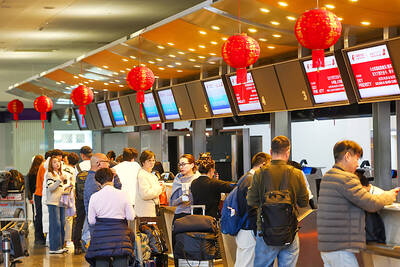
GROUP EFFORT: The number of inbound travelers rose 11 to 12 percent last month, with a significant increase in tourists from Europe and North America, an official said The government aims to attract 9.4 million visitors this year, the Tourism Administration said yesterday, citing last year’s success in diversifying tourist markets. Taiwan last year drew about 8.57 million international arrivals, 72.3 percent of pre-COVID-19 levels. By contrast, the nation had about 18.94 million outbound tourists last year, surpassing the pre-COVID-19 level of 17.1 million. The estimated tourism revenue deficit was about NT$700.9 billion (US$22.22 billion). Taoyuan International Airport Corp expects more than 160,000 passengers to pass through the nation’s largest airport daily during the Lunar New Year holiday, which begins on Saturday. As of Jan. 30, the nation’s average hotel occupancy rate


 RSS
RSS