


The Ministry of Foreign Affairs defended its supervision of foreign aid yesterday, dismissing media allegations of improper use of funds in Panama and Paraguay.
Foreign aid was granted only after careful evaluation and under certain conditions, ministry spokesman Michel Lu (呂慶龍) said.
"Reports relating to this matter were published in their local newspaper ABC Color, which failed to identify a source. Nor did it provide adequate proof," Lu said.
He said that under such conditions, it would be "inconvenient" for him to comment.
Media outlets in Paraguay reported on Tuesday that US$100 million in credit granted by Taiwan to former president Luis Gonzalez Macchi's administration to help local financial institutions had disappeared.
"So far, we do not know what happened to the money. We are investigating," central bank chief Gabriel Gonzalez told reporters after meeting with Paraguayan President Nicanor Duarte.
Gonzalez Macchi was in power from 1999 to last year, during which time Taiwan gave Paraguay US$400 million, of which US$100 million is unaccounted for, the central bank president said. Just before leaving office in August last year, Gonzalez Macchi signed a decree saying that the executive branch had canceled its debt to the central bank for the sum in question, and that any questions were an "internal problem" at the central bank.
Lu defended the ministry's lending practices yesterday, stressing that the loans had been made in 1999 "on a commercial basis between our banks and Paraguay."
He said that Paraguay had taken loans from two local banks, China Trust and the International Com-mercial Bank of China, as public bonds totaling US$400 million.
In addition, following Minister of Foreign Affairs Mark Chen's (陳唐山) disclosure in May that the ministry was considering a US$125 million loan to Paraguay, Lu denied that reports of corruption in Paraguay would impact on the issuance of similar loans in the future.
Lu said it would be premature to comment on the matter as loans depended on various considerations, including Taiwan's financial capability and the results of bipartisan negotiations.
The money from Taiwan was supposed to bolster Paraguay's financial system. Gonzalez Macchi is being investigated in three corruption cases and has already been accused of embezzling state funds.
"There is a process of careful negotiation between both parties before donation plans are agreed to. In addition, funds are not transferred as a lump sum. They are remitted over a period of time," Lu told the Taipei Times.
"The government is not so stupid as to give money without careful evaluation and without stipulations as to the conditions and procedures for the provision of foreign aid," Lu said.
He responded in a similar manner to accusations of irregularities found during an investigation into aid to Panama.
"With regard to plans for cooperation and aid to Panama, it is all conducted within the limits of Taiwan's capabilities. In addition, aid proposals must clear the Legislative Yuan and are therefore under the supervision of the legislature. It also comes under the supervision of processes tied to the legislative budget," Lu said.
A team of auditors appointed by Panamanian President Martin Torrijos uncovered a series of irregularities involving donations by Taiwan to the previous government.
The Comptroller's Office said on Tuesday that it was investigating the donations in view of possible corrupt acts by government officials. An audit of Panama's government books conducted since Torrijos took office on Sept. 1 found irregularities in the way US$45 million donated by Taiwan was handled by the Southern Sea Foundation, an organization created by the government to promote social programs.
Former health minister Fernando Gracia headed the foundation, which he declared had completed its tasks and used all its funds just two days before former president Mireya Moscoso ended her term. But bank officials confirmed that US$10 million from the foundation was used to open four investment accounts and a savings account at Panabank. The officials did not say whose name was on the accounts.
Taiwan's ambassador to Panama, David Hu (胡正堯), said Taiwan does not donate to individuals, only to governments for use in civic, cultural or scientific projects.
Some of the funds donated by Taiwan were used to build a maternity ward at a hospital and a child-ren's museum called the Toucan Museum. But after visiting the Toucan facility, new first lady Vivian Fernandez said it was unsuitable to be used as a museum. She complained of a lack of funds left to her office, and an investigation was launched into Ruby Moscoso, sister of former president Mireya Moscoso, who served as first lady in the previous administration.
On Monday, police seized a truck carrying valuable paintings, furniture and documents belonging to Ruby Moscoso. Through her lawyers, the former first lady said the cargo seized was personal items and household goods, not objects taken from government offices.
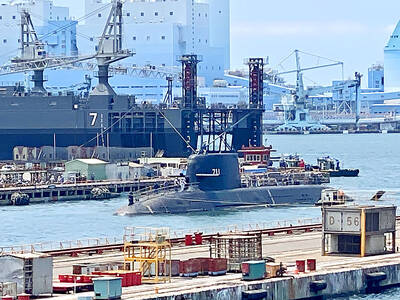
AGING: While Japan has 22 submarines, Taiwan only operates four, two of which were commissioned by the US in 1945 and 1946, and transferred to Taiwan in 1973 Taiwan would need at least 12 submarines to reach modern fleet capabilities, CSBC Corp, Taiwan chairman Chen Cheng-hung (陳政宏) said in an interview broadcast on Friday, citing a US assessment. CSBC is testing the nation’s first indigenous defense submarine, the Hai Kun (海鯤, Narwhal), which is scheduled to be delivered to the navy next month or in July. The Hai Kun has completed torpedo-firing tests and is scheduled to undergo overnight sea trials, Chen said on an SET TV military affairs program. Taiwan would require at least 12 submarines to establish a modern submarine force after assessing the nation’s operational environment and defense

A white king snake that frightened passengers and caused a stir on a Taipei MRT train on Friday evening has been claimed by its owner, who would be fined, Taipei Rapid Transit Corp (TRTC) said yesterday. A person on Threads posted that he thought he was lucky to find an empty row of seats on Friday after boarding a train on the Bannan (Blue) Line, only to spot a white snake with black stripes after sitting down. Startled, he jumped up, he wrote, describing the encounter as “terrifying.” “Taipei’s rat control plan: Release snakes on the metro,” one person wrote in reply, referring
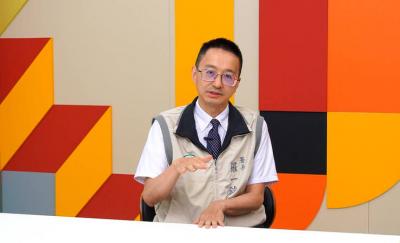
Taiwan’s two cases of hantavirus so far this year are on par with previous years’ case numbers, and the government is coordinating rat extermination work, so there should not be any outbreaks, Centers for Disease Control (CDC) Director-General Philip Lo (羅一鈞) said today in an interview with the Liberty Times (the Taipei Times’ sister newspaper). An increase in rat sightings in Taipei and New Taipei City has raised concerns about the spread of hantavirus, as rats can carry the disease. In January, a man in his 70s who lived in Taipei’s Daan District (大安) tested positive posthumously for hantavirus, Taiwan’s
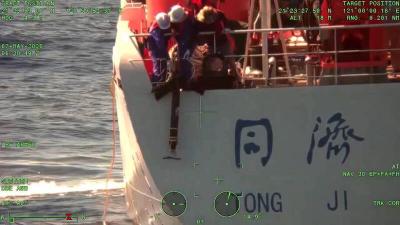
The coast guard today said that it had disrupted "illegal" operations by a Chinese research ship in waters close to the nation and driven it away, part of what Taipei sees a provocative pattern of China's stepped up maritime activities. The coast guard said that it on Thursday last week detected the Chinese ship Tongji (同濟號), which was commissioned only last year, 29 nautical miles (54km) southeast of the southern tip of Taiwan, although just outside restricted waters. The ship was observed lowering ropes into the water, suspected to be the deployment of scientific instruments for "illegal" survey operations, and the coast


 RSS
RSS