


President Chen Shui-bian's (
"No matter what China's decision is, Taiwan's unchanging policy objective aims to achieve peace and stability, as well as mutually beneficial development, across the Taiwan Strait," Mainland Affairs Council Chairman Joseph Wu (
"However, the extension of goodwill is a two-way process ... and no sound can come from one hand clapping," Wu said.
The president late Monday night called off the live-fire military drills scheduled for Sept. 9 following reports that Chinese authorities had withdrawn soldiers from China's military exercises on Dongshan Island. Dongshan Island, located just 277km west of Taiwan's Penghu Island, has been the site of several simulated invasions of Taiwan in the past.
While reiterating Taiwan's goodwill in canceling military exercises, Wu nevertheless cautioned that the China's military expansion was "astonishing."
"Despite all this, I still have to remind the Taiwanese people that the rate of modernization of China's military forces is astonishing, and in this aspect the structure of the military has not changed -- China's military capabilities surpass what is necessary for defense," Wu said.
"China continues to intensify its `three types of warfare' -- the so-called propaganda, psychological and legal warfare on Taiwan. Thus, increasing Taiwan's defensive capabilities is an important aspect of the government's work. Only by maintaining a [military] balance can we evade the incentive to attack," Wu continued, saying that once initiated, military engagement cannot be retracted.
Wu further pointed to the important role that confidence building measures could play in the prevention of inadvertant military conflict across the Taiwan Strait.
"This would include the rejection of first strike attacks by both sides, mutual notification of planned military drills, transparency of deployment plans, the establishment of a hotline, demilitarized zones, etc. The end goal is to sign a peace treaty with China," Wu said, calling for the resumption of negotiations.
Minister of National Defense Lee Jye (
According to Lee, he met with the president at 8:30pm on Monday before the president's departure and Chen asked for his opinion regarding the cancelation of the exercise.
"Acting in accordance with or information, the president decided to call [the drills] off, and I supported his proposal, so we did," Lee said. "As the president said, we would like to show our sincerety in maintaining peace in the Taiwan Strait."
In addition, Lee also denied that the US was involved in Taiwan's decision to cancel its live-fire exercises.
"I assure you that the US has nothing to do with this. Nobody forced us to do anything," Lee added.
Regarding the president's statement that Taiwan decided to cancel the exercises as a gesture of good will for the Chinese military's canceling of its live-fire exercises in Dongshan Island, Lee would not confirm that the Chinese military did in fact "cancel" its exercises.
"Our investigation shows that they [the Chinese military] are withdrawing their troops from the island. We take that as a sign of good will," Lee said.
The live-fire exercise was to be the climax of the annual Han Kuang exercises and the president was to join the event in person. In this year's drill, the live-fire exercise was initially scheduled for Aug. 25.
In addition to the invitation to all military affairs reporters, the Ministry of National Defense also invited news directors and editors-in-chief from local news agencies to join the show, along with the president.
However, the exercise was postponed until Sept. 9 due to Typhoon Aere last week.
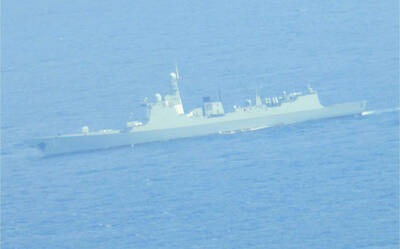
The military has spotted two Chinese warships operating in waters near Penghu County in the Taiwan Strait and sent its own naval and air forces to monitor the vessels, the Ministry of National Defense (MND) said. Beijing sends warships and warplanes into the waters and skies around Taiwan on an almost daily basis, drawing condemnation from Taipei. While the ministry offers daily updates on the locations of Chinese military aircraft, it only rarely gives details of where Chinese warships are operating, generally only when it detects aircraft carriers, as happened last week. A Chinese destroyer and a frigate entered waters to the southwest
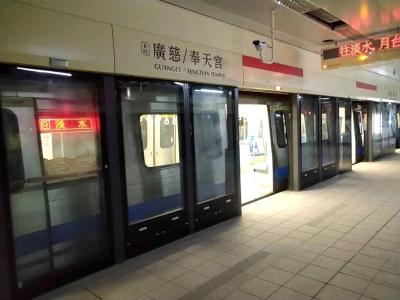
The eastern extension of the Taipei MRT Red Line could begin operations as early as late June, the Taipei Department of Rapid Transit Systems said yesterday. Taipei Rapid Transit Corp said it is considering offering one month of free rides on the new section to mark its opening. Construction progress on the 1.4km extension, which is to run from the current terminal Xiangshan Station to a new eastern terminal, Guangci/Fengtian Temple Station, was 90.6 percent complete by the end of last month, the department said in a report to the Taipei City Council's Transportation Committee. While construction began in October 2016 with an
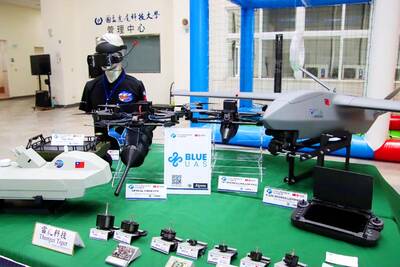
NON-RED SUPPLY: Boosting the nation’s drone industry is becoming increasingly urgent as China’s UAV dominance could become an issue in a crisis, an analyst said Taiwan’s drone exports to Europe grew 41.7-fold from 2024 to last year, with demand from Ukraine’s fight against Russian aggression the most likely driver of growth, a study showed. The Institute for Democracy, Society and Emerging Technology (DSET) in a statement on Wednesday said it found that many of Taiwan’s uncrewed aerial vehicle (UAV) sales were from Poland and the Czech Republic. These countries likely transferred the drones to Ukraine to aid it in its fight against the Russian invasion that started in 2022, it said. Despite the gains, Taiwan is not the dominant drone exporter to these markets, ranking second and fourth
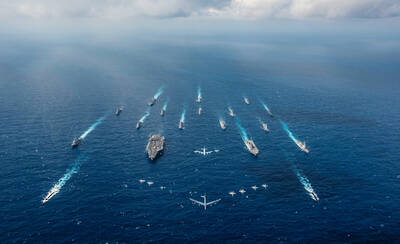
Japanese Prime Minister Sanae Takaichi’s comment last year on Tokyo’s potential reaction to a Taiwan-China conflict has forced Beijing to rewrite its invasion plans, a retired Japanese general said. Takaichi told the Diet on Nov. 7 last year that a Chinese naval blockade or military attack on Taiwan could constitute a “survival-threatening situation” for Japan, potentially allowing Tokyo to exercise its right to collective self-defense. Former Japan Ground Self-Defense Force general Kiyofumi Ogawa said in a recent speech that the remark has been interpreted as meaning Japan could intervene in the early stages of a Taiwan Strait conflict, undermining China’s previous assumptions


 RSS
RSS