


Ahead of former US President Ronald Reagan's state funeral in Washington today, government officials, diplomats and the people of Taiwan paid respects to the Taiwan-friendly US leader by signing a book of condolences provided by the American Cultural Center in Taipei yesterday.
The Ministry of Foreign Affairs released a statement praising Reagan's long-time support for Taiwan's democracy.
"Mr. Reagan was a firm friend of all democracies. Our government and people deeply regret the passing away of the former US president," the statement said. "President Chen Shui-bian (
The ministry has decided to send Control Yuan President Frederick Chien (
"Chien has a close relationship with the US and had opportunities to meet Reagan on many occasions. He is the right person to represent Taiwan to join Reagan's funeral," Vice Minister of Foreign Affairs Michael Kau said after signing the book of condolences.
Chien and his wife departed for Washington yesterday afternoon.
Chen Chien-jen (
Kau described the "Six Assurances," which the Reagan administration gave Taipei in July 1982, as one of the most important milestones in Taiwan-US relations.
In the Six Assurances, the Reagan administration promised Taiwan that it would not set a date for the ending of arms sales to Taiwan; not consult with China on arms sales; not play a mediation role between the People's Republic of China (PRC) and Taiwan; not revise the Taiwan Relations Act; change its position regarding sovereignty over Taiwan; nor exert pressure on Taipei to enter into negotiations with Beijing.
The Six Assurances came as the Reagan administration's efforts to soften the blow to Taiwan after the US and China signed the 817 Communique, which called for a reduction of US arms sales to Taiwan.
Judith Mudd-Krijgelmans, spokesperson for the American Institute in Taiwan, thanked Kau for the ministry's condolence.
"We will always remember the `Great Communicator,' especially for his support for US public diplomacy," Judith wrote in the book of condolences of her memory of the victor of the Cold War, one of whose most famous quotes is "the march of freedom and democracy will leave Marxism-Leninism on the ash heap of history."
Reagan visited Taiwan twice during the 1970s. On Oct. 9, 1971, Reagan, then the governor of California, arrived at Taipei as former US President Richard Nixon's special representative to attend the Republic of China's (ROC) National Day celebrations on Oct. 10.
Reagan, accompanied by his wife. Nancy Reagan, said upon arrival in Taipei that he carried a message of good will from Nixon to Chiang Kai-shek (
In 1978, one year before the US switched recognition from Taipei to Beijing, Reagan again visited Taipei by invitation of Koo Chen-fu (辜振甫), now chairman of the Straits Exchange Foundation, to deliver a speech at a conference hosted by the Sino-American Cultural and Economic Association.
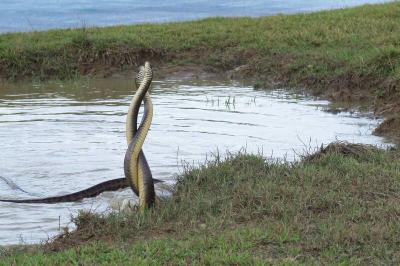
Kenting National Park service technician Yang Jien-fon (楊政峰) won a silver award in World Grand Prix Photography Awards Spring Season for his photograph of two male rat snakes intertwined in combat. Yang’s colleagues at Kenting National Park said he is a master of nature photography who has been held back by his job in civil service. The awards accept entries in all four seasons across six categories: architectural and urban photography, black-and-white and fine art photography, commercial and fashion photography, documentary and people photography, nature and experimental photography, and mobile photography. Awards are ranked according to scores and divided into platinum, gold and
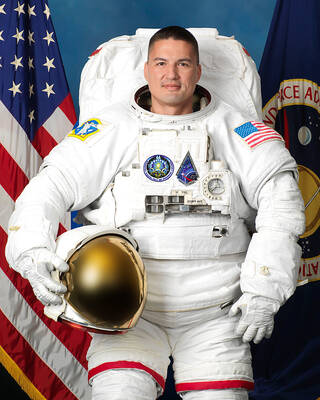
SPACE VETERAN: Kjell N. Lindgren, who helps lead NASA’s human spaceflight missions, has been on two expeditions on the ISS and has spent 311 days in space Taiwan-born US astronaut Kjell N. Lindgren is to visit Taiwan to promote technological partnerships through one of the programs organized by the US for its 250th national anniversary. Lindgren would be in Taiwan from Tuesday to Saturday next week as part of the US Bureau of Educational and Cultural Affairs’ US Speaker Program, organized to celebrate the 250th anniversary of the signing of the Declaration of Independence, the American Institute in Taiwan (AIT) said in a statement yesterday. Lindgren plans to engage with key leaders across the nation “to advance cutting-edge technological partnerships and inspire the next generation of scientists and engineers,”

The Chinese Nationalist Party (KMT) caucus yesterday said it opposes the introduction of migrant workers from India until a mechanism is in place to prevent workers from absconding. Minister of Labor Hung Sun-han (洪申翰) on Thursday told the Legislative Yuan that the first group of migrant workers from India could be introduced as early as this year, as part of a government program. The caucus’ opposition to the policy is based on the assessment that “the risk is too high,” KMT caucus secretary-general Lin Pei-hsiang (林沛祥) said. Taiwan has a serious and long-standing problem of migrant workers absconding from their contracts, indicating that
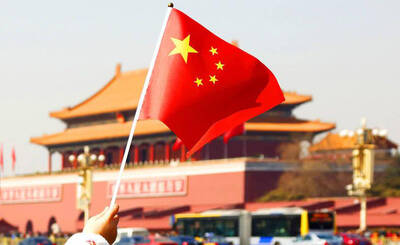
TRADE-OFF: Beijing seeks to trade a bowl of tempura for a Chinese delicacy, an official said, while another said its promises were attempts to interfere in the polls The government must carefully consider the national security implications of building a bridge connecting Kinmen County and Xiamen, China, the Public Construction Commission (PCC) said yesterday. PCC Commissioner Derek Chen (陳金德), who is also a minister without portfolio, made the remarks in a meeting of the legislature’s Transportation Committee, after Democratic Progressive Party Legislator Hsu Fu-kuei (徐富癸) asked about China’s proposal of new infrastructure projects to further connect Kinmen and Lienchiang (Matsu) counties with Xiamen. China unveiled the bridge plan, along with nine other policies for Taiwan, on Sunday, the last day of Chinese Nationalist Party (KMT) Chairwoman Cheng Li-wun’s (鄭麗文) visit


 RSS
RSS