

The highest decision-making body of the Chinese Nationalist Party (KMT) yesterday approved Chairman Lien Chan's (連戰) proposal to push for a merger with the People First Party (PFP).
"After an enthusiastic meeting discussion, the proposal was unanimously approved by all members of the Central Standing Commit-tee," Lien said at a news conference held following a three-hour closed-door committee meeting.
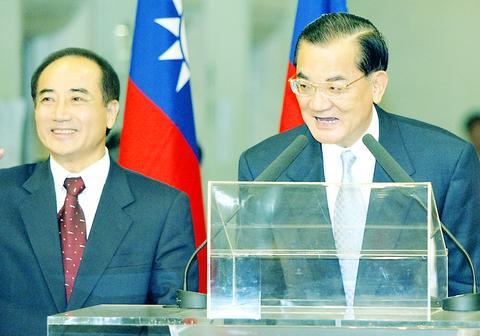
PHOTO: LIN CHENG-FANG, TAIPEI TIMES
The KMT's vice chairmen and a number of committee members attended the press conference.
Without elaborating on details of the merger plan, such as whether he or PFP Chairman James Soong (宋楚瑜) would lead the merged party, Lien said that he and Soong would assemble a task force to facilitate the merger.
Soong, a former KMT member, created the PFP after he lost the 2000 presidential election, in which had run as an independent candidate after failing to win the KMT's nomination. Most of the PFP's founding members were KMT defectors.
Lien said the KMT's organization department will hold seminars for grassroots party members to exchange views concerning this matter.
"Once consensus is established, the merger plan will be forwarded to the upcoming national party congress for approval and confirmation," Lien said.
The party congress is scheduled for July.
Stressing that "Taiwan must continue to strengthen and consolidate an all-people politics that is centrist, rational, tolerant and diverse," Lien said that it was according to such ideals that "the KMT and the PFP, on the existing base of cooperation, are working toward a merger, which is the expectation and will of the majority of the public."
Lien's announcement was greeted with cheers and applause from a crowd of pan-blue supporters who had gathered in lobby of the KMT's national headquarters. Some of the supporters waved national flags or held up homemade posters that read "Go, go! Lien Chan."
When asked by reporters about a timetable for the merger, Lien said "the sooner the better."
KMT Secretary-General Lin Fong-cheng (林豐正) had on Tuesday said that the merger would be more meaningful if the deal could be finalized ahead of the year-end legislative elections.
Emphasizing that he is not opposed to the merger plan, KMT Legislator Hsu Chong-hsiung (徐中雄), a member of the Central Standing Committee, said "proper logistics" must be upheld in working on the merger.
Hsu said that several other committee members shared his view that the party ought to allow open debate on the issue and leave it to a vote among party members.
Meanwhile, Soong told reporters yesterday said that the merger would provide the people of Taiwan with another option.
Soong, however, also said that the KMT needs to tackle many issues, including "localization," party assets, "black gold" politics and internal power struggles.
Soong's remarks were echoed by PFP legislators.
"There are some KMT legislators who went missing during the presidential election campaign, but came back to criticize their party afterwards. We also have to watch [former president] Lee Teng-hui's (李登輝) past connections in the KMT. It's those [people] from the localization faction who are damaging the party's image," said PFP caucus whip Hsieh Chang-chieh (謝章捷).
"The merger is not just about the two parties or a few individuals but rather the whole opposition. Chairman Lien has to act tough and clear out those who are trying to split the party. Those who wish to go should be allowed to go. If that doesn't happen, the merger would be a marriage between a disciplined and well-respected PFP and a corrupted KMT," Hsieh said.
"The KMT and the PFP are not merging for the sake of merging. So the they have to reflect first on whether the merger is good for the Taiwanese people, national development and the pan-blue supporters," said Chang Hsien-yao (張顯耀), director of the PFP Policy Research Center.
"Before the merger, the KMT needs to deal with `black gold' politics, differing party-development ideas and party assets," Chang said.
"Plus Lee Teng-hui is trying to `TSU-ize' the KMT, and the KMT should first clear out the so-called `localization' faction or Lee's people," Chang said.
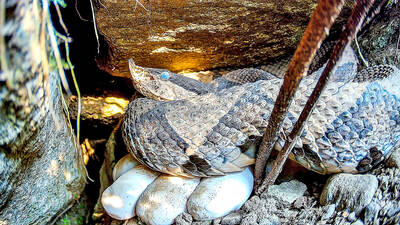
NATURE TAKES ITS COURSE: The agency’s head said he felt a sense of loss watching red-banded snakes eat the babies, as they had decided on non-intervention The Forestry and Nature Conservation Agency yesterday released a documentary on a hundred-pace viper that had incubated 16 eggs, all of which hatched, but only a baby viper escaped after they were attacked by red-banded snakes. The agency’s Taichung branch last year launched the viper reproduction monitoring project soon after forest rangers Lin Chun-yu (林俊佑) and Chou Chia-cheng (周家成) spotted a pregnant hundred-pace viper in a grass-covered burrow near a parking lot in Tbulan Village (松鶴部落). The Atayal village, in Taichung’s Heping District (和平), is headed by Ecyang Yapu, who was positive about the project and assisted in access control and power
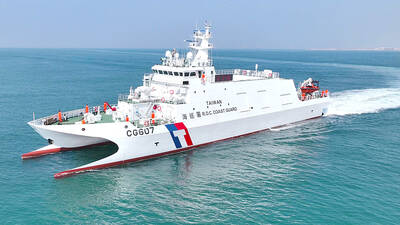
The Coast Guard Administration (CGA) yesterday said that it had deployed vessels to “monitor” Chinese ships operating in waters off the east coast. The CGA said it dispatched vessels in response to a China Coast Guard announcement that it had carried out another “routine law-enforcement patrol” in waters off the east coast. “The CGA firmly rejects China’s cognitive warfare campaign of ‘law enforcement in name, jurisdictional expansion in practice,’” it said on X. As of 11am yesterday, two China Coast Guard ships were “loitering and drifting” about 105 nautical miles (195km) and 74 nautical miles east of Green Island (綠島) respectively, it said. It
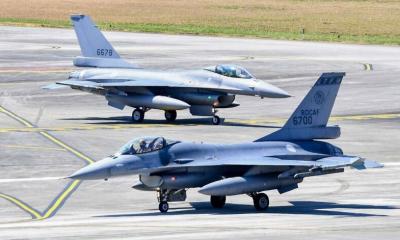
The first two F-16V Block 70 jets Taiwan purchased from the US were spotted unexpectedly turning back after departing from Hawaii yesterday, potentially further delaying delivery of the aircraft. Taiwan has purchased 66 of the F-16 C/D Block 70 jets to be deployed at Chihhang Air Base (志航基地) in Taitung County and operated by the air force's 7th Tactical Fighter Wing to defend Taiwan’s eastern region. Two single-seat jets, bearing serial No. 6727 and 6728, were spotted taking off from Hickam Field in Hawaii yesterday, observers said. Based on the precedent set during the delivery of Taiwan's older F-16 Block 20s, the new
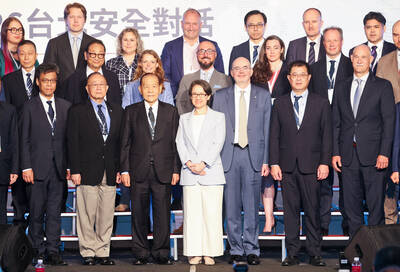
Taiwan’s growing defense preparations might be sending a stronger signal to the US than to Beijing, highlighting the need for Taipei to tailor its deterrence efforts to different audiences, a US security academic said yesterday. Stanford University Freeman Spogli Institute for International Studies fellow Oriana Skylar Mastro made the comment during a Taipei Security Dialogue panel examining lessons Taiwan could draw from the wars in Ukraine and the Middle East. Mastro said she was impressed by Taiwan’s increased defense spending, emphasis on asymmetric capabilities and efforts to prepare society for conflict, but questioned whom those initiatives were influencing. She said when she asked


 RSS
RSS