


President Chen Shui-bian (陳水扁) will give details of the constitutional reform agenda slated for 2006 in his inauguration speech tomorrow, Mainland Affairs Council chairman-designate Joseph Wu (吳釗燮) said yesterday.
Wu, currently deputy secretary-general of the Presidential Office, said during a news conference for foreign reporters covering the inauguration that reforming the government structure and the legislature will be key issues the new constitution aims to deal with.
The strong worded statement on Taiwan which Beijing issued on Monday, condemning Chen's alleged separatists actions such as referendums and calling for a new constitution, shows that China does not understand Taiwan's democratization process, Wu said.
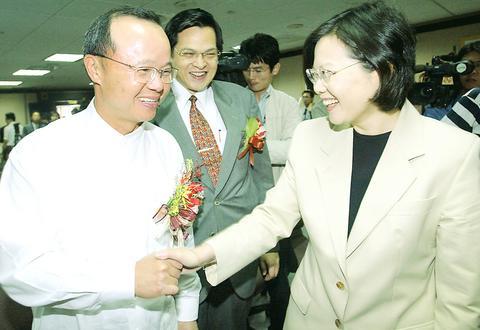
PHOTO: CNA
According to Wu, the current five-branch system of government has not functioned efficiently and needs to be changed.
When asked whether Chen will repeat his "five noes" pledge in tomorrow's speech, Wu said Chen's inaugural address will follow the spirit of the one he made four years ago
Voicing concern about the escalation of China's military power, Wu said Taiwan needs to strengthen its own military capacity by procuring more weapons and cooperating with the US.
China has been developing and modernizing its air and naval forces and purchasing arms from Russia, Wu said, noting in China and Taiwan's case, "the stronger side may be tempted to use military force against the weaker side."
He said while misunderstandings between Beijing and Taipei exist, some of his academic friends in China, who advise the Chinese leadership about Taiwan, have been frustrated because they frequently discover that their reports have been revised by government officials reviewing the documents.
By the time the reports reach the top officials, they're unrecognizable from the original, he said.
Wu said Taiwan's independence is not an issue for the people of Taiwan, who elect their own president and legislature.
Every aspect of Taiwan will prove it an "exclusive jurisdiction," he said.
Meanwhile, outgoing council chairperson Tsai Ing-wen (
The council held yesterday a farewell tea party for its three outgoing officials, Tsai and vice chairmen Chen Ming-tong (
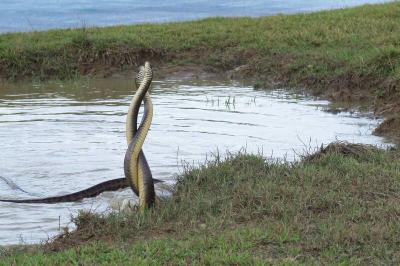
Kenting National Park service technician Yang Jien-fon (楊政峰) won a silver award in World Grand Prix Photography Awards Spring Season for his photograph of two male rat snakes intertwined in combat. Yang’s colleagues at Kenting National Park said he is a master of nature photography who has been held back by his job in civil service. The awards accept entries in all four seasons across six categories: architectural and urban photography, black-and-white and fine art photography, commercial and fashion photography, documentary and people photography, nature and experimental photography, and mobile photography. Awards are ranked according to scores and divided into platinum, gold and
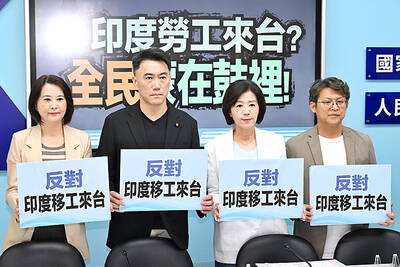
The Chinese Nationalist Party (KMT) caucus yesterday said it opposes the introduction of migrant workers from India until a mechanism is in place to prevent workers from absconding. Minister of Labor Hung Sun-han (洪申翰) on Thursday told the Legislative Yuan that the first group of migrant workers from India could be introduced as early as this year, as part of a government program. The caucus’ opposition to the policy is based on the assessment that “the risk is too high,” KMT caucus secretary-general Lin Pei-hsiang (林沛祥) said. Taiwan has a serious and long-standing problem of migrant workers absconding from their contracts, indicating that
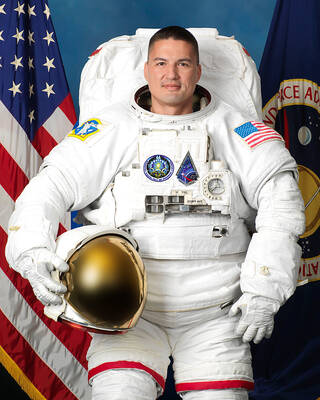
SPACE VETERAN: Kjell N. Lindgren, who helps lead NASA’s human spaceflight missions, has been on two expeditions on the ISS and has spent 311 days in space Taiwan-born US astronaut Kjell N. Lindgren is to visit Taiwan to promote technological partnerships through one of the programs organized by the US for its 250th national anniversary. Lindgren would be in Taiwan from Tuesday to Saturday next week as part of the US Bureau of Educational and Cultural Affairs’ US Speaker Program, organized to celebrate the 250th anniversary of the signing of the Declaration of Independence, the American Institute in Taiwan (AIT) said in a statement yesterday. Lindgren plans to engage with key leaders across the nation “to advance cutting-edge technological partnerships and inspire the next generation of scientists and engineers,”
TRADE-OFF: Beijing seeks to trade a bowl of tempura for a Chinese delicacy, an official said, while another said its promises were attempts to interfere in the polls The government must carefully consider the national security implications of building a bridge connecting Kinmen County and Xiamen, China, the Public Construction Commission (PCC) said yesterday. PCC Commissioner Derek Chen (陳金德), who is also a minister without portfolio, made the remarks in a meeting of the legislature’s Transportation Committee, after Democratic Progressive Party Legislator Hsu Fu-kuei (徐富癸) asked about China’s proposal of new infrastructure projects to further connect Kinmen and Lienchiang (Matsu) counties with Xiamen. China unveiled the bridge plan, along with nine other policies for Taiwan, on Sunday, the last day of Chinese Nationalist Party (KMT) Chairwoman Cheng Li-wun’s (鄭麗文) visit


 RSS
RSS