


The organizers of the 228 Hand-in-Hand Rally yesterday held hands once again along with several non-governmental organizations to call on the World Health Organization (WHO) to grant Taiwan observer status in the health body.
Meanwhile, the WHO stated that the new accreditation procedures which will bar Taiwanese reporters from the upcoming World Health Assembly (WHA) were not created under Chinese influence.
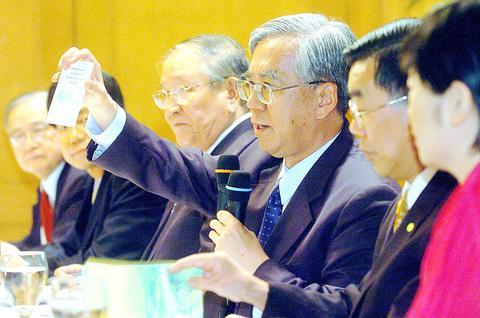
PHOTO: SEAN CHAO, TAIPEI TIMES
accreditation
While the office responsible for the accreditation process, the UN Department of Public Information, stated on Tuesday that reporters holding Taiwanese passports would not be granted press passes to the WHA, department official Katherine Segli yesterday further said that the newspaper also had to be headquartered in a UN member state for accreditation.
According to Segli, if the journalist seeking accreditation holds a passport from a UN member state but writes for a newspaper headquartered in Taiwan, then accreditation could not be granted.
At the same time, a Taiwanese passport is grounds for the rejection of accreditation application, no matter which publication the journalists work for.
In light of the new policies, several political leaders cautioned that excluding Taiwan from the WHO was "health apartheid."
"Infectious diseases will not stop at Taiwan's borders, nor will infectious diseases be confined to Taiwan," chief organizer Ng Chiau-tong (
The Feb. 28 Hand-in-Hand Rally saw the formation of a 500km human chain to symbolize the protection of Taiwan from Chinese missiles.
"Many people say that gaining observer status for Taiwan is a `mission impossible,' but the 228 rally was mission impossible as well. But it was accomplished in the end," said Lin Shih-chia (
Ng said that Taiwan's population surpassed that of at least three-fourths of the WHO members.
Linking hands
Raising linked hands, the 228 Hand in Hand Rally planners said in unison, "Say Yes to Taiwan, Say No to China."
According to the Medical Professionals' Alliance, a total of 71 people representing at least 10 organizations will be heading for Geneva to support Taiwan's bid.
Representatives including Presidential advisor Chen Lung-chu (陳隆志) and General Secretary of the Presbyterian Church in Taiwan Reverend William J.K. Lo (羅榮光), departed for Europe yesterday in a last-minute effort to garner support for Taiwan's application for observer status.
The Ministry of Foreign Affairs (MOFA) also said yesterday that several media groups, including the Geneva Association of United Nations Correspondents (ACANU), said they support the accreditation of Taiwanese reporters.
policy changes
Recent policy changes made public on Tuesday by the UN Department of Public Information on the accreditation process to obtain press passes for covering the WHA will bar Taiwanese passport holders from entry into the assembly building.
While WHO spokesman Iain Simpson yesterday said that China had not had a hand in creating the new regulations, MOFA spokesman Richard Shih (
Shih also said that it does not bode well for Taiwan that this year's WHA president hails from Pakistan, a country that has traditionally been supportive of China's policies and that could turn the vote against Taiwan.
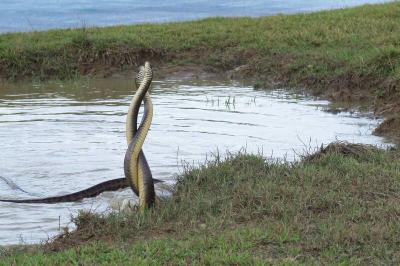
Kenting National Park service technician Yang Jien-fon (楊政峰) won a silver award in World Grand Prix Photography Awards Spring Season for his photograph of two male rat snakes intertwined in combat. Yang’s colleagues at Kenting National Park said he is a master of nature photography who has been held back by his job in civil service. The awards accept entries in all four seasons across six categories: architectural and urban photography, black-and-white and fine art photography, commercial and fashion photography, documentary and people photography, nature and experimental photography, and mobile photography. Awards are ranked according to scores and divided into platinum, gold and

SPACE VETERAN: Kjell N. Lindgren, who helps lead NASA’s human spaceflight missions, has been on two expeditions on the ISS and has spent 311 days in space Taiwan-born US astronaut Kjell N. Lindgren is to visit Taiwan to promote technological partnerships through one of the programs organized by the US for its 250th national anniversary. Lindgren would be in Taiwan from Tuesday to Saturday next week as part of the US Bureau of Educational and Cultural Affairs’ US Speaker Program, organized to celebrate the 250th anniversary of the signing of the Declaration of Independence, the American Institute in Taiwan (AIT) said in a statement yesterday. Lindgren plans to engage with key leaders across the nation “to advance cutting-edge technological partnerships and inspire the next generation of scientists and engineers,”

The Chinese Nationalist Party (KMT) caucus yesterday said it opposes the introduction of migrant workers from India until a mechanism is in place to prevent workers from absconding. Minister of Labor Hung Sun-han (洪申翰) on Thursday told the Legislative Yuan that the first group of migrant workers from India could be introduced as early as this year, as part of a government program. The caucus’ opposition to the policy is based on the assessment that “the risk is too high,” KMT caucus secretary-general Lin Pei-hsiang (林沛祥) said. Taiwan has a serious and long-standing problem of migrant workers absconding from their contracts, indicating that

TRADE-OFF: Beijing seeks to trade a bowl of tempura for a Chinese delicacy, an official said, while another said its promises were attempts to interfere in the polls The government must carefully consider the national security implications of building a bridge connecting Kinmen County and Xiamen, China, the Public Construction Commission (PCC) said yesterday. PCC Commissioner Derek Chen (陳金德), who is also a minister without portfolio, made the remarks in a meeting of the legislature’s Transportation Committee, after Democratic Progressive Party Legislator Hsu Fu-kuei (徐富癸) asked about China’s proposal of new infrastructure projects to further connect Kinmen and Lienchiang (Matsu) counties with Xiamen. China unveiled the bridge plan, along with nine other policies for Taiwan, on Sunday, the last day of Chinese Nationalist Party (KMT) Chairwoman Cheng Li-wun’s (鄭麗文) visit


 RSS
RSS