


Attorneys for The Journalist magazine yesterday tried to persuade Supreme Court judges that the Constitution covers both criminal and civil cases, while Vice Presi-dent Annette Lu's (
To decide whether the verdict of the libel suit brought by Lu against The Journalist should be upheld or the Taiwan High Court should rehear it, the Supreme Court's Civil Department yesterday held a debate for the two sides' lawyers to defend their arguments and try to persuade five Supreme Court Judges -- Lin Chi-fu (
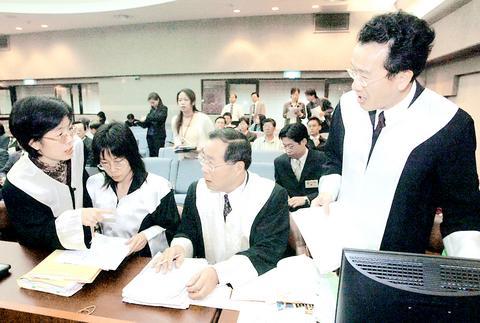
PHOTO: TAIPEI NEWS PHOTOGRAPHER ASSOCIATION
Lu sued the magazine for publishing a story in November 2000 that said she had called its editor-in-chief to spread a rumor that President Chen Shui-bian (陳水扁) was having an affair with one of his aides.
The judges did not summon Lu or any of the defendants, but the magazine's president, Wang Chien-chuang (
Lu's five attorneys are all familiar faces who have frequently defended the Democratic Progressive Party (DPP) and its members, including Wellington Koo (
Koo and Hung are also repre-senting the DPP in the lawsuit brought by the Chinese Nationalist Party (KMT)-People First Party alliance requesting a recount of the March 20 election ballots.
The Journalist was represented by Lo Ming-tung (
Lo said that Articles 11 and 22 of the Constitution should cover the case and that was why the magazine decided to appeal the verdict.
Article 11 states, "The people shall have freedom of speech, teaching, writing and publication."
Article 22 says, "All other freedoms and rights of the people that are not detrimental to social order or public welfare shall be guaranteed under the Constitution."
"Reporters are responsible for reporting, not investigating," Lo said.
Lo also declared: "It is impossible for reporters to come up with `100 percent accurate' stories."
"The plaintiff's civil claim could sink the entire magazine since it is quite impossible for it to afford the claim," he said.
In response to Lo's arguments, Koo said his client's bottom line was the demand for an apology.
"Our major argument is to ask for a proper apology. That is all," Koo said.
"We know that the defendants may not be able afford so much, but the second verdict by the high court has marginalized the penalty, did it not? We are merely requesting the defendants to make it up to Lu for the damage they have done," he said.
The debate lasted nearly two and a half hours, but the atmosphere was calm.
Lin, the presiding judge, said that a decision would be announced tomorrow at 10am.
According to Lu's original civil claim, which was upheld by the district court, the defendants -- Wang, editor-in-chief Yang Chao (
The cost of printing such clarifications has been estimated at NT$180 million.
The Taiwan High Court reduced the penalty and ruled that the defendants only needed to buy half-page ads on the front pages of four major Chinese-language newspapers to publish a clarification for one day. That would cost about NT$3.86 million.
The court ruled the clarification did not have to be aired over the radio and TV for three days, taking into account the defendants' in- ability to pay for such a large amount of air time.

Actor Darren Wang (王大陸) was sentenced to six months in prison, commutable to a fine, by the New Taipei District Court today for contravening the Personal Data Protection Act (個人資料保護法) in a case linked to an alleged draft-dodging scheme. Wang allegedly paid NT$3.6 million (US$114,380) to an illegal group to help him evade mandatory military service through falsified medical documents, prosecutors said. He transferred the funds to Chen Chih-ming (陳志明), the alleged mastermind of a draft-evasion ring, although he lost contact with him as he was already in detention on fraud charges, they said. Chen is accused of helping a

SECURITY: Starlink owner Elon Musk has taken pro-Beijing positions, and allowing pro-China companies to control Taiwan’s critical infrastructure is risky, a legislator said Starlink was reluctant to offer services in Taiwan because of the nation’s extremely high penetration rates in 4G and 5G services, the Ministry of Digital Affairs said yesterday. The ministry made the comments at a meeting of the legislature’s Transportation Committee, which reviewed amendments to Article 36 of the Telecommunications Management Act (電信管理法). Article 36 bans foreigners from holding more than 49 percent of shares in public telecommunications networks, while shares foreigners directly and indirectly hold are also capped at 60 percent of the total, unless specified otherwise by law. The amendments, sponsored by Chinese Nationalist Party (KMT) Legislator Ko

The eastern extension of the Taipei MRT Red Line could begin operations as early as late June, the Taipei Department of Rapid Transit Systems said yesterday. Taipei Rapid Transit Corp said it is considering offering one month of free rides on the new section to mark its opening. Construction progress on the 1.4km extension, which is to run from the current terminal Xiangshan Station to a new eastern terminal, Guangci/Fengtian Temple Station, was 90.6 percent complete by the end of last month, the department said in a report to the Taipei City Council's Transportation Committee. While construction began in October 2016 with an

NON-RED SUPPLY: Boosting the nation’s drone industry is becoming increasingly urgent as China’s UAV dominance could become an issue in a crisis, an analyst said Taiwan’s drone exports to Europe grew 41.7-fold from 2024 to last year, with demand from Ukraine’s fight against Russian aggression the most likely driver of growth, a study showed. The Institute for Democracy, Society and Emerging Technology (DSET) in a statement on Wednesday said it found that many of Taiwan’s uncrewed aerial vehicle (UAV) sales were from Poland and the Czech Republic. These countries likely transferred the drones to Ukraine to aid it in its fight against the Russian invasion that started in 2022, it said. Despite the gains, Taiwan is not the dominant drone exporter to these markets, ranking second and fourth


 RSS
RSS