


The unpolluted, turquoise ocean surrounding the Marshall Islands will be what Li Shr-jie (黎世傑), who joined the alternative diplomatic-service program two years ago, misses most when he is due to leave the Pacific island nation in the middle of March.
Li, a graduate from National Taiwan University's Department of Horticulture, chose to enroll the program, a substitute for compulsory military service, because he wanted to go to Latin American countries.
When Li was informed he would be dispatched to the Marshall Islands, one of Taiwan's five allies in the Pacific, his parents were worried he could not cope with life in such a remote country.
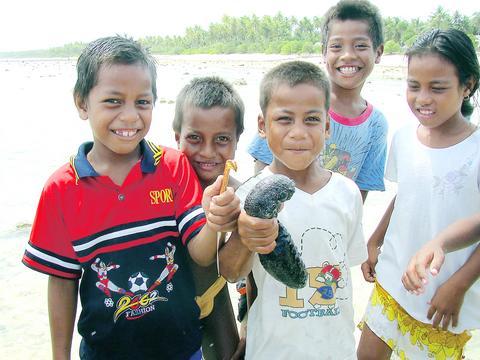
PHOTO: MELODY CHEN, TAIPEI TIMES
"When I first came here, I had fever several times. I felt particularly lonely and bored at night," said the 26-year-old serviceman.
The alternative diplomatic-service program had proved daunting to some who signed up for it.
"When the countries we were to be sent were announced, six of the 41 boys volunteering to join it withdrew," Li said.
The government's International Cooperation and Development Fund, which coordinates the program, usually deploys servicemen to Taiwan's 27 diplomatic allies to assist local workers.
Since Li arrived on the Marshall Islands in November 2002, he has been working with Taiwan's Technical Mission in the country.
Li's daily routine includes supervising workers in the field in the mission's compound, where a five-person agricultural team, including Li, grows various kinds of fruits and vegetables and raises pigs.
Li also helps with the mission's paperwork. In his leisure time, he often goes fishing, plays basketball and visits downtown Majuro, the Marshall Islands' capital.
"I also keep two dogs," he said.
Having picked up some simple words in the local tongue, Li said he would miss his friends in the Marshall Islands when his term finishes in March.
"They love to make friends," Li said of local residents.
The technical mission arrived in August 1999 after Taiwan established diplomatic ties with the Marshall Islands in November 1998.
The Marshall Islands government allotted about three hectares of land for the technical mission.
The mission has developed roughly one hectare to grow crops and build pigsties, according to the leader of the mission, Cheng Ming-ching (鄭明欽).
An agricultural expert from Hualien, Cheng had never joined a foreign mission before going to the Marshall Islands.
"Though the soil and climate in this country are different from that of Taiwan, I don't find it difficult to get used to life here," said Cheng, whose family has moved with him to the Marshall Islands.
People in the Marshall Islands had virtually no agricultural development before the arrival of Taiwan's technical mission.
"This country has very few natural resources and government budgets for agriculture are limited," Cheng said.
Through the mission's help, 50 households in the country have turned to farming and found the results satisfying, according to Cheng.
"Local farmers find their lives improved. They get the money to furnish their houses and are able to purchase refrigerators and television sets," Cheng said.
The mission developed agriculture on the Marshall Islands from nothing, Cheng said.
The situation of starting from scratch is now faced by Michael Lu (呂瑞源), leader of Taiwan's Technical Mission to Kiribati, Taiwan's newest ally.
Lu, who followed Minister of Foreign Affairs Eugene Chien's (簡又新) delegation to Kiribati earlier this month, will be starting agricultural work in a compound that used be home to a satellite station of China's.
Many cooperation programs between Kiribati and Taiwan have begun, Samuel Chen (陳世良), Taiwan's ambassador to Kiribati, said during Chien's visit there.
A local media agency, the Broadcasting and Publications Authority, which ran a story on the opening of Taiwan's embassy in Kiribati, is seeking assistance to improve its printing technology.
The agency consists of a publication manager, an editor, an assistant editor, two reporters, two printers and one typist.
The main function of the agency is to "produce a weekly bilingual newspaper aiming at informing local readers about a variety of events and issues that occur within the community, the government, the Pacific region and the world," said Tibewere Bobo, the publication manager.
The agency produces a weekly called Te Uekera meaning "The Tree of Knowledge."

UPGRADE: The Kang Ding-class frigate is replacing its Chaparall missiles with Tien Chien II and Hua Yang VLS, which would provide it with long-range, 360° air defense Taiwan plans to produce 1,200 to 1,376 Hai Chien II missiles (海劍二, Sea Sword II) — also known as TC-2N — to serve as the standard air defense system of the navy’s surface combatant fleet, a source said yesterday. Last week, the Hai Chien II, the naval version of the Tien Kung II missile (天劍二, Sky Sword II), completed a live-fire test in waters off the National Chungshan Institute of Science and Technology’s Jiupeng facility (九鵬) in Pingtung County’s Manjhou Township (滿州). The MIM72 Chaparral and other dated air defense missiles that currently arm Taiwanese ships have inadequate range to combat Chinese

REASONS FOR TRAVEL: An assistant professor said that proposed amendments to penalize drivers if they used drugs overseas would not deter people from traveling People who operate a motor vehicle under the influence of marijuana would have their driver’s license revoked, even if they used the substance while overseas, the Ministry of Transportation and Communications said yesterday, citing proposed amendments to the Road Traffic Management and Penalty Act (道路交通管理處罰條例). The amendments would also authorize the government to revoke the licenses of people determined to have used Category 1 or Category 2 narcotics, even if they were not operating a vehicle while under the influence of drugs, as well as ban them from taking the license test for three years, the ministry said. People aged 18 or

HEAVY WEATHER: Typhoon Jangmi is due to crash straight into the Ryukyus as airlines look to shift flights to larger aircraft or cancel flights to Okinawa entirely Taiwan’s international air carriers announced flight adjustments over the weekend as Typhoon Jangmi is forecast to hit the Ryukyu Islands today and tomorrow. The Central Weather Administration (CWA) upgraded Jangmi from a tropical storm to a typhoon at 8am yesterday, with the eye located 580km south of Naha city. It was moving north at 19kph. Today, China Airlines’ CI-120, CI-121, CI-122 and CI-123 flights between Taoyuan and Naha, Okinawa, have been canceled as well as CI-132 and CI-133 between Kaohsiung and Naha. EVA Air’s BR-112, BR-113, BR-186 and BR-185 flights between Taoyuan and Naha are also canceled. Low-cost carrier Tigerair Taiwan canceled IT-230,
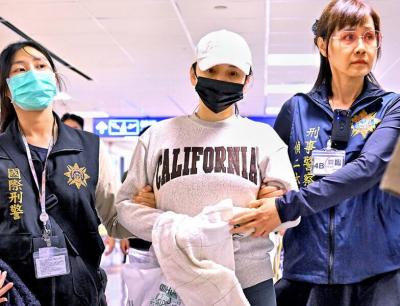
Johanne Liou (劉喬安), a Taiwanese woman who shot to unwanted fame during the Sunflower movement protests in 2014, returned to Taiwan last night after being deported from the US. She is to stand trial in Taiwan for charges involving embezzlement, fraud and drug crimes. The Criminal Investigation Bureau (CIB) said it took her into custody at Taiwan Taoyuan International Airport and would first question her before transferring her to the New Taipei District Prosecutors’ Office. She was arrested upon disembarking a flight from San Francisco that landed shortly before 7pm. Liou absconded to the US in 2019 after jumping bail


 RSS
RSS