


Taiwan will take the opportunity of the discovery of avian-flu virus subtype H5N2 on a poultry farm in Changhua County to try to develop a bird-flu vaccine for humans, a Department of Health (DOH) official said yesterday.
Su Ih-jen (
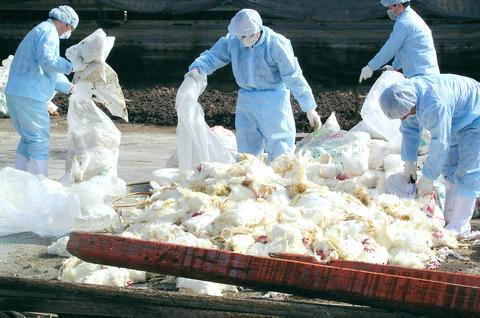
PHOTO: WANG PAI-LIEN, TAIPEI TIMES
Noting that H5 vaccines for fowl have already been produced abroad, Su said that the department will seek to cooperate with foreign pharmaceutical companies to jointly research and develop H5 vaccines for humans.
Su has traveled from Taipei to Changhua County to inspect the poultry farm in Fangyuan Township where some 20,000 chickens were destroyed early yesterday morning after the avian flu virus subtype H5N2 was discovered among the fowl.
Su said that all six workers on the poultry farm, including the owner, will undergo thorough health checks to make sure they have not been infected with the virus. One of the six workers has had a cough, but Su, who holds a doctoral degree in medicine, said that, judging from the worker's symptoms, it is likely that he only had the common cold.
Noting that Taiwan has never had an avian flu case, Su said it is believed that the H5N2 virus that was detected on the Fangyuan farm was probably brought to Taiwan by migratory birds.
Meanwhile, poultry farm owners in neighboring Chiayi County have apparently become jittery as a result of the H5N2 report in Changhua. Many of the owners have begun to sterilize their farms and to chase migratory birds from their fields.
In Taipei, officials from the Kuandu Nature Park said that since avian-flu cases were reported in Japan, Vietnam and South Korea earlier this week, the park had sent relevant samples obtained from birds in the park to the Bureau of Animal and Plant Health Inspection and Quarantine for testing.
None of the samples has been found to carry the H5 virus.
The Kuandu Nature Park, located near Tamsui, is one of the largest natural habitats in northern Taiwan for wild birds, particularly migratory birds.
In related news, an official from the Bureau of Animal and Plant Health Inspection and Quarantine yesterday called on the public not to use raw eggs as an ingredient when they eat hot-pot while there are concerns that the bird-flu virus could be affecting the nation's poultry population.

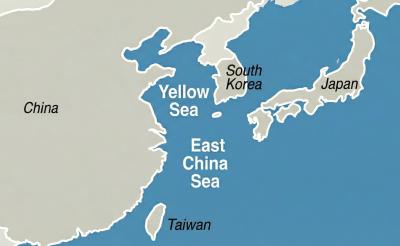
China has reserved offshore airspace in the Yellow Sea and East China Sea from March 27 to May 6, issuing alerts usually used to warn of military exercises, although no such exercises have been announced, the Wall Street Journal (WSJ) reported yesterday. Reserving such a large area for 40 days without explanation is an “unusual step,” as military exercises normally only last a few days, the paper said. These alerts, known as Notice to Air Missions (Notams), “are intended to inform pilots and aviation authorities of temporary airspace hazards or restrictions,” the article said. The airspace reserved in the alert is
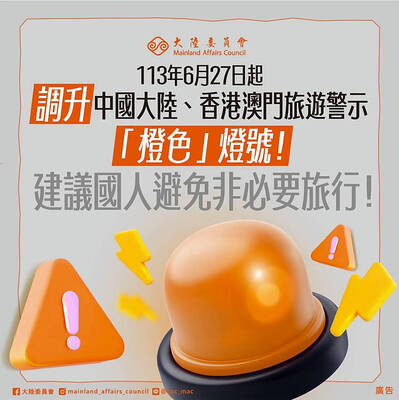
More than 6,000 Taiwanese students have participated in exchange programs in China over the past two years, despite the Mainland Affairs Council’s (MAC) “orange light” travel advisory, government records showed. The MAC’s publicly available registry showed that Taiwanese college and university students who went on exchange programs across the Strait numbered 3,592 and 2,966 people respectively. The National Immigration Agency data revealed that 2,296 and 2,551 Chinese students visited Taiwan for study in the same two years. A review of the Web sites of publicly-run universities and colleges showed that Taiwanese higher education institutions continued to recruit students for Chinese educational programs without

A bipartisan group of US senators has introduced a bill to enhance cooperation with Taiwan on drone development and to reduce reliance on supply chains linked to China. The proposed Blue Skies for Taiwan Act of 2026 was introduced by Republican US senators Ted Cruz and John Curtis, and Democratic US senators Jeff Merkley and Andy Kim. The legislation seeks to ease constraints on Taiwan-US cooperation in uncrewed aerial systems (UAS), including dependence on China-sourced components, limited access to capital and regulatory barriers under US export controls, a news release issued by Cruz on Wednesday said. The bill would establish a "Blue UAS
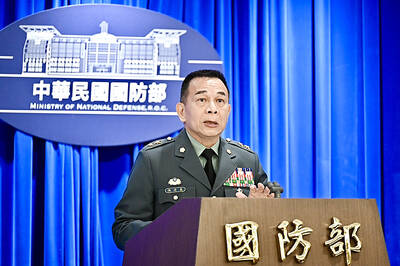
The Republic of China Army Command yesterday relieved Kinmen Defense Battalion commander after authorities indicted the officer on charges connected to using methamphetamine. The Kinmen District Prosecutors’ Office on Wednesday detained Colonel He (何) after the Coast Guard linked him to drug shipments and proceeded to charge him yesterday for using and possessing crystal meth. The man was released on a NT$50,000 bail and banned from leaving Kinmen, the office said. Army Chief of Staff Lieutenant General Chen Chien-yi (陳建義) told a news conference yesterday that He has been removed and another officer is taking over the unit as the acting commander. The military


 RSS
RSS