


1.
SARS outbreak kills 37 people in Taiwan
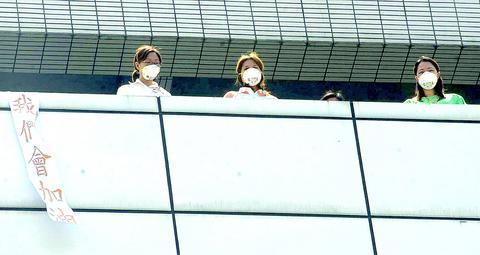
Severe acute respiratory syndrome (SARS) was first introduced to Taiwan as a mere "atypical pneumonia of unknown etiology" when two patients reported unusual symptoms to the Center for Disease Control (CDC) in mid-March.
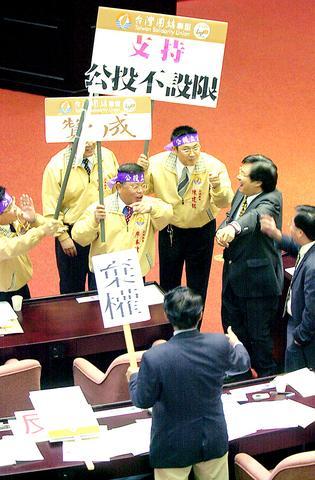
PHOTO: TAIPEI TIMES FILE PHOTO
But by June, SARS had claimed a total of 37 lives from at least 346 suspected cases, according to World Health Organization figures. Reports at the time doubled the fatality rate until a later analysis of causes of death corrected the toll.
More recently, a SARS case that apparently resulted from a laboratory mishap was reported on Dec. 17, reviving fears of a resurgence of SARS in Taiwan.
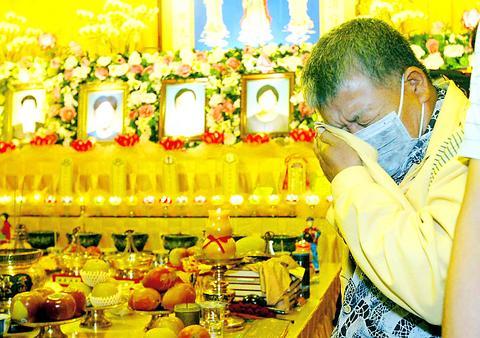
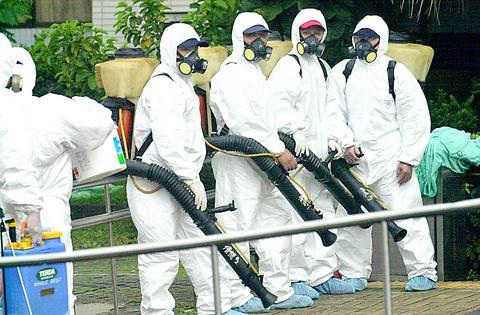
The darkest hours of the outbreak came with the isolation of the Taipei Municipal Hoping Hospital on April 27 after an escalating number of suspected cases there. Nine-hundred-and-thirty staff members and 240 patients were quarantined inside the hospital for two weeks. Thirty-five of those quarantined at the time died, though not all because of SARS, while one person committed suicide.
PHOTOS: TAIPEI TIMES FILE PHOTOS
The economy was also hit hard by the outbreak. A survey of Taipei's 150 business associations at the end of May indicated that trade was down 30 percent on the previous month and 40 percent on the same period last year. The numbers of outbound travelers and inbound tourists fell by 60 percent and 50 percent respectively in April. Then, a damaging travel advisory against non-essential travel was placed on Taiwan on May 8 and this was not lifted until June 17.
The CDC has drafted new policies to deal with infectious diseases in the future, including the formation of an Infection Prevention Medical Care Network which would assign certain hospitals to the treatment of infectious diseases.
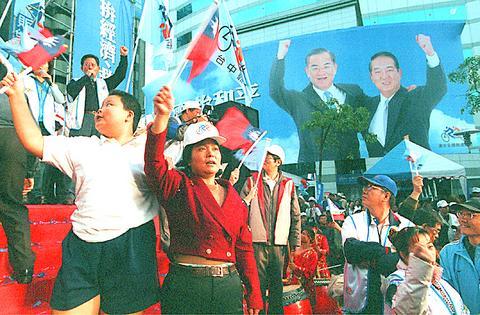
PHOTO: TAIPEI TIMES FILE PHOTO
--by Joy Su
2.
Legislature passes Referendum Law
A historic but contested Referendum Law (

PHOTO: TAIPEI TIMES FILE PHOTO
For a considerable period, pan-blue politicians considered the referendum proposal to be a threat to the cross-strait status quo, fearing that the pan-green camp would use the referendum to agitate for Taiwanese independence.
Buckling under public pressure, the opposition-controlled legislature instead passed a watered-down Referendum Law on Nov. 27. The law granted legislators the right to call a referendum while even preventing the Executive Yuan from calling advisory polls, with jail terms awaiting those officials who dared to try.
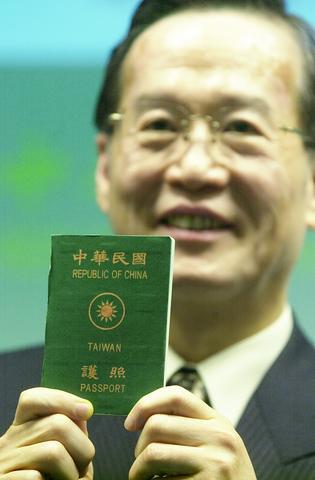
PHOTO: TAIPEI TIMES FILE PHOTO
The public was also prohibited from initiating a referendum, bans were placed on critical subjects such as sovereignty and a new constitution and all proposals were subject to approval by a Referendum Supervisory Committee.
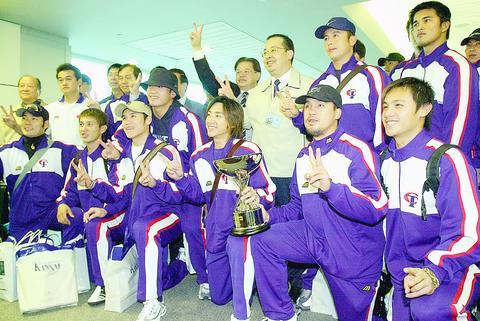
PHOTO: TAIPEI TIMES FILE PHOTO
The law disappointed Democratic Progressive Party (DPP) Legislator Trong Chai (
The president was the only officer in the government permitted to call a referendum, and then only a "defensive referendum," which would be triggered in response to a threat to the nation's sovereignty. The DPP and its pan-green ally, the Taiwan Solidarity Union, dissatisfied with the emaciated law, said it caged the people's power. The Executive Yuan filed a request to the legislature to reconsider the legislation in mid-December, but this request was vetoed on Dec. 20.
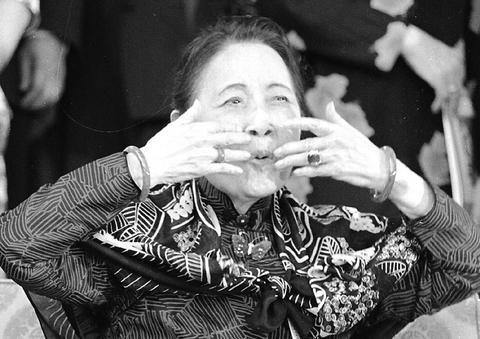
PHOTO: TAIPEI TIMES FILE PHOTO
--by Fiona Lu
3.
KMT, PFP join up to tackle election
In a bid to avoid a repeat of their defeat in the 2000 presidential election, the leaders of the two major opposition parties, Chinese Nationalist Party (KMT) Chairman Lien Chan (連戰) and People First Party (PFP) Chairman James Soong (宋楚瑜), agreed in February to run together on a joint ticket in the upcoming presidential election.
The two parties also signed a memorandum of understanding on the formation of the KMT-PFP alliance to take on President Chen Shui-bian (
The PFP was originally a KMT splinter group. Soong, a former KMT secretary-general, founded the PFP after he narrowly failed in his own maverick campaign during the three-way presidential race in 2000. Lien, then the KMT candidate, came in a distant third.
Debates over who was to lead the presidential ticket had been a thorny issue in talks within the alliance. The debate dragged on for nearly two months before the two parties announced in April that Lien would run for the presidency with Soong as his running mate.
Speculation dogged the pair, however, with a Chinese-language newspaper in June running a front-page story claiming that Lien, in a bid to persuade Soong to yield and become the vice presidential candidate, had promised to let Soong run for the top job in 2008.
The KMT-PFP alliance dismissed the report, saying it was "based on nothing but rumor."
The Lien-Soong ticket also met with dissent from within the two parties about whether the former enemies could work together.
--by Huang Tai-lin
4.
Tallest building in the world opens
There is little doubt that Taipei 101 is by far the world's tallest building. It is somewhat less clear exactly when construction on the 508m high skyscraper will be completed.
But many Taiwanese would find it hard to forget the inauguration of the Taipei 101 Mall on Nov. 14, which drew over 500,000 people in the first three days after its grand opening.
The five-story shopping mall sits at the base of the 508m tower, which is still under construction and is scheduled to be opened to the public next year. The mall, featuring 161 stores and numerous international brands, hopes to generate annual sales of NT$16 billion to NT$19 billion with customer traffic of between 15 million and 18 million people in the first year after its opening.
President Chen Shui-bian (
"It is not only a landmark for Taipei but a sign of Taiwan's development and prosperity. It is Taiwan's asset and pride," Chen said.
Taipei Mayor Ma Ying-jeou (馬英九) also praised the building as "the pride of Taipei residents" and a symbol of the country's global ambitions.
Despite all the glamor, Taipei 101 made the news several times due to accidents. Just last week two people were injured by marble tiles which fell off a newly decorated wall of a restaurant on the fourth floor of the mall. In November, about 3,000 people were evacuated from the mall after metal debris from the 91st floor of the adjoining office tower fell to the ground, injuring four people.
In January a fire broke out on the roof of the mall, with no casualties. An earthquake in March last year caused two cranes to fall from the building, killing five people.
--by Amber Chung
5.
Huge rallies held to demand change
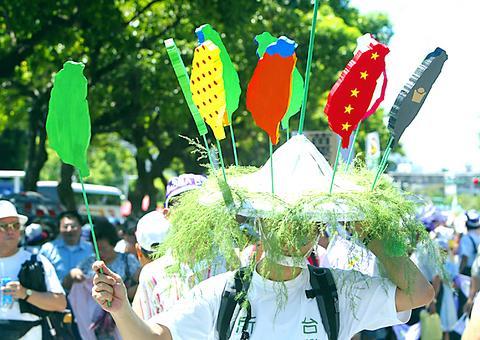
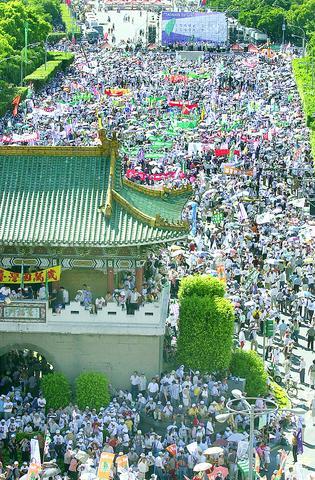
Hundreds of thousands of people demonstrated in Taipei and Kaohsiung in September and October this year to support changing the nation's name from the "Republic of China" (ROC) to "Taiwan" and to introduce a referendum law.
The Sep. 6 and Oct. 25 rallies, amassing 150,000 and 200,000 people in Taipei and Kaohsiung respectively, were led by former president Lee Teng-hui (
Lee, who is leading efforts to rename the country, said the name-rectification campaign had woken the entire nation up to the fact that a change was needed to reflect the reality that the ROC didn't exist anymore.
Lee said the facts showed that Taiwan had never been a part of the ROC, and that the ROC had ceased to exist after the Chinese Communist Party ousted the Chinese Nationalist Party (KMT) from China in 1949.
He urged the nation to abandon the use of "ROC," which enjoys virtually no recognition in the international community, to better reflect Taiwan's separate identity.
The massive demonstration in Kaohsiung led by President Chen pushed for referendum legislation to allow the creation of a new Taiwanese constitution in 2006 to replace the current ROC Constitution.
The two events were organized by pro-localization political forces -- the Democratic Progressive Party, the Taiwan Solidarity Union and hundreds of civic groups -- and dragged the conservative KMT-People First Party alliance into a debate on referendum legislation, facilitating the passage of the Referendum Law on Nov. 27.
--by Chang Yun-ping
6.
Six female illegal immigrants drown
On Aug. 26, human smugglers dumped 26 Chinese women into the sea off Tunghsiao, Miaoli County, while trying to evade Coast Guard Administration authorities. Six drowned and the others were rescued or managed to swim to shore.
The brutal tragedy shocked governments on both sides of the Taiwan Strait, who blamed each other for the accident.
Bereaved families of the victims flew from China to attend their daughters' sea funerals on the beach of Tunghsiao in September. In November, a court sentenced Wang Chung-hsing (王中興) to death and Ko Ching-sung (柯清松) to life in prison for their role in the smuggling.
The tragedy, however, appears to have done little to stem the flow of illegal Chinese immigrants.
Taiwan's affluence still attracts relatively impoverished Chinese, especially from the inland provinces.
"They said Taiwan is a great place, it's easy to find work and easy to earn money," said Zhang Hongyan (張洪燕), 22, from Sichuan Province.
The political standoff between Taiwan and China has hindered the government's attempts to contain the crime and other social problems generated by the growing population of illegal Chinese immigrants.
Taiwan's three shelters for illegal Chinese immigrants in Hsinchu, Ilan and Matsu are already packed and police stations around the nation serve as temporary homes for these people.
When cross-strait hostility grows, Beijing simply halts all the boats that routinely ferry the illegal immigrants back to China.
--by Melody Chen
7.
President takes hold of reform agenda
Using "Taiwan's autonomy and democratic reform" as the primary theme for his re-election, President Chen Shui-bian (
During a speech honoring the Democratic Progressive Party's 17th anniversary, Chen said that he would push for a new constitution in his second term, completing a draft before the end of 2006, then putting it to the public in a referendum for implementation in 2008.
The Chinese Nationalist Party (KMT)-People First Party alliance initially dismissed Chen's agenda as, in the words of KMT chairman Lien Chan (
Because Chen did not provide precise details on his referendum and constitutional plans, most international media described his remarks as a move toward Taiwanese independence. The international community also expressed reservations over developments.
Even the Bush administration, which had demonstrated strong support for Chen, said it was concerned. White House and State Department spokespeople reminded President Chen of the "five noes" pledge he made at his inauguration speech, during which he told the world that he would not change the status quo and would not move toward independence.
But Chen stuck by his guns. At a ceremony to receive an award from the International League for Human Rights (ILHR) in late October, Chen expressed his determination to strengthen direct democracy and guarantee basic human rights for the people of Taiwan.
--by Lin Chieh-yu
8.
Soong Mayling's death ends an era
The death of Madame Chiang Kai-shek, or Soong Mayling (
Soong, 105, the wife of former president Chiang Kai-shek (
After fleeing with her husband and the Chinese Nationalist Party (KMT) government to Taiwan in 1949, Soong was deprived of a genuine stage for her talents but still enjoyed the benefits of power in a country dwarfed by China until her husband's death in 1975.
Before losing China to the Communists in 1949, Soong and her husband ruled the country as a family. They were married in 1926. Chiang was 11 years older than his bride.
Soong, born in Shanghai to a Hainanese family, had two older sisters, Soong Ai-ling (宋靄齡) and Soong Ching-ling (宋慶齡), who also married two of the most powerful men in China before Chiang made his mark.
Ai-ling's husband was Kung Hsiang-hsi (孔祥熙), a wealthy man who controlled the treasures of China. Ching-ling's other half was Sun Yat-sen (孫中山), the founding father of modern China.
Soong is remembered for her famous address to the US Congress in 1943, in which she asked for support to fight against the Japanese.
Soong was almost worshipped like a goddess by those who fled to Taiwan with the KMT in 1949, but an awakening among Taiwanese in recent years to their cultural and ideological differences has started to debunk the myth.
--by Brian Hsu
9.
National Baseball team set for Athens
The national baseball team won the right to take part in next year's Olympic Games, to be held in Athens, Greece, after Japan's 2-0 victory over South Korea on Nov. 7.
It was the first time in 12 years that Taiwan succeeded in gaining admission to the Olympic baseball tournament.
The last time was in 1992 in Barcelona, where Taiwan took a silver medal -- the highest award the country's baseball team has received at the Olympics.
The team won its ticket to next year's Olympics with a dramatic 5-4 victory over South Korea and a breathtakingly tense 3-1 win over China in the final round of the Asian Baseball Championship held in Sapporo, Japan, in early November.
Taiwan and Japan will represent the cream of Asia's baseball talent at the Olympics.
Slugger Chen Chin-feng (
Chen, Chang and pitcher Wang Chien-ming (王建民) were viewed as national heroes after the team triumphed in Japan.
All three married their partners before the end of the year, because 2004 is not an auspicious year for weddings, according to the Chinese horoscope.
After the team's victory in this year's Asian Baseball Championship, baseball has become a sport that has served to unite public sentiment. Everybody, from regular people to legislators, is now crazy about the game.
--by Jewel Huang
10.
'Taiwan' added to passport covers
To more clearly differentiate Taiwan from China, the Ministry of Foreign Affairs (MOFA) on Sept. 1 finally issued passports with the word "Taiwan" on the cover.
Previously, many people had complained of bad treatment due to being mistaken for Chinese nationals because of the words "Republic of China" -- Taiwan's official name -- on their passports.
The word "Taiwan" in Roman script is placed below the national emblem on the passport's cover, while the rest of the design remained unchanged, including the name "Republic of China," in English and Chinese.
The government originally planned to launch the new passports in February, but the Cabinet decided to postpone their release to avoid complications arising from the US-led military action in Iraq and the SARS epidemic.
The Legislative Yuan on May 20 passed a pair of non-binding resolutions on passport reform that contradicted each another. The first resolution stated that the passports should not be changed, while the second stipulated that the word "Taiwan" should be added to the cover.
The ministry later dropped its original idea of adding the words "Issued in Taiwan" to the cover of new passports after both opposition and Democratic Progressive Party (DPP) lawmakers opposed the idea. Opposition legislators argued that this would be a move toward independence, while DPP lawmakers said it would belittle the country and didn't go far enough in clarifying the nation's identity.
The resolution to just add "Taiwan" to the passports received a boost on July 2, when the DPP's Central Standing Committee urged the Cabinet to adopt the recommendation.
--by Ko Shu-ling

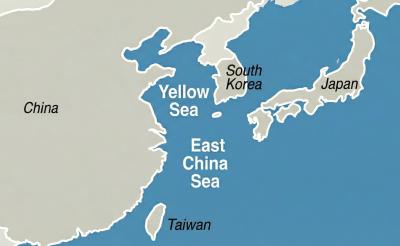
China has reserved offshore airspace in the Yellow Sea and East China Sea from March 27 to May 6, issuing alerts usually used to warn of military exercises, although no such exercises have been announced, the Wall Street Journal (WSJ) reported yesterday. Reserving such a large area for 40 days without explanation is an “unusual step,” as military exercises normally only last a few days, the paper said. These alerts, known as Notice to Air Missions (Notams), “are intended to inform pilots and aviation authorities of temporary airspace hazards or restrictions,” the article said. The airspace reserved in the alert is

South Korea is planning to revise its controversial electronic arrival card, a step Taiwanese officials said prompted them to hold off on planned retaliatory measures, a South Korean media report said yesterday. A Yonhap News Agency report said that the South Korean Ministry of Foreign Affairs is planning to remove the “previous departure place” and “next destination” fields from its e-arrival card system. The plan, reached after interagency consultations, is under review and aims to simplify entry procedures and align the electronic form with the paper version, a South Korean ministry official said. The fields — which appeared only on the electronic form
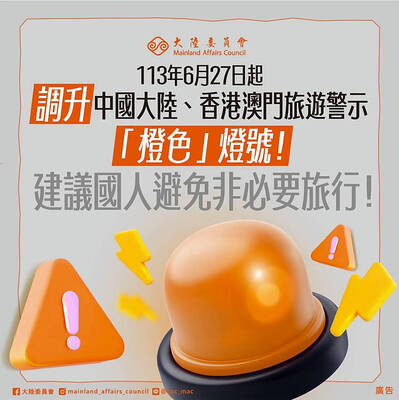
More than 6,000 Taiwanese students have participated in exchange programs in China over the past two years, despite the Mainland Affairs Council’s (MAC) “orange light” travel advisory, government records showed. The MAC’s publicly available registry showed that Taiwanese college and university students who went on exchange programs across the Strait numbered 3,592 and 2,966 people respectively. The National Immigration Agency data revealed that 2,296 and 2,551 Chinese students visited Taiwan for study in the same two years. A review of the Web sites of publicly-run universities and colleges showed that Taiwanese higher education institutions continued to recruit students for Chinese educational programs without

A bipartisan group of US senators has introduced a bill to enhance cooperation with Taiwan on drone development and to reduce reliance on supply chains linked to China. The proposed Blue Skies for Taiwan Act of 2026 was introduced by Republican US senators Ted Cruz and John Curtis, and Democratic US senators Jeff Merkley and Andy Kim. The legislation seeks to ease constraints on Taiwan-US cooperation in uncrewed aerial systems (UAS), including dependence on China-sourced components, limited access to capital and regulatory barriers under US export controls, a news release issued by Cruz on Wednesday said. The bill would establish a "Blue UAS


 RSS
RSS