


The Ministry of Education recently decided to cut the number of foreign English teachers it had planned to employ and use the savings to hire teacher-trainers.
The ministry said after a recent forum that it hopes to hire between 400 and 600 foreign teachers for elementary schools instead of the original 1,000 and proposed a remuneration scale for teachers of NT$60,000 to NT$90,000 per month. Vice Minister of Education Fan Sun-lu (范巽綠) has said the salaries of the teacher-training specialists should exceed NT$90,000 per month.
At the forum, members of the ministry's English Education Advisory Committee unanimously disagreed with the plan to hire so many foreign teachers, saying the move would do more harm than good for primary-level education.
Lin Wen-chi (林文淇), an associate professor at National Central University, said the plan to hire foreign English teachers looked like a short cut for improving English-language education. He said the proposal brought with it too many problems and would ultimately fail.
"If the purpose of hiring foreign English teachers is simply to have teachers with native-English accents, I believe that local teachers could do the job if they were properly trained [with programs that] use the money [intended for hiring] foreign teachers," he said.
Sebastian Liao (廖咸浩), chairman of the Department of Foreign Languages and Literature at National Taiwan University (NTU), warned the ministry that hiring foreign teachers would not serve as a panacea for problems associated with the provision of successful English-language education or with globalization.
"Some schools in the remote Hualien and Taitung areas have applied to hire foreign English teachers to enhance their students' English skills. Can't our own teachers do the job?" Liao asked.
"These students in remote areas enjoy fewer educational and cultural resources than children in cities. If we expose them directly to a foreign culture, how will they adjust to the cultural differences which might interfere with the process by which they begin to identify with their mother culture?" he said.
Shih Yu-hwei (施玉惠), a professor in the English Department at National Taiwan Normal University, cited problems with Japan's and South Korea's experiences with hiring foreign teachers for primary schools.
"Both Japan and South Korea have reduced the number of foreign English teachers. The problem was that the foreign teachers usually had difficulty in coordinating with the domestic teachers, and were often treated as simply `living recorders' who did nothing but regurgitate native-English pronunciation," Shih said.
"This was a waste of educational resources," Shih said.
She added that local teachers in these countries often ended up being treated as second-rate instructors.
Cheung Hin-tat (張顯達), an associate professor at NTU's Graduate Institute of Linguistics and an expert in child language-acquisition, said the teaching methods of Western instructors and their Asian counterparts can be very different.
"We know from Hong Kong's experience that foreign teachers cannot meet the students' needs in terms of dealing with tests -- a very important means of evaluation in Chinese society," Cheung said.
"Like students in Taiwan, Hong Kong students are under pressure to pass tests in order to get in to senior high schools or colleges. The foreign teachers' schedules and methods prevent them from meeting the students' needs for coaching to pass the tests. Much of the work required to make up for that deficiency then falls to local teachers," Cheung said.
It was on the basis of the advisory committee's deliberations that the ministry decided to reduce the number of foreign teachers to be recruited and to instead hire foreign teacher-trainers.
Minister of Education Huang Jong-tsun (黃榮村) said in the Legislative Yuan early last month that the foreign teachers are only intended to complement the work of their domestic counterparts, rather than to replace them.
Most of the foreign teachers will be sent to elementary schools or junior high schools in small cities or remote areas where English teachers are in short supply, Huang added.
The director-general of the ministry's Department of Elementary and Junior High School Education, Wu Tsai-shung (吳財順), said that the foreign teachers should be qualified in teaching English as a second language and have a rudimentary command of Chinese.
The ministry also proposed to discuss the recruiting of teacher trainers with universities in the US and the UK.
The Ministry of Education's plan forms part of the Cabinet's Six Year National Development Plan for 2002 to 2008. The plan cites nationwide improvements in English as a key goal.
The plan to hire 1,000 teachers sparked protest from local tea-chers, who said the proposal was poorly thought out and rushed.
Many also said that the proposal, which fueled fears of job losses among local teachers, came at a bad time, with the economy in the doldrums and unemployment still high.

Yangmingshan National Park authorities yesterday urged visitors to respect public spaces and obey the law after a couple was caught on a camera livestream having sex at the park’s Qingtiangang (擎天崗) earlier in the day. The Shilin Police Precinct in Taipei said it has identified a suspect and his vehicle registration number, and would summon him for questioning. The case would be handled in accordance with public indecency charges, it added. The couple entered the park at about 11pm on Thursday and began fooling around by 1am yesterday, the police said, adding that the two were unaware of the park’s all-day live

Fast food chain McDonald's is to raise prices by up to NT$5 on some products at its restaurants across Taiwan, starting on Wednesday next week, the company announced today. The prices of all extra value meals and sharing boxes are to increase by NT$5, while breakfast combos and creamy corn soup would go up by NT$3, the company said in a statement. The price of the main items of those meals, if ordered individually, would remain the same. Meanwhile, the price of a medium-sized lemon iced tea and hot cappuccino would rise by NT$3, extra dipping sauces for chicken nuggets would go up
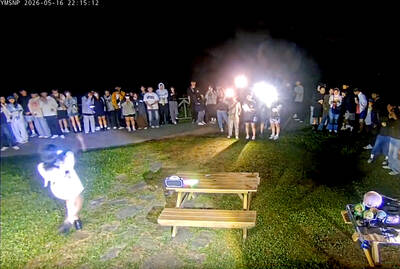
Yangmingshan National Park’s Qingtiangang (擎天崗) nature area has gone viral after a park livestream camera observed a couple in the throes of intimate congress, which was broadcast live on YouTube, drawing large late-night crowds and sparking a backlash over noise, bright lights and disruption to wildlife habitat. The area’s livestream footage appeared to show a couple engaging in sexual activity on a picnic table in the park on Friday last week, with the uncensored footage streamed publicly online. The footage quickly spread across social media, prompting a tide of visitors to travel to the site to “check in” and recreate the

Minister of Digital Affairs Lin Yi-ching (林宜敬) yesterday cited regulatory issues and national security concerns as an expert said that Taiwan is among the few Asian regions without Starlink. Lin made the remarks on Facebook after funP Innovation Group chief executive officer Nathan Chiu (邱繼弘) on Friday said Taiwan and four other countries in Asia — China, North Korea, Afghanistan and Syria — have no access to Starlink. Starlink has become available in 166 countries worldwide, including Ukraine, Malaysia, the Philippines and Vietnam, in the six years since it became commercial, he said. While China and North Korea block Starlink, Syria is not


 RSS
RSS