


Although Yang Teh-chih (
A KMT member, the 62-year-old Ilan native stayed in his current position after the transfer of power in 2000 and was reappointed last February during the first Cabinet reshuffle of the DPP-led government.
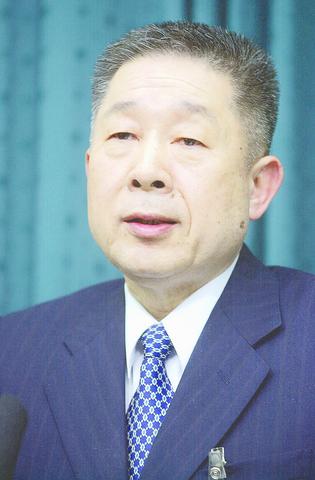
TAIPEI TIMES FILE PHOTO
The KMT suspended Yang for violating a party policy that prohibits members from assuming political appointments in the DPP government.
The KMT has also suspended the party rights of Minister of National Defense Tang Yao-ming (湯曜明) and Liu San-chi (劉三琦), head of the Directorate General of Budget, Accounting and Statistics.
Caught between his own party and the DPP-led government, Yang has been given a hard time by the legislature.
The hike in the monthly allowance for retired veterans is a good example. While Yang wanted to increase the amount from NT$13,100 per person to NT$13,550, the DPP's tiny TSU ally opposed the plan. The TSU said the government should not favor retired soldiers over other groups, especially at a time when the nation is experiencing financial trouble.
The TSU joined forces with the DPP to boycott the proposal and the commission's annual budget. With the help of his own party and the PFP the plan was eventually approved by the legislature.
Yang, however, did not win the support of the opposition camp easily. Opposition lawmakers once called him a "KMT traitor who conspires with the DPP at the expense of the interests of veterans."
Fighting media speculation that the Cabinet would be reshuffled after the Lunar New Year, Premier Yu Shyi-kun confirmed on Saturday that Yang had expressed his desire to quit for health reasons.
Yang issued a press release later that day saying that he wanted to quit because of health problems and that he has completed the tasks to which he had been assigned.
Insisting that national stability is paramount, Yu turned down Yang's request to resign and said that he would like all government officials to stick to their post.
Although the premier refused to let Yang go, sources in the Cabinet told the Taipei Times yesterday that Yu might have to let go of Yang if the Presidential Office insists on meddling in the Cabinet's authority and forcing Yang to leave.
"As far as I know, an influential individual at the Presidential Office wants him [Yang] to go," the source said. "As Yang has already tendered his resignation, it's now up to the Presidential Office to decide whether to keep him."
The Presidential Office has been planning to let civilians, rather than soldiers, head the Veterans Affairs Commission as well as the armed forces.
Yang is a former commander of the military's combined logistics command (
Commenting on the speculation, Chin Heng-wei (金恆煒), a political observer and editor in chief of Contemporary Monthly magazine, said that Chien would be a better choice.
"The government should seriously consider neutralizing the commission, which has long been manipulated by the KMT as a voting machine," Chin said.
Wu Tung-yeh (
"The DPP-led government should realize that it's the global trend to have civilians instead of soldiers lead a nation's armed forces. It may take some time to reach that goal, but it's the way to go," he said.
According to a senior defense reporter who requested anonymity, Yang's health was once a concern, but that is no longer the case.
"He is in perfect shape and still enjoys hiking and mountain climbing," he said.
Yang was hospitalized last November after receiving improper medication from a Chinese-medicine doctor for shoulder pain. The medication reportedly contained steroids.

NATIONAL SECURITY: Authorities are working to confirm the identities of the military personnel involved and investigating possible illegal conduct and regulatory violations Authorities are probing possible national security implications after Kinmen police and immigration officers on Sunday found a Chinese woman allegedly posing as a tourist while engaging in prostitution involving more than 10 military personnel. The woman, surnamed Chen (陳), has since been deported, authorities said, adding that investigators are still working to confirm the identities of those implicated, as the records only listed code names and aliases. The case stemmed from a report received by the Kinmen District Prosecutors’ Office on Friday last week from the Jinhu Precinct of the Kinmen County Police Bureau. On Sunday, police, along with the National Immigration

GLOBALGIVING: ‘ Caving to external pressure is not acceptable for an organization that has cultivated justice reform and human rights for 30 years,’ one NGO said A slew of non-government organizations (NGOs) have withdrawn from the GlobalGiving fundraising platform after it announced it would use “Chinese Taipei” instead of “Taiwan” from next month. The Taiwan Good Rice Association wrote on Facebook on Friday that it was informed on April 28 via a teleconference call of the change, which was made because the platform wanted to operate in China. Taiwan Good Rice is to terminate all cooperative relationships with GlobalGiving in response to the platform’s “unilateral and non-negotiable” decision to remove references to Taiwan, the NGO said. “Taiwan is in the official name of Taiwan Good Rice Association and the
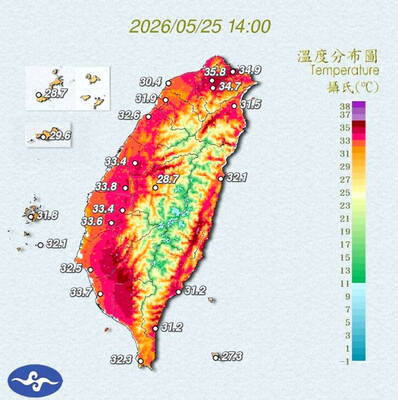
STAY COOL: The HPA recommended that people stay hydrated, use air-conditioning or fans while indoors, wear loose-fitting clothes and walk in the shade while outdoors Employers must implement measures such as installing cooling equipment, and providing drinking water and rest breaks for outdoor workers starting from Monday next week, the Taipei Department of Labor said on Sunday. Employers who fail to comply could face fines of NT$30,000 to NT$300,000 under the Occupational Safety and Health Act (職業安全衛生法), the department said. Businesses in Taipei employing fewer than 100 workers, as well as registered self-employed workers with labor insurance coverage, could receive on-site assessments and guidance from occupational safety consultants to help them apply for central government subsidies to implement or improve heat-protection measures, it said. Under the Ministry of

HEAVY WEATHER: Typhoon Jangmi is due to crash straight into the Ryukyus as airlines look to shift flights to larger aircraft or cancel flights to Okinawa entirely Taiwan’s international air carriers announced flight adjustments over the weekend as Typhoon Jangmi is forecast to hit the Ryukyu Islands today and tomorrow. The Central Weather Administration (CWA) upgraded Jangmi from a tropical storm to a typhoon at 8am yesterday, with the eye located 580km south of Naha city. It was moving north at 19kph. Today, China Airlines’ CI-120, CI-121, CI-122 and CI-123 flights between Taoyuan and Naha, Okinawa, have been canceled as well as CI-132 and CI-133 between Kaohsiung and Naha. EVA Air’s BR-112, BR-113, BR-186 and BR-185 flights between Taoyuan and Naha are also canceled. Low-cost carrier Tigerair Taiwan canceled IT-230,


 RSS
RSS