


Chu Mei-feng (璩美鳳), disgraced after she was filmed having sex with a married man, is planning to marry a Chinese man and settle in Shanghai, a report said yesterday.
Chu's new love is a man from the Shanghai literary circle who was introduced to her by former legislator Elmer Fung (馮滬祥), the China-based Yangcheng Evening News said.
The report cited Fung as saying Chu and her boyfriend, identified only by his surname Xu, were planning to get married this month, but because of their hectic schedules they will delay the wedding until the end of the year.
Xu is a Nanjing native who studied abroad in Spain and loves music and literature, it said.
Chu shot to notoriety last December when she was filmed by an estranged friend having sex with a married man.
The 40-minute video compact disc was given away free by a tabloid magazine, Scoop, and spread throughout Asia via the Internet and black markets.
Pirated copies of the video were snapped up by a curious public in China, not used to having access to any juicy details about the private lives of politicians.
A book about Chu, which she authorized a ghost writer to pen and published in China, has become a bestseller, despite a lack of promotion.
Chu was quoted in the book saying she was disappointed in Taiwanese society and has found some peace of mind since moving to China.
"She gave her younger life to Taiwan society, but now, when she watches Taiwanese television, she changes the channel whenever she sees a political figure," the report said.
Chu has cashed in on her notoriety by launching a singing career, and has performed to sell-out crowds in both Singapore and Hong Kong.
However, she was banned from performing in Malaysia on the grounds that she was a bad role model for young people.
She has also been criticized for her singing ability.
Now, Chu is planning to become an English-Chinese interpreter, the report said.
The former politician dismisses criticisms of her behavior, considering herself brave for bouncing back after the scandal, it said.
"She likes herself better than before," the newspaper report quoted the book as saying.

SECURITY: Starlink owner Elon Musk has taken pro-Beijing positions, and allowing pro-China companies to control Taiwan’s critical infrastructure is risky, a legislator said Starlink was reluctant to offer services in Taiwan because of the nation’s extremely high penetration rates in 4G and 5G services, the Ministry of Digital Affairs said yesterday. The ministry made the comments at a meeting of the legislature’s Transportation Committee, which reviewed amendments to Article 36 of the Telecommunications Management Act (電信管理法). Article 36 bans foreigners from holding more than 49 percent of shares in public telecommunications networks, while shares foreigners directly and indirectly hold are also capped at 60 percent of the total, unless specified otherwise by law. The amendments, sponsored by Chinese Nationalist Party (KMT) Legislator Ko

The eastern extension of the Taipei MRT Red Line could begin operations as early as late June, the Taipei Department of Rapid Transit Systems said yesterday. Taipei Rapid Transit Corp said it is considering offering one month of free rides on the new section to mark its opening. Construction progress on the 1.4km extension, which is to run from the current terminal Xiangshan Station to a new eastern terminal, Guangci/Fengtian Temple Station, was 90.6 percent complete by the end of last month, the department said in a report to the Taipei City Council's Transportation Committee. While construction began in October 2016 with an
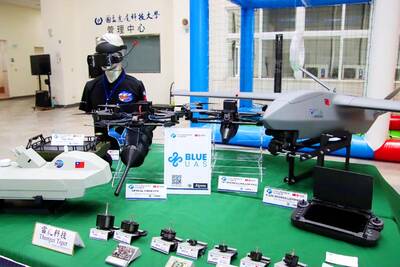
NON-RED SUPPLY: Boosting the nation’s drone industry is becoming increasingly urgent as China’s UAV dominance could become an issue in a crisis, an analyst said Taiwan’s drone exports to Europe grew 41.7-fold from 2024 to last year, with demand from Ukraine’s fight against Russian aggression the most likely driver of growth, a study showed. The Institute for Democracy, Society and Emerging Technology (DSET) in a statement on Wednesday said it found that many of Taiwan’s uncrewed aerial vehicle (UAV) sales were from Poland and the Czech Republic. These countries likely transferred the drones to Ukraine to aid it in its fight against the Russian invasion that started in 2022, it said. Despite the gains, Taiwan is not the dominant drone exporter to these markets, ranking second and fourth

Japanese Prime Minister Sanae Takaichi’s comment last year on Tokyo’s potential reaction to a Taiwan-China conflict has forced Beijing to rewrite its invasion plans, a retired Japanese general said. Takaichi told the Diet on Nov. 7 last year that a Chinese naval blockade or military attack on Taiwan could constitute a “survival-threatening situation” for Japan, potentially allowing Tokyo to exercise its right to collective self-defense. Former Japan Ground Self-Defense Force general Kiyofumi Ogawa said in a recent speech that the remark has been interpreted as meaning Japan could intervene in the early stages of a Taiwan Strait conflict, undermining China’s previous assumptions


 RSS
RSS