


Despite rising chaos in the troubled Solomon Islands, ties between Taipei and Honiara remain stable, said a foreign ministry official after confirming that Taipei issued a US$1 million check to the country's prime minister yesterday.
"The political situation is very stable there and it won't affect our bilateral ties," Peter Cheng (鄭博久), director-general of the foreign ministry's department of East Asian and Pacific affairs, told the Taipei Times.
Cheng's remarks came in the wake of the recent escalation of tension in the capital of the Pacific country. Police on Wednesday erected razor wire barricades around the prime minister's office and the nation's finance department.
The finance department has been unable to pay civil servants for more than a month.
Cheng also confirmed an AFP report filed from Honiara yesterday that said Taiwan ambassador Teng Pei-yin (
"The amount was in Solomon Island dollars," Cheng clarified, which is roughly US$1 million.
State-run Solomon Islands Broadcasting (SIBC) said some of the money would be used for the razor wire fencing and 500,000 Solomon Island dollars would be sent to Fiji to pay school fees for Solomon Islands students at the University of the South Pacific.
Cheng said the latest financial aid package from Taiwan was "long term" in nature and would pay for "a man-power training program" and "a security program."
Solomon Islands is one of five remaining diplomatic allies Taiwan has in the Pacific region, after Nauru, switched recognition from Taipei to Beijing last month. Taipei currently has 27 diplomatic allies.
When contacted yesterday evening, a Honiara-based Taiwanese diplomat confirmed that Taiwan last year promised to lend the troubled state US$25 million.
"But so far we've only given out US$20 million," said the diplomat, who declined to be named.
The diplomat also said disorder in the capital of the Pacific nation was worsening.
"The government has surrounded the prime minister's office and the finance office with razor wire barricades" to keep out angry crowds, he said.
The war-torn Solomon Islands sank into deeper confusion yesterday after Kemakeza sacked his foreign minister and then promptly said he had made a mistake.
Foreign Minister Alex Bartlett, who was a key member of an illegal militant group, was bitterly critical of his sacking and threatened to pull out of the ruling coalition.
"You will hear more discussion over the coming days over this issue because the man is not right, the actions he has taken are completely outrageous and are not in the interests of healing the nation," he told the Radio New Zealand International.
The Solomons has been facing bankruptcy after a war provoked by militants destabilized the country.
The militants, currently known as the Isatambu Freedom movement, live on the main island of Guadalcanal.
The war began when the militants attempted to drive out migrants from the neighboring island Malatia.
In the war around 100 people have been killed in a country, once known as "The Happy Isles," of just 300,000 while 20,000 people have lost their homes.
Malaita responded with the formation of the Malaita Eagle Force, whose leadership included Bartlett, which counter-attacked and staged a coup in 2000, taking over Honiara.
Following democratic elections last December, peace slowly returned but a Guadalcanal warlord, Harold Keke, killed 10 Malaita men last month.
On Monday, Kemakeza reshuffled his Cabinet, downgrading Bartlett to the tourism portfolio and moving eight others down. Kemakeza announced yesterday he was sacking Bartlett altogether.
But later Robert Goh, an official in Kemakeza's department, issued a statement saying the sacking was an error and had been rescinded.
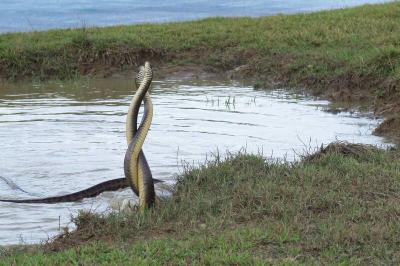
Kenting National Park service technician Yang Jien-fon (楊政峰) won a silver award in World Grand Prix Photography Awards Spring Season for his photograph of two male rat snakes intertwined in combat. Yang’s colleagues at Kenting National Park said he is a master of nature photography who has been held back by his job in civil service. The awards accept entries in all four seasons across six categories: architectural and urban photography, black-and-white and fine art photography, commercial and fashion photography, documentary and people photography, nature and experimental photography, and mobile photography. Awards are ranked according to scores and divided into platinum, gold and

More than half of the bamboo vipers captured in Tainan in the past few years were found in the city’s Sinhua District (新化), while other districts had smaller catches or none at all. Every year, Tainan captures about 6,000 snakes which have made their way into people’s homes. Of the six major venomous snakes in Taiwan, the cobra, the many-banded krait, the brown-spotted pit viper and the bamboo viper are the most frequently captured. The high concentration of bamboo vipers captured in Sinhua District is puzzling. Tainan Agriculture Bureau Forestry and Nature Conservation Division head Chu Chien-ming (朱健明) earlier this week said that the

The Chinese Nationalist Party (KMT) caucus yesterday said it opposes the introduction of migrant workers from India until a mechanism is in place to prevent workers from absconding. Minister of Labor Hung Sun-han (洪申翰) on Thursday told the Legislative Yuan that the first group of migrant workers from India could be introduced as early as this year, as part of a government program. The caucus’ opposition to the policy is based on the assessment that “the risk is too high,” KMT caucus secretary-general Lin Pei-hsiang (林沛祥) said. Taiwan has a serious and long-standing problem of migrant workers absconding from their contracts, indicating that

SPACE VETERAN: Kjell N. Lindgren, who helps lead NASA’s human spaceflight missions, has been on two expeditions on the ISS and has spent 311 days in space Taiwan-born US astronaut Kjell N. Lindgren is to visit Taiwan to promote technological partnerships through one of the programs organized by the US for its 250th national anniversary. Lindgren would be in Taiwan from Tuesday to Saturday next week as part of the US Bureau of Educational and Cultural Affairs’ US Speaker Program, organized to celebrate the 250th anniversary of the signing of the Declaration of Independence, the American Institute in Taiwan (AIT) said in a statement yesterday. Lindgren plans to engage with key leaders across the nation “to advance cutting-edge technological partnerships and inspire the next generation of scientists and engineers,”


 RSS
RSS