


A group of DPP legislators yesterday alleged that KMT Vice Chairman Vincent Siew (蕭萬長) covered up fraud and other irregularities involving the management of the China Technical Consultants Incorporated (CTCI) Foundation, a government-funded organization of which Siew is a senior adviser.
The legislators did not explain exactly how Siew covered up for his associates.
The lawmakers, including Tu Wen-ching (
Siew immediately rejected the allegations, saying that he had never participated in the foundation's business affairs and had no idea as to how it was being operated.
The CTCI Foundation, founded in 1959 with donations from state-run enterprises, including Chinese Petroleum Corp and the Taiwan Power Company, is subject to the supervision of the Ministry of Economic Affairs.
The foundation, set up by the CTCI Corp (中鼎工程公司) in 1979 as a joint venture, holds 36.83 percent of the company's stocks.
CTCI provides consultancy services on energy conservation and environmental issues and carries out general research and development in these areas.
It depends largely on government-subsidized projects.
Liu Wei-teh (劉維德), a former director-general of the Board of Foreign Trade, and Yu Chun-yen (余俊彥), a former board official, are chairmen of the CTCI Foundation and CTCI Corp, respectively.
According to the DPP legislators, Siew, Liu and Yu were colleagues at the Board of Foreign Trade.
After Siew stepped down from the premiership two years ago, Liu hired him as the foundation's senior adviser at NT$300,000 per month and offered him a spacious office .
As senior adviser, the legislators said, Siew covered up for Liu and Yu in a bid to buy up CTCI stock through a "fake foreign investor," -- a subsidiary company set up by the CTCI in Singapore also headed by Yu -- in an effort to amass a controlling interest in CTCI.
In what way the setting up of the subsidiary company was illegal was also left unexplained by lawmakers.
The legislators said that Liu, fearing that he might be replaced as chairman after the DPP came to power, maneuvered to control the board of the CTCI Corp to try to wrest authority over the company from the Ministry of Economic Affairs.
These machinations are ongoing, the lawmakers said.
Siew, who is currently on a trip to Japan, said through his aides that none of the things alleged by the DPP lawmakers have anything to do with him.
Siew reiterated that although he has served as a senior adviser to the CTCI Foundation since leaving office, he has not played a part in operations of the foundation.


UPGRADE: The Kang Ding-class frigate is replacing its Chaparall missiles with Tien Chien II and Hua Yang VLS, which would provide it with long-range, 360° air defense Taiwan plans to produce 1,200 to 1,376 Hai Chien II missiles (海劍二, Sea Sword II) — also known as TC-2N — to serve as the standard air defense system of the navy’s surface combatant fleet, a source said yesterday. Last week, the Hai Chien II, the naval version of the Tien Kung II missile (天劍二, Sky Sword II), completed a live-fire test in waters off the National Chungshan Institute of Science and Technology’s Jiupeng facility (九鵬) in Pingtung County’s Manjhou Township (滿州). The MIM72 Chaparral and other dated air defense missiles that currently arm Taiwanese ships have inadequate range to combat Chinese

REASONS FOR TRAVEL: An assistant professor said that proposed amendments to penalize drivers if they used drugs overseas would not deter people from traveling People who operate a motor vehicle under the influence of marijuana would have their driver’s license revoked, even if they used the substance while overseas, the Ministry of Transportation and Communications said yesterday, citing proposed amendments to the Road Traffic Management and Penalty Act (道路交通管理處罰條例). The amendments would also authorize the government to revoke the licenses of people determined to have used Category 1 or Category 2 narcotics, even if they were not operating a vehicle while under the influence of drugs, as well as ban them from taking the license test for three years, the ministry said. People aged 18 or
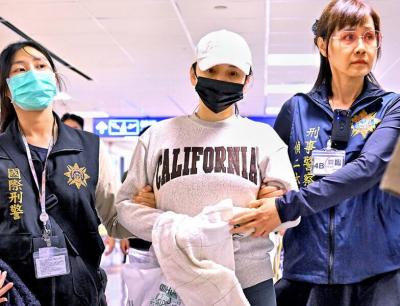
Johanne Liou (劉喬安), a Taiwanese woman who shot to unwanted fame during the Sunflower movement protests in 2014, returned to Taiwan last night after being deported from the US. She is to stand trial in Taiwan for charges involving embezzlement, fraud and drug crimes. The Criminal Investigation Bureau (CIB) said it took her into custody at Taiwan Taoyuan International Airport and would first question her before transferring her to the New Taipei District Prosecutors’ Office. She was arrested upon disembarking a flight from San Francisco that landed shortly before 7pm. Liou absconded to the US in 2019 after jumping bail
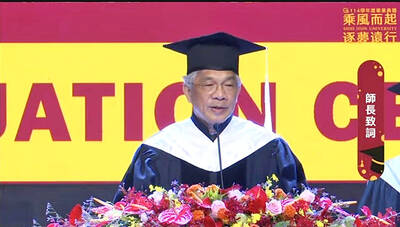
Shih Hsin University President Chen Ching-he (陳清河) yesterday issued a public apology for comments made in his commencement speech last week, stating that he has asked the school to suspend his duties and halt his wages for two months as a show of contrition. At the commencement ceremony on May 30, Chen said, “If you don’t manage your time well, or your own emotions, or your health, then I am telling every one of you — put a quick end to ‘you,’ because the world has no need for ‘you.’” The comments have sparked significant controversy online, and Chen through an open


 RSS
RSS