


The legislature is bracing for another showdown today when lawmakers are slated to decide whether to invite President Chen Shui-bian (
The four legislative caucuses have all issued a top-mobilization order asking members to attend the assembly.
The ruling DPP is expected to have difficulty defeating the motion when it is introduced by the TSU.
"We are not against the proposal itself," said DPP legislative whip Wang Tuoh (
The ruling party, with 89 votes in the 225-member legislature, lacks the majority needed to block the measure.
For the first time since the session began on Feb. 1, its 13 TSU allies said they would vote at odds with the DPP in the interest of upholding the Constitution.
The proposed fourth constitutional amendment stipulates that the lawmaking body may hear a report by the president on the state of the nation.
"We find it important for the president to set an example for future successors to follow," said TSU lawmaker Chen Chien-ming (
He added that his party is not an organ of the DPP.
Before the National Assembly was reduced to a non-regular organ in 2000, the president had to appear before its convocation, hearing and responding to their advice on national affairs.
Though the legislature has since taken over the power of the assembly, it has not maintained this particular practice.
President Chen has said he is willing to fulfill any duty required of him, but is hesitant to take questions from lawmakers, as the practice falls outside the constitutional design.
Both the KMT and the PFP have signaled their approval of the invitation and suggested holding a question-and-answer session right after Chen's speech.
"With the country facing critical challenges at home and abroad, we don't think Chen's speech alone will satisfy our need to know," said PFP lawmaker Thomas Lee (
KMT legislative whip Lin Yi-shih (
But Wang said that even if the motion passes, the DPP caucus would continue seeking to postpone the speech during cross-party talks.
He expressed apprehension that opposition lawmakers would grill the president over the recent disclosure of classified intelligence documents.
"Legislators should not be allowed to embarrass the president when exercising their right of oversight," Wang said.
"We will try to get all caucuses to agree on when the speech will be held, how it will be carried out, what it should cover and so on."
Also, the legislature will vote on whether to set up an investigative committee to probe the Lafayette frigate affair -- an arms-purchasing scandal dating back to the KMT-controlled government.
In addition, the lawmaking body will take up the PFP motion on whether to ask the Council of Grand Justices to rule on the legality of disfranchising "ghost voters" -- residents who move their registered residency to other districts months ahead of certain elections in an attempt to affect their outcome.

FUKUOKA SITUATION: Japanese media reported that the pathogen is expected to be identified by the summer, while the CDC downplayed the idea that it was hMPV A “mysterious cold-like illness” reported in Japan’s Fukuoka Prefecture does not seem to be a new disease, but Japanese authorities have been asked about the situation, the Centers for Disease Control (CDC) said yesterday. The Fukuoka Prefectural Medical Association on Wednesday told a news conference that a “mystery cold” that has become a hot topic on social media is “highly likely to be caused by some kind of viral infection,” Japan’s KBC News reported. “Many people are experiencing symptoms starting with a sore throat, followed by a runny nose, phlegm and a severe cough,” KBC News reported, citing association officials. Health authorities are

Nvidia Corp CEO Jensen Huang (黃仁勳) arrived in Taiwan yesterday ahead of upcoming AI and technology events, saying he plans to meet with clients and Taiwan Semiconductor Manufacturing Co Chairman C.C. Wei (魏哲家) during his visit. After landing at Taipei Songshan Airport, Huang posed for photos with fans and handed out Yakult drinks to reporters and supporters waiting at the scene, saying he has “a lot to do” during the trip. Asked about reports that Nvidia’s planned headquarters site in Taipei’s Beitou Shilin Technology Park could break ground on May 27, Huang said that if the company holds an event, he would

Carrefour Taiwan is to begin using a new name from the start of July, but it cannot divulge the name until then, the chairman of the supermarket chain's parent company said today. President Chain Store Co chairman Lo Chih-hsien (羅智先) was asked by reporters after a shareholders' meeting to confirm whether the company has settled on a new name for the supermarket brand. In March, the government-registered name of two Carrefour Taiwan branches was quietly changed to "Le Chia Kang" (樂家康) in Chinese, raising speculation that has been selected as the name. Lo said that because of local regulations and contractual obligations, the
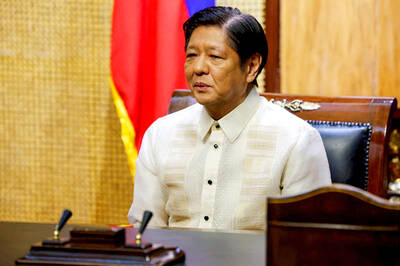
The Philippines would likely be involved in any conflict over Taiwan due to its proximity to the democracy claimed by China, President Ferdinand Marcos Jr said, reiterating a stance that risks angering Beijing. “In the Philippines, we do not have a choice because Taiwan is so close to the Philippines and we have almost 200,000 Filipino nationals living and working in Taiwan,” Marcos said in an interview with Japanese media in Manila on Monday. The Philippine leader’s comments come ahead of a state visit to Japan next week, where he is to meet with Japanese Prime Minister Sanae Takaichi to discuss security


 RSS
RSS