


In a small workshop just outside Tokyo, mechanics hammer, weld and measure as they craft “the Porsche of wheelchairs” for the world’s top Paralympic athletes ahead of next year’s Olympics.
Paralympians using wheelchairs built by OX Engineering, a small company in Chiba, have won 122 medals since 1996 — making them the gold medal champion among Japan’s main manufacturers.
Since Tokyo won the bid to host next year’s Olympics and Paralympics, orders have flown in, increasing by about one-fifth every year. The firm now makes about 500 sports wheelchairs a year for athletes from 21 countries.
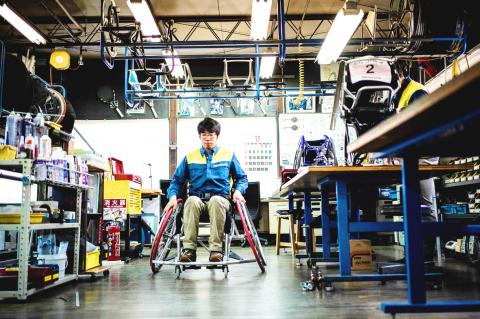
Photo: AFP
“We have the technology to make a wheelchair fit perfectly for each athlete and to help them perform at their best,” company president Katsuyuki Ishii said.
OX Engineering was founded in 1988 by Ishii’s father, Shigeyuki, who used to sell motorbikes until his life was turned upside down by injury.
Road-testing a new bike, he had an accident that caused spinal injuries and left him paralyzed.
He tried out several wheelchairs, but was unable to find a suitable one.
“My father wanted a wheelchair with a cool design like a motorbike, but there was nothing like that around at the time,” Ishii said. “Then he decided to make one himself.”
Manufacturing sports wheelchairs is high-precision work — they have to be specially designed for speed and agility, depending on the sport.
Tennis wheelchairs, for instance, have two large, angled wheels for stability in quick turns, with two casters wheels at the front and one at the back.
Racing wheelchairs, on the other hand, look completely different, with two large rear wheels and one small front wheel connected by a long shaft.
The detailed process of designing and manufacturing wheelchairs at OX Engineering remains top secret, but one of the ways the company pioneered to enhance athletes’ performance was to boost the durability of the vehicle.
The company has refined the shape of their pipes to strengthen the equipment. The ability to create personalized equipment is also key, Ishii said.
“The way the pipes are shaped, the way parts are assembled ... everything is tailored” precisely to each athlete, he said.
Shingo Kunieda, who has won 26 Grand Slam tennis titles and three Paralympic gold medals, said that a wheelchair must “feel like a part of the athlete’s body.”
“My wheelchair is my feet, so changing a wheelchair is like replacing my feet,” the 35-year-old said. “A wheelchair is made delicately. We feel something is wrong even with 1mm change.”
For Masayuki Higuchi, a middle-distance athlete who competed at the 2016 Rio Paralympics, the most important aspect of the wheelchair is “stability at high speed.”
“We race at a speed of more than 35kph, so it’s important to have stability when cornering in a group,” said the 40-year-old, who started working with OX Engineering three years ago.
As athletes compete for gold on the track, wheelchair companies are trying to outdo each other with technology.
At Rio, US athletes used what BMW claimed was “the world’s fastest wheelchair.”
The machine was made from carbon fiber, making it lighter and more shock-absorbent — but also much more expensive.
“Such a wheelchair could cost ¥3 million [US$26,862]. An ordinary athlete can never afford that,” Higuchi said.
Higuchi stressed the need to keep costs down to expand the popularity of Paralympic sport.
“If we cannot win without such wheelchairs, only a handful of athletes will be able to compete,” he said.
OX Engineering strives to keep costs down as much as possible — between ¥200,000 and ¥500,000.
“It’s not very profitable... but our mission is to provide wheelchairs ordinary people can buy,” Ishii said. “We know they want to win no matter what, so our job is to help improve their performance.”


“I don’t remember the moment, but ever since I was a kid, that’s the first thing I loved,” two-time NBA All-Star Isaiah Thomas said of his lifelong romance with basketball. However, that journey unfolded against the limitations of his size in a game where height often dictates opportunity — a reality he confronted throughout his career. At 175cm, Thomas is less than 2cm taller than the average Taiwanese adult male, while NBA players during his career stood at about 200cm on average. Compared with the NBA’s average career length of less than five years, Thomas’ 13-season career stands out as

Dakar and Rabat have longstanding ties, but relations have been strained since the Africa Cup of Nations (AFCON) final, which Senegal won in mid-January before being stripped of the title, which was transferred to Morocco. Now, the AFCON trophy is something of a thorn in the two countries’ sides. On Rue Mohamed V, the street where Moroccan vendors are based in the Senegalese capital, a police van is parked. “The police have been on high alert since the Confederation of African Football [CAF] decided to award the title to Morocco, but there have been no incidents,” a local resident said.

Hans Niemann declares he would become a “stone cold killer” in a Netflix documentary released on Tuesday about his feud with five-time classical world champion Magnus Carlsen, a pledge that injects new edge into the lingering fallout from the cheating scandal that shook elite chess. “I’m gonna be a stone cold killer the rest of my life,” the US’ Niemann says in the film. “I’m going to become the best player in the world, and no one is going to believe that now, but this clip will play over and over again in 10 years — just wait.” “I just

Top seeded Jessica Pegula on Friday once again fought back from a set down to reach the WTA Charleston Open semi-finals with a 3-6, 6-3, 6-2 win against Russia’s Diana Shnaider. Defending champion Pegula has lost the first set in all three of her matches at the tournament so far, but again dug deep to maintain her hopes of retaining the title. The world No. 5 from the US took 2 hours, 10 minutes to defeat 19th-ranked Shnaider, relying on a formidable service game that included eight aces. Shnaider battled well in the first two sets and broke early for a 2-0 lead


 RSS
RSS