


Naomi Osaka is hogging the headlines for all the right reasons in her native land after she became the first Japanese player to reach a Grand Slam singles final, with one major newspaper hailing her as “a new heroine Japan can be proud of.”
The 20-year-old, who was to face 23-time Grand Slam champion Serena Williams in the US Open final yesterday, is also helping break new ground in Japan due to her multiracial identity: the daughter of a Haitian father and Japanese mother.
She is one of several young mixed-race athletes who are challenging Japan’s traditional self-image as a racially homogenous country, including sprinter Asuka Cambridge and baseball player Yu Darvish.
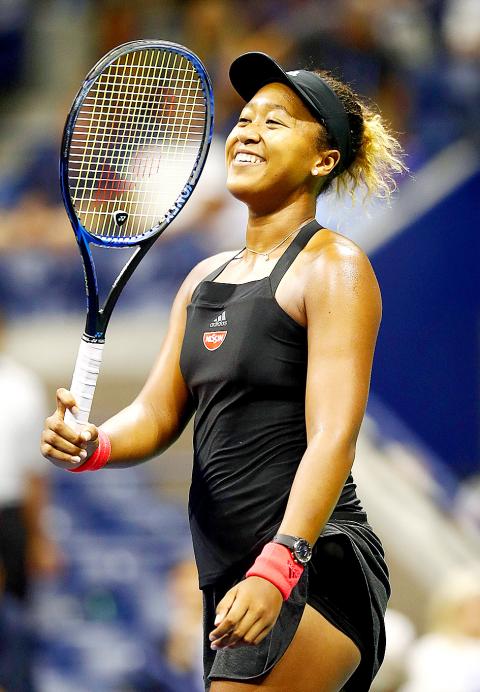
Photo: AFP
Osaka was born in Japan, but left when she was three years old and raised in the US. She holds both Japanese and US citizenship, and is far more adept in English than she is in her mother tongue.
However, many Japanese appear to have embraced Osaka, charmed by her off-court genuineness as much as her on-court ferocity.
“Her Japanese isn’t that good, right? But the way she tries to speak in Japanese is so cute,” 41-year-old Tokyo resident Yukie Ohashi said. “My impression of her is that she sticks to her beliefs and is powerful.”
The Asahi described how Osaka’s unpretentious, sometimes humorous responses in post-match interviews and news conferences have won over spectators and journalists alike.
Sometimes critical of her own post-victory speeches, Osaka admitted to being teased on social media for crying after her quarter-final win, prompting her to keep a straight face after her semi-final triumph over home hope Madison Keys.
Osaka also has a strong attachment to Japanese culture, describing her visits to the country as like a “super-awesome extended vacation that I don’t want to leave,” media have reported.
“The combination of her strength and childlike innocence is her charm,” the Yomiuri said.
Tennis is not as big in Japan as baseball, soccer or sumo, but Osaka’s 6-2, 6-4 semi-final win over Keys made the front pages of major local newspapers on Thursday — although it was dwarfed by news of the earthquake that struck Hokkaido earlier that day.
While Japan is becoming more ethnically diverse — one in 50 births is to interracial couples — there is still plenty of prejudice against haafu, or half-Japanese, including cases of bullying against mixed-race children.
However, public attitudes are slowly changing as Japanese society becomes more integrated with the global economy, and the emergence of more ethnically mixed celebrities — especially in sports — is helping.
At the 2016 Rio Olympics, Mashu Baker won a gold medal in judo and sprinter Cambridge anchored the silver medal-winning 4x100m team.
“For sure, we will have more athletes like her who are half-Japanese as athletes become more international,” said Hiroshi Nakamura, a 65-year-old fan of Osaka.
Osaka is probably the most prominent mixed-race Japanese female athlete to enter the limelight and playing Williams, who is 16 years her senior, in the US Open final is a dream come true, she said.
The pair have met just once before, with Osaka stunning Williams 6-3, 6-2 at the Miami Open in March.
The final was to be played at 5am Japan time today and even if she fails to pull off a stunning victory, the Asahi believes Osaka’s US Open run could hail the beginning of a generational shift in women’s tennis.
“She’s a new heroine that Japan can be proud of,” the Yomiuri said.

FIFA on Friday blamed the empty seats during the FIFA World Cup match between South Korea and the Czech Republic in Guadalajara, Mexico, on fans who watched from the concourses. There were many visible empty spots at the 45,664-capacity Guadalajara Stadium, with sections in the middle of the stands showing many unoccupied spaces and with other empty seats scattered around the venue. The announced attendance was 44,985 — including FIFA president Gianni Infantino. “Official attendance figures reflect the number of tickets scanned and spectators present within the stadium footprint, rather than visual assessments of seating occupancy at any given moment
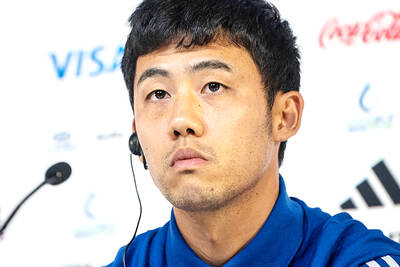
Japan captain Wataru Endo on Thursday was ruled out of the FIFA World Cup with injury and announced his international retirement, three days before his team’s opener against the Netherlands. The Liverpool midfielder pulled out of the tournament after failing to recover from a foot injury and was replaced in Japan’s squad by Shuto Machino. The 33-year-old Endo said on social media that he was “frustrated” at not being able to play, but backed his team to impress in Group F, where they face the Netherlands, Tunisia and Sweden. “There will definitely come a time in the future when Japan win the World

A rotting body was found on Friday in the trunk of a car parked near the stadium where Iran’s FIFA World Cup team is training in Mexico. The gruesome discovery came with games under way in the tournament, which is being jointly hosted by Mexico, the US and Canada. Reporters watched as police in Tijuana opened the trunk of the gray Toyota SUV, which had California plates, in the parking lot of a supermarket directly across from the Caliente Stadium, where Team Melli are training as they prepare for three games in the US. Specialists in white protective suits worked

About 100 people gathered at a bar in Taipei to watch the FIFA World Cup start in Mexico, despite the early hour of 3am yesterday. All seats had been reserved before the game started, said a clerk at the Brass Monkey, a bar in Taipei where customers can watch live sports broadcasts. The Group A clash between Mexico and South Africa drew supporters from multiple continents to the venue. For Misael Alanis, a Mexican student who has lived in Taiwan for two-and-a-half years, the atmosphere was just as important as the game itself. “There are a lot of Mexicans here and you can tell


 RSS
RSS