


Every country competing at the London Olympic Games will include female athletes for the first time in history after Saudi Arabia agreed on Thursday to send two women to compete in judo and athletics.
The move by the ultraconservative Muslim kingdom to break with its practice of fielding male-only teams followed earlier decisions by Qatar and Brunei to send women athletes to the Olympics for the first time.
“With Saudi Arabian female athletes now joining their fellow female competitors from Qatar and Brunei, it means that by London 2012 every national Olympic committee will have sent women to the Olympic Games,” International Olympic Committee (IOC) president Jacques Rogge said.
Saudi Arabia had been under intense pressure from the IOC and human-rights groups to include female athletes. Thursday’s announcement followed months of IOC negotiations with the Saudis to bring women to London.
The two female Saudi competitors are Wodjan Ali Seraj Abdulrahim Shahrkhani in judo and 800m runner Sarah Attar.
“A big inspiration for participating in the Olympic Games is being one of the first women for Saudi Arabia to be going,” the 17-year-old Attar said in an IOC video from her US training base in San Diego, California. “It’s such a huge honor and I hope that it can really make some big strides for women over there, to get more involved in sport.”
Attar, who has spent most of her life outside of Saudi Arabia, said she hopes her inclusion would encourage women in the conservative kingdom that does not even allow women to drive to participate in sports.
“To any woman who wants to participate, I say: ‘go for it,’ and don’t let anybody hold you back,” Attar said in the video after running a lap on the track wearing pants and a headscarf.
“We all have potential to get out there and get moving,” she said, speaking in an American accent.
Women in Saudi Arabia bear the brunt of their nation’s deeply conservative values. They are often the target of the unwanted attention of the kingdom’s intrusive religious police, who enforce a rigid interpretation of Islamic law.
There are no written laws that prohibit women from participating in sports, but women are not allowed into stadiums and they cannot rent athletic venues. There is no physical education for girls in public schools and no women-only hours at swimming pools.
Women cannot register for sports clubs, league competitions and other female-only tournaments with the government. They are banned from entering all-male national trials, which makes it impossible for them to qualify for international competitions, including the Olympics.
Attar and Shahrkhani were entered for the London Games by the Saudi Arabian Olympic Committee by Monday’s deadline. Neither qualified to compete in the Olympics, but they received special invitations from the IOC “based on the quality of the athletes,” Rogge said.
“We’ve looked at the ones who are the closest to qualifying standards and these were the two athletes,” he said. “That’s always the bottom line in all these invitations.”
Rights groups hailed the decision as a step forward for Saudi women in their quest for basic rights, but emphasized that the fundamental problem in the Gulf country — the legal gender segregation — remains firmly in place.
“The participation of two Saudi women in London is an important breakthrough, but will not hide the fact that millions of Saudi girls are effectively banned from sports in schools in Saudi Arabia,” Minky Worden of Human Rights Watch said. “Now is the time for the International Olympic Committee to use its leverage and lay down achievable conditions to jump-start sport in the kingdom.”
Rogge said the IOC would continue to support female Saudi athletes with scholarships and other programs.
“This is not new, we have done it in the past,” he said. “We’ll now do it with more athletes. That’s the best way to improve the skills.”
The Gulf kingdom will also include female officials in their Olympic delegation for the first time.
About 10,500 athletes are expected to compete in London, representing more than 200 national Olympic committees.
“The IOC has been working very closely with the Saudi Arabian Olympic Committee and I am pleased to see that our continued dialogue has come to fruition,” Rogge said. “The IOC has been striving to ensure a greater gender balance at the Olympic Games and today’s news can be seen as an encouraging evolution.”
The IOC said Brunei has entered one woman in athletics, Maziah Mahusin, while Qatar has entered four female athletes — swimmer Nada Arkaji, track athlete Noor al-Malki, table tennis player Aya Magdy and shooter Bahiya al-Hamad.
Qatar announced on Wednesday that al-Hamad would be the country’s flag-bearer at the opening ceremony on July 27.
“I’m overwhelmed to have been asked to carry the Qatari flag at the opening ceremony,” she said. “It’s a truly historic moment for all athletes.”
The goal of gender equity is enshrined in the IOC’s charter, but it has proved difficult to achieve.
At the 1996 Atlanta Olympics, 26 national teams had no women. The figure dropped to three in Beijing four years ago.
In Beijing, women represented 42 percent of the athletes and the figure is expected to increase in London.
Women’s boxing is included on the Olympic program in London for the first time.
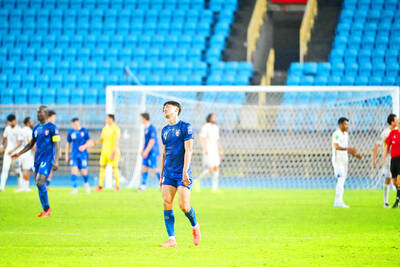
Yu Yao-hsing on Tuesday nabbed Taiwan’s only goal in the final round of qualifiers for the 2027 AFC Asian Cup, as they fell 3-1 to Sri Lanka at Taipei Municipal Stadium. Early goals from Sri Lanka in the first half left Taiwan struggling to get on the board, and Christopher Tiao’s own goal at 53 minutes sealed the team’s fate in the third round of qualifiers. While acknowledging that the defeat, Taiwan’s sixth in Group D, was disappointing, head coach Matt Ross said he saw reasons to stay positive about the team’s development. “There were lots of positive signs in terms of the
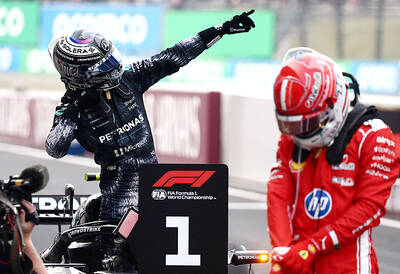
Mercedes’ Kimi Antonelli yesterday vowed to “keep raising the bar” after winning the Japanese Grand Prix to become the youngest driver in Formula One history to lead the championship standings. The 19-year-old Italian took advantage of a mid-race safety car to jump into the lead after a dreadful start from pole position, crossing the line ahead of McLaren’s Oscar Piastri and Ferrari’s Charles Leclerc. Antonelli’s Suzuka victory came two weeks after the first grand prix win of his career in China, and sent him top of the championship standings after three races, nine points ahead of team-mate George Russell. Mercedes are struggling to
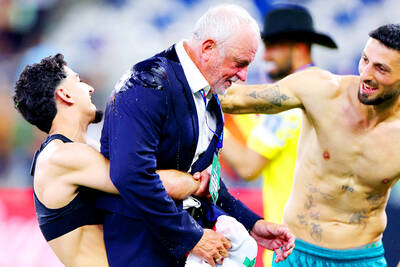
INDIGESTION: Italy failed to qualify for the World Cup for a third consecutive time after a 4-1 defeat to Bosnia on penalties in a loss Gattuso said was ‘difficult to digest’ Coach Graham Arnold on Tuesday challenged his players to “shock the world” after Iraq became the 48th and final team to qualify for the FIFA World Cup with a nerve-shredding 2-1 win over Bolivia in an intercontinental playoff in Mexico, as Bosnia and Herzegovina, Turkey, the Czech Republic, Sweden and the Democratic Republic of the Congo (DRC) also secured their places at the finals. Iraq, whose preparations were disrupted by the war in the Middle East, sealed their first appearance at the finals in 40 years and are to play in Group I against France, Senegal and Norway. Goals from Ali al-Hamadi

Teng Kai-wei, the only Taiwanese player on an opening-day roster in this year’s Major League Baseball (MLB) season, took his first win of the year with the Houston Astros in his season debut. Teng entered in relief in the top of the fifth inning against the Los Angeles Angels on Saturday, with the Astros trailing 5-0. He pitched 2-1/3 scoreless innings with two strikeouts, as Houston scored 11 runs during his outing to snatch an 11-9 comeback victory. The win is the Astros’ first of the season and the third of Teng’s MLB career. “It’s my first time pitching for the Astros, so


 RSS
RSS