


The World Cup was treated to its final, just two games too early. For drama and intensity, the spectacle of the Netherlands stunning and bullying Brazil will be hard to outdo at this tournament.
The five-time champions are such soccer giants that there is always an earthquake-like thump when they are brought to their knees. Yet, this time, their 2-1 loss didn’t feel like a massive shock.
Kaka and his amigos mistakenly thought they could lift the heavy gold statue without showing up in South Africa with the beautiful game that made Pele and his teammates world-famous.
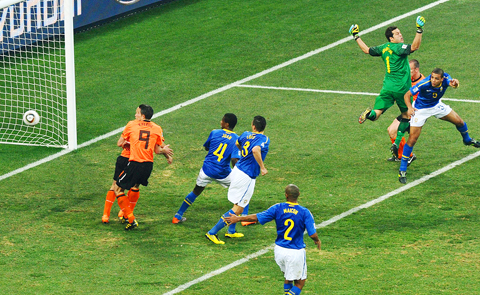
PHOTO: AFP
Coach Dunga gambled that merely winning would be enough to assuage the critics on the beaches and farms, in the cities and shantytowns back home who worried that Brazil’s traditions of entertaining, dancing soccer were being betrayed.
Dunga was right. Had Brazil won, the manner of it wouldn’t have mattered, but losing wasn’t part of the deal. In the end, the manner of Brazil’s play was far more important than Dunga made out. In kidding themselves that efficient, often unglamorous, percentage soccer would take them to the July 11 showpiece match, the Brazilians forgot to light up and really spark in South Africa. They were definitely good, but not Brazilian brilliant, and that was their undoing. They let Argentina claim the crown as kings of attacking, inventive soccer. As a result, Diego Maradona is looking like an increasingly good bet to win the World Cup both as a player and coach.
Dunga blamed a poor second-half against the Dutch, but that was only half the story.
In five World Cup games, Brazilian beauty came only in flashes and it wasn’t enough. Maicon’s oooh-aaah! strike in the first match against the North Koreans, squeezed between the keeper and his post from the tightest of angles, was, in fact, a mirage, because it misleadingly suggested that Brazil would be both flashy and victorious. With hindsight, the 55 minutes it took Brazil to break open the Korean defense should have set alarm bells ringing.
Luis Fabiano’s illegally handled second goal took some of the shine off Brazil’s 3-1 defeat of Ivory Coast. A goalless draw with Portugal was not only boring, but again showed that Brazil couldn’t call up goals at will. Only half an hour into the round of 16 elimination game against Chile did Brazil finally turn it on.
Never mind, we told ourselves, this is Brazil. They’ll find a higher gear when they need it.
Well, they needed it against the Netherlands, but instead, they lost their heads. Turns out that Brazilians get hot, bothered and lose their focus when niggled by the likes of Mark van Bommel, who was a real bully in the Dutch midfield, and Arjen Robben, who did not score, but made a real pest of himself with his light-footed runs.
A turning point was Felipe Melo’s stupid hot-headed stamp on Robben’s thigh. It got him sent off with 20 minutes left, scuttling Brazil’s chances of recovering from its 2-1 goal deficit.
Also vital was Maarten Stekelenburg’s astounding save of Kaka’s shot on 31 minutes. Had it gone in, it would have been curtains for the Netherlands, giving Brazil a 2-0 lead.
The lead-up — Robinho wriggling past two defenders, passing to Luis Fabiano, his subsequent backheel to Kaka — was the most delightful piece of Brazilian play at this World Cup. Had Brazil done that more often, Brazil would still be here, not making excuses.
“I just called home and my son was crying,” Felipe Melo said after the match. “I have to apologize.”
However, the fault was collective not individual, and it didn’t help Brazil that Kaka was not at his best in South Africa. Like other stars of world soccer — think Ronaldo, Wayne Rooney or Samuel Eto’o — he failed to live up to his billing.
Like his team.

Greek swimmer Kristian Gkolomeev was the only athlete to “beat” a world record on Sunday at the Enhanced Games, winning the men’s 50m freestyle at the divisive competition where athletes were free to take performance-enhancing substances. His time of 20.81 seconds — which is not considered official — came in the final event of the night in Las Vegas, sparing the blushes of organizers who made claims that multiple world records would be surpassed due to a sophisticated doping regime. Gkolomeev, who was wearing a synthetic “supersuit” long banned at events such as the Olympics, outpaced Australia’s Cameron McEvoy’s 20.88 set in

Fred Kerley is competing unaugmented against drug-fuelled athletes at this weekend’s Enhanced Games and still hopes to race in the 2028 Olympics, the suspended former 100m world champion said on Friday. Arguably the biggest name at the divisive event in Las Vegas, where doping is permitted, the US sprinter said he had chosen not to take any of the banned substances including testosterone and steroids that his competitors have been using. “I don’t need it. God gave me fast feet for a reason. And I’m here to showcase my talent,” Kerley said. Kerley last September became the first US competitor and first track
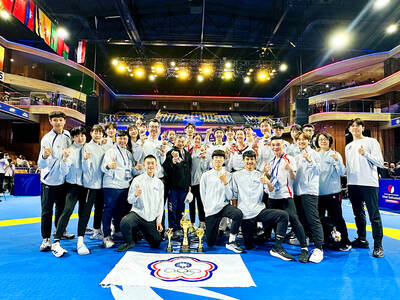
VICTORY ABROAD: The team took home a fistful of medals and secured spots for the autumn’s Asian Games, scheduled for September in Nagoya Taiwan’s women’s team captured the overall title at the Asian Taekwondo Championships in Mongolia on Sunday, finishing with two golds, one silver and one bronze medal. The strong showing, led by gold medalists Wang Chieh-ling and Chang Jui-en secured the full quota of available spots for Taiwan at the Asian Games in Nagoya, Japan, in September. Wang opened Taiwan’s medal run by winning gold in the women’s under-46kg class on Thursday, the first day of competition. Liu Yu-yun later earned a silver in the under-49kg class. On the final day on Sunday, Chang won Taiwan’s second gold medal in the under-62kg event, and
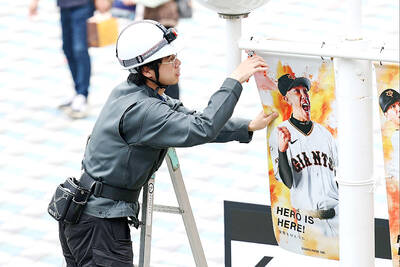
The manager of the Yomiuri Giants, one of Japan’s most popular baseball teams, resigned yesterday after he was arrested for allegedly physically attacking his teenage daughter. Shinnosuke Abe allegedly grabbed the 18-year-old and forced her to the floor at their home in central Tokyo on Monday evening, reported national broadcaster NHK and Kyodo News, citing unnamed police sources. “Leaving like this really means I’m causing you a lot of trouble, and I feel truly sorry about that,” Abe told a hastily arranged news conference, his eyes red with tears. The former star catcher, who is among baseball-obsessed Japan’s most recognized sports figures,


 RSS
RSS