


The Uni-President Lions’ unexpected triumph over South Korea’s SK Wyverns and its close battle against Japan’s Seibu Lions last weekend in the Konami Cup Asia Series have reignited the nation’s passion for professional baseball.
However, the team’s much-applauded performance cannot overshadow the fact that the Chinese Professional Baseball League (CPBL) is struggling to stay in operation with only four teams left after the Chinatrust Whales went belly-up last week.
Whales president Charles Lo (羅聯福) said in a press conference last week the decision to disband the team had a lot to do with its performance over the years.

PHOTO: LIN CHENG-KUN, TAIPEI TIMES
“We were simply no match for the top three teams when you compare our offense and defense statistics with theirs,” he said.
At one point, Lo said, he had proposed merging the Whales and Brother Elephants to help raise the overall performance of the players. The Elephants, however, turned down the idea.
He also sought to merge with the dmedia T-Rex, but threw in the towel when T-Rex players were accused of match-fixing in collusion with underground syndicates. The match-fixing searchlight has since also fallen on the Whales.
Lo has several ideas on fixing the problems plaguing the league.
He suggested that the CPBL reform the nation’s professional baseball system by toughening penalties for game-fixing, establishing a free-agent system, making the CPBL an independent operation and listing CPBL games in sports lotteries.
Meanwhile, Lo said each of the remaining teams should implement a system of first-tier and second-tier players to ensure that good players have a way to move up the career ladder.
The Chinatrust Group’s decision to disband the Whales came as no surprise to many CPBL enthusiasts.
“They were a box office killer, and the players’ skills did not seem to improve,” baseball fan “Danny Tu” (丹尼兔) said in his online journal.
Last year, five Whales players were implicated in gambling allegations, which piled more straw on the camel’s back, he said.
Another baseball fan, “Jason,” who cited left-handed pitchers Sheng Yu-chieh (沈鈺傑) and Ni Fu-te (倪福德) as his favorite Whales players, blamed the CPBL, saying it was unable to stop players from engaging in gambling.
“Taiwan’s baseball fans spend tonnes of money flying overseas to watch Taiwan play against another country, or burn the midnight oil to watch Wang Chien-ming (王建民) on TV,” he said.
“But they don’t want to buy tickets to watch a CPBL game. They probably don’t even bother to switch TV channels to watch a CPBL game. Have people in the CPBL wondered why this is?” he asked.
While fans lament the demise of a professional team, experts say it might offer an opportunity for the CPBL to change its fate.
“Four teams are the bottom line, but it’s not necessarily a bad thing,” National Taiwan Museum researcher Hsieh Shih-yuan (謝仕淵) said.
Hsieh, who has written a book on the history of baseball in Taiwan, said the interference of underground syndicates was the biggest problem afflicting local professional baseball.
The government needed to recognize the significance of baseball to Taiwanese and file harsher criminal charges against game fixers, he said.
“We absolutely cannot let professional baseball die,” Hsieh said. “Players representing Taiwan internationally are mostly chosen from domestic professional baseball teams. If the league fails, not only would it affect Taiwan’s international performance, it would also destroy the amateurs’ path to pro baseball.”
Hsieh agreed with Lo that a well-rounded second-tier player system is badly needed, but does not share his opinion on free-agent players. Nor is he confident that listing CPBL games in sports lotteries would curb gambling.
“The [free-agent] system only benefits more wealthy baseball sponsors, like Chinatrust, that have the financial capacity to support high-profile players who can give the box office a boost,” Hsieh said.
“Underground gambling is a well-established industry. It did not cease to exist after the nation introduced sports lotteries,” he said.
The Sports Affairs Council is meanwhile scheduled to review a surrogate training program today that would exempt selected players undergoing training with professional baseball teams from military service.
The program could become the major source for second-tier players.
Wu Chun-che (吳俊哲), director of the council’s athletic sports department, said although the council requires each team to have at least 20 second-tier players and three coaches for them, not a single team met the requirement last year.
Wu said that the Chinese Taipei Baseball Association has proposed that surrogate program players be trained at the National Athletes Training Center in Tsoying (左營), and that they be collectively trained by coaches recruited by the association.
Liu Chi-sheng (劉志昇), manager of the CPBL’s Sinon Bulls, said the council kept changing its policy on the program, making it difficult for teams to establish a second-tier system.
“The council should not confuse the surrogate training program with the professional second-tier team we are talking about here,” he said. “Players from a professional second-tier team should act as replacements if any of the first-tier players are injured. Participants in the surrogate training program would not necessarily be capable of handling a professional game.”
The council will discuss various possibilities at the meeting today, Wu said.

Greek swimmer Kristian Gkolomeev was the only athlete to “beat” a world record on Sunday at the Enhanced Games, winning the men’s 50m freestyle at the divisive competition where athletes were free to take performance-enhancing substances. His time of 20.81 seconds — which is not considered official — came in the final event of the night in Las Vegas, sparing the blushes of organizers who made claims that multiple world records would be surpassed due to a sophisticated doping regime. Gkolomeev, who was wearing a synthetic “supersuit” long banned at events such as the Olympics, outpaced Australia’s Cameron McEvoy’s 20.88 set in

Fred Kerley is competing unaugmented against drug-fuelled athletes at this weekend’s Enhanced Games and still hopes to race in the 2028 Olympics, the suspended former 100m world champion said on Friday. Arguably the biggest name at the divisive event in Las Vegas, where doping is permitted, the US sprinter said he had chosen not to take any of the banned substances including testosterone and steroids that his competitors have been using. “I don’t need it. God gave me fast feet for a reason. And I’m here to showcase my talent,” Kerley said. Kerley last September became the first US competitor and first track

The manager of the Yomiuri Giants, one of Japan’s most popular baseball teams, resigned yesterday after he was arrested for allegedly physically attacking his teenage daughter. Shinnosuke Abe allegedly grabbed the 18-year-old and forced her to the floor at their home in central Tokyo on Monday evening, reported national broadcaster NHK and Kyodo News, citing unnamed police sources. “Leaving like this really means I’m causing you a lot of trouble, and I feel truly sorry about that,” Abe told a hastily arranged news conference, his eyes red with tears. The former star catcher, who is among baseball-obsessed Japan’s most recognized sports figures,
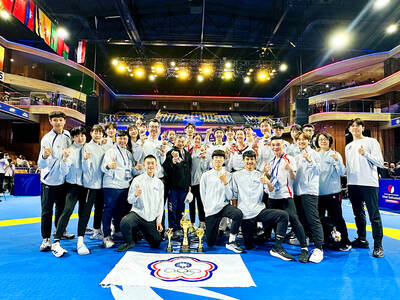
VICTORY ABROAD: The team took home a fistful of medals and secured spots for the autumn’s Asian Games, scheduled for September in Nagoya Taiwan’s women’s team captured the overall title at the Asian Taekwondo Championships in Mongolia on Sunday, finishing with two golds, one silver and one bronze medal. The strong showing, led by gold medalists Wang Chieh-ling and Chang Jui-en secured the full quota of available spots for Taiwan at the Asian Games in Nagoya, Japan, in September. Wang opened Taiwan’s medal run by winning gold in the women’s under-46kg class on Thursday, the first day of competition. Liu Yu-yun later earned a silver in the under-49kg class. On the final day on Sunday, Chang won Taiwan’s second gold medal in the under-62kg event, and


 RSS
RSS