


The tranquil countryside of Royal Berkshire on a mild, spring afternoon doesn’t seem like the ideal location to prepare for the sapping heat and humidity of Beijing.
Nestling in it, though, is a chamber of secrets designed to give British Olympians the edge over European rivals.
The British Olympic Association has drawn on the country’s military expertise in desert and jungle warfare to ensure medal hopefuls aren’t restricted by the oppressive conditions expected in August.
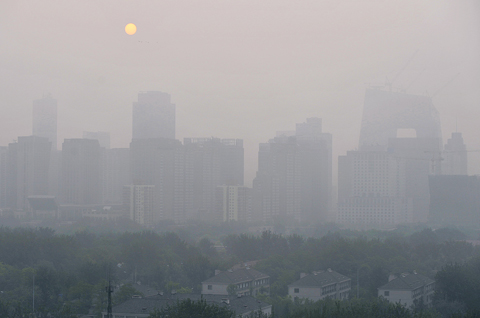
PHOTO: AFP
Unlike the choking pollution anticipated, heat cramps and exhaustion are hindrances that can be suppressed by training in the chamber-cum-laboratory 50km west of London.
With scientists monitoring equipment, athletes ride on exercise bikes and rowing machines at the English Institute of Sport High Performance Centre that is set to 80 percent humidity to simulate the Chinese capital’s expected impediments. A selection of ice vests are used to lower the body temperature.
The British have calculated that thermal stress can impact on 90 percent of the performance of their athletes, who will be banned from sunbathing in China and at the pre-games training camp in Macau.
“With Beijing’s prevailing conditions of high temperatures coupled with high humidity, the first priorities must be cooling and hydration and that is where we have concentrated our energies,” Scott Drawer of UK Sport said. “With medals won by increasingly small margins, we have analyzed every factor that can affect the ability of our leading athletes to perform to their potential.
“Every games location brings with it its own set of special challenges and our job is to equip every sport with a toolkit that will allow them to meet those challenges head on,” he said.
Preparations for Beijing have been under way since the 2004 Athens Games when Britain’s marathon favorite Paula Radcliffe dropped because of dehydration.
Marco Cardinale, the Italian charged with science and research for the British Olympic Association, believes his training tool outstrips those of his European rivals.
“We are at the same level as the Americans and Australians,” Cardinale said, emerging from the chamber’s choking heat. “But we have some knowledge and solutions that are unique that will be unveiled during the games, but we want to keep them as close as we possibly can.”
Such as the work with Britain’s Ministry of Defense. Cardinale’s team has picked up tips from the military’s creativity in handling humid conditions, notably during the 2003 invasion of Iraq.
Such is the sensitivity of the information that everyone working on the project must sign confidentiality agreements.
“The army is a big source of research,” Cardinale said.
“They know how to perform highly complicated tasks in hot environments and we tap into their research to learn some lessons,” he said. “We want to make sure athletes get there in the prepared condition possible and we’ve left no stone unturned with our preparations.”
One thing that can’t be simulated is Beijing’s pollution, with ethical problems cited in recreating those conditions.
“There isn’t much we can do,” Cardinale sighed.

Greek swimmer Kristian Gkolomeev was the only athlete to “beat” a world record on Sunday at the Enhanced Games, winning the men’s 50m freestyle at the divisive competition where athletes were free to take performance-enhancing substances. His time of 20.81 seconds — which is not considered official — came in the final event of the night in Las Vegas, sparing the blushes of organizers who made claims that multiple world records would be surpassed due to a sophisticated doping regime. Gkolomeev, who was wearing a synthetic “supersuit” long banned at events such as the Olympics, outpaced Australia’s Cameron McEvoy’s 20.88 set in

The manager of the Yomiuri Giants, one of Japan’s most popular baseball teams, resigned yesterday after he was arrested for allegedly physically attacking his teenage daughter. Shinnosuke Abe allegedly grabbed the 18-year-old and forced her to the floor at their home in central Tokyo on Monday evening, reported national broadcaster NHK and Kyodo News, citing unnamed police sources. “Leaving like this really means I’m causing you a lot of trouble, and I feel truly sorry about that,” Abe told a hastily arranged news conference, his eyes red with tears. The former star catcher, who is among baseball-obsessed Japan’s most recognized sports figures,

For some, Cristiano Ronaldo remains the essential spearhead for Portugal’s FIFA World Cup bid, while others believe his presence would prevent Roberto Martinez’s strong side from flourishing. The debate around the five-time Ballon d’Or winner rages on, as it did at UEFA Euro 2024 and four years ago in Qatar — yet Ronaldo endures, ready to play in a record sixth World Cup. The 41-year-old remains a global superstar despite swapping the European elite for Saudi Arabia’s Al-Nassr, and is the leading men’s international goalscorer with 143 strikes. With 25 of those coming in 30 games under Martinez, the coach
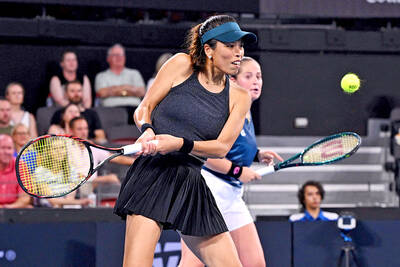
Taiwanese tennis star Hsieh Su-wei on Wednesday advanced to the second round of the mixed doubles at the French Open, after she and German partner Mark Wallner defeated Slovenian Andreja Klepac and Briton Lloyd Glasspool in straight sets, despite temperatures exceeding 32°C in Paris, while Taiwan’s top men’s doubles player Ray Ho also reached the second round. Hsieh, who made it to the semi-finals in the mixed doubles at Roland Garros in 2024, and Wallner defeated Klepac and Glasspool 6-3, 7-5 in just more than an hour, converting three of five break points, while holding their opponents to just one conversion


 RSS
RSS