

The Chinese-language media reported yesterday that an unidentified person contacted prosecutors on Tuesday, claiming that a politician from Hsinchu was behind the recent sex VCD scandal.
Suspect Kuo Yu-ling (
The man was questioned by prosecutors afterward and the results led to Kuo being summoned a second time and later detained, the report said.
Prosecutors at the Taipei District Prosecutors' Office denied the report.
Kuo, a "spiritual growth" instructor with a US-based group named Avatar, was detained yesterday on suspicion of involvement in the creation and release of a secretly recorded VCD allegedly depicting a sexual encounter between Chu Mei-feng (璩美鳳), the former director of Hsinchu's Cultural Affairs Bureau, and married businessman Tseng Chung-ming (曾仲銘).
Kuo, a close friend of Chu, is believed to have had a falling out with Chu in August. The cause of the soured friendship is still unclear, although local media speculation has suggested a financial dispute and a love triangle.
Kuo, who had the keys to Chu's house in Tamsui, did not return them to Chu until September, the report said.
A detective agency has confirmed with prosecutors that Kuo had bought a pinhole camera and had it installed at Chu's house, the report said.
Investigators suspect Kuo may have installed the pinhole camera as early as July of this year, according to the report. The camera has apparently been removed since then and investigators are still looking into how and where the camera was installed in Chu's bedroom.
Kuo had also taken security tapes out of Chu's apartment complex twice in July, the report said.
Chu is also a former girlfriend of Hsinchu's former DPP mayor Tsai Jen-chien (
On Dec. 1, Tsai lost his re-election bid and Chu lost her legislative bid to represent the New Party in the Taichung constituency.
Meanwhile, the Hsinchu City Government was hit by fallout from the scandal after newly inaugurated KMT Mayor Lin Jeng-jzer (林政則) said the city's anti-corruption department was preparing a report into alleged irregularities in the creation of a special budget for "spiritual growth" courses for city officials while Tsai was in office.
Chu was one of the officials who attended Avatar classes taught by Kuo.
Lin also hinted that the courses were pushed through by a former high-level city official, adding that neither Chu nor Tsai was the official in question.
Lin appeared to be pointing the finger at former deputy mayor Lin Cheng-chieh (
The new Hsinchu mayor did not elaborate on how spending on the spiritual growth course violated regulations, but said the city government will not require its officials to attend any more spiritual courses.
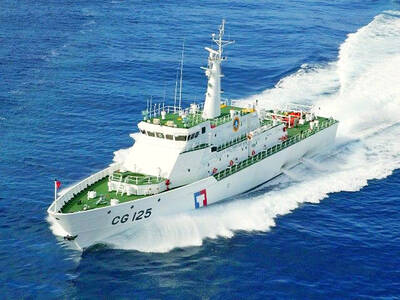
GEOPOLITICAL SIGNIFICANCE: The CGA’s nonmilitary role makes it a tool to avert diplomatic issues, an official said, while confirming the donation of a ship to Manila Coast Guard Administration (CGA) ships are scheduled to sail to the Philippines bearing the words “Taiwan Coast Guard” in a high-profile visit in October next year, the first such visit by a Taiwanese maritime law enforcement vessel to the Southeast Asian nation, the agency said yesterday. The CGA also confirmed that it had donated one of its decommissioned patrol vessels to the Philippines in a rare transfer of a retired ship to a nondiplomatic ally. The Republic of China (ROC) Navy last made such a visit in 1974, shortly before the Philippines switched diplomatic recognition to the People’s Republic of China in
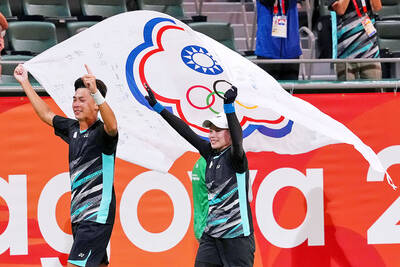
SOFT TENNIS: Yu Kai-wen and Huang Shih-yuan narrowly defeated their Japanese rivals to capture Taiwan’s first gold at the Asian Games in Nagoya Yu Kai-wen (余凱文) and Huang Shih-yuan (黃詩媛) won Taiwan’s first gold of this year’s Asian Games, defeating a Japanese duo in a nail-biter in the soft tennis mixed doubles final in Nagoya, Japan, while Johnny Sun (孫家閎) won silver in wushu and Shih Cheng-chung (石政中) won bronze in men’s kumite. Yu and Huang narrowly defeated Japan’s Toshiki Uematsu and Rena Temma 5-4 (2-4, 5-3, 4-2, 1-4, 1-4, 4-0, 1-4, 4-1, 7-5) to give Taiwan its first gold in soft tennis mixed doubles at an Asian Games since 2018. Sun secured Taiwan’s first wushu medal at this year’s game, with a combined score

CALL FOR CHANGE: They urged the UN to facilitate Taiwan’s involvement in the body, recognize its peace efforts and to work with members in preventing military conflict Representatives to the UN from five of Taiwan’s diplomatic allies sent a joint letter to UN Secretary-General Antonio Guterres on Friday, calling for the country’s inclusion in the body. Allies in the letter sent ahead of the 81st session of the UN General Assembly General Debate made three demands in support of Taiwan: inclusion, recognition and camaraderie. They implored the UN to seek an appropriate way to facilitate Taiwan’s meaningful involvement in the world governing body, saying that UN Resolution 2758, which accepted the People’s Republic of China (PRC) as a member of the UN, does not exclude Taiwan. Beijing claims that the
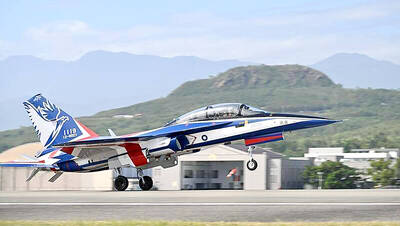
Aerospace Industrial Development Corp (AIDC, 漢翔航空工業) has finished production of the nation’s T-5 Brave Eagle (勇鷹) advanced jet trainers, with the final aircraft scheduled to be formally delivered at a ceremony on Thursday. The delivery of the trainer jets marks the end of the program, which dates back to 2017, with the first prototypes completed in 2019. Fifty-six of the 66 trainers had been delivered as of May. The Brave Eagle was developed and produced by AIDC and the National Chungshan Institute of Science and Technology. The program has provided a foundation for the development of a domestically produced next-generation primary trainer and


 RSS
RSS