


Nguyen Thi Leu of Vietnam finally bid farewell to Taiwan on Saturday, which she had called home. During her four-month stay, she said her beautiful dream of a better life in a new country became a nightmare, as her new home turned into hell.
"I'd never want to come back again," she said.
Nguyen, 21, was handpicked by her Taiwanese husband, who is 13 years her senior, at a bride camp in Ho Chi Minh City in May. Three days later, he gave her family NT$5,000 (US$150) as a gift for the wedding.

PHOTO: CHEN CHENG-CHANG, TAIPEI TIMES
While Nguyen thought she was about to embark for a new and better life in a foreign land, she quickly learned that things were not what she had expected.
Just a few days after her wedding, Nguyen found out that her husband was already married with three children, and that his wife was living above their apartment in a building in Wuku, Taipei County. Nguyen said her husband told her that he was divorced from his first wife.
During the four-month marriage, Nguyen said she was physically and verbally abused by her husband, the other wife and the wife's family.

PHOTO: CHEN CHENG-CHANG, TAIPEI TIMES
Although Nguyen personally did not wish to file for a divorce, she said she was tricked into signing divorce papers because she could not read Chinese and spoke little of the language.
"I still love him. He is, after all, my husband," Nguyen said.
Sitting at a McDonald's on Chungshan North Road in Taipei City's Shihlin District, Nguyen said that her four-month marriage has changed her life for good.
"I regret that I married a Taiwanese and I don't think I'll ever get married again," said Nguyen, who was still wearing her gold wedding band.
The second child and the first daughter of a family of six, Nguyen was recruited by the bride camp in Ho Chi Minh City, which promised her family that it would find her a rich husband from either Taiwan or South Korea.
Nguyen's parents, who eke out a meager living by fishing, encouraged her to go to the bride camp because it seemed the only way to get Nguyen -- an elementary school drop-out -- out of poverty.
"I didn't want to go because if I did, I'd have to break up with my boyfriend," she said, wiping her tears.
"I eventually ended up going because I had to help my family pay off its debts."
Nguyen's family had borrowed US$1,000 from loan sharks when she was 15 so that she could have surgery on her intestines. The mounting interest on the loan over the last five years had only exacerbated the family's economic difficulties.
Nguyen said there were about 10 women at the bridal camp while she was there. Food and accommodation were provided free of charge, with the husbands reimbursing the camp for their brides' expenses.
Nguyen's husband paid NT$8,500 to marry Nguyen, including the NT$5,000 that went to her family.
After six months of waiting, Nguyen met her husband. However, the four-month marriage was one nightmare after another.
"His [other] wife did everything to pick fights with me. When she was really upset with me, she would use scissors to cut my clothes," Nguyen said.
In addition to her husband's three children, Nguyen said she also had to take care of her husband's sister-in-law's three children.
Nguyen said she was badly beaten by her husband when she confronted him about tricking her into signing the divorce papers.
"They held me by the hands so he would be easily able to hit me," she said, referring to her husband's wife and his mother-in-law.
After the beating, Nguyen saw a doctor, who gave her a document certifying that she had been injured in a manner which strongly suggested abuse.
Armed with the certificate, Nguyen was ready to file a lawsuit against her husband, but was dissuaded from doing so because he said he would pay her NT$120,000 to settle the matter out of court.
With the money now in her hands, Nguyen said she would use it to help her family pay off its debt.
"One thing I'm reluctant to let go of here is my father-in-law," she said. "A few days ago, he was telling me over the phone how much he missed me. I'd really hate to tell him that our marriage didn't work." (Nguyen's father-in-law did not live in the building with her husband's family.)
Love at first sight
It was love at first sight when Fang Tse (方策) was introduced to Nguyen Thi Diem (no relation to Nguyen Thi Leu), during his vacation in Vietnam in the summer of 1993.
After corresponding for a year, the two finally tied the knot.
Now happily married with a four-year-old boy, Fang, 35, said that he was attracted to Vietnamese women because they are beautiful and share similar culture and customs.
"Although my wife didn't speak Chinese when we met, she took the time to learn and asked her Chinese friends to read my letters to her in Vietnamese and to write me back in Chinese," Fang said at the kitchen table of his Tamsui home on Tuesday evening.
Although his parents at first disapproved of his decision to marry a foreigner, Fang said that they eventually gave in.
When Nguyen first came to Taiwan, the food was one of the many things that she had trouble adjusting to.
"It took her six months to get used to the food and about a year to adapt to the environment," Fang said.
Now looking more Taiwanese than her husband, who is a native of the Paiwan tribe, Yguyen is a volunteer interpreter and counselor at the foreign brides training camps sponsored by Taipei City's civil affairs bureau.
"I know how hard it is to marry a foreign husband and live in a foreign country. My heart sinks when I think of those who are not as lucky as I am to have such a loving husband and such caring in-laws," she said.
Nguyen did not encounter much opposition from her family and friends when she decided to marry Fang.
"My parents adore him because they think he's an honest man although he's not rich," Nguyen said.
"Besides, it doesn't bother me much to live in a foreign country as long as I'm with the one I love."
One piece of advice Nguyen said she would give to foreign brides is to reach out for help.
"Over the past few months as a counselor, I've seen many foreign brides withdraw from society because of their limited communication skills. My advice to them is to speak out because no one will know your problems and come to your rescue if you keep it to yourself," she said.
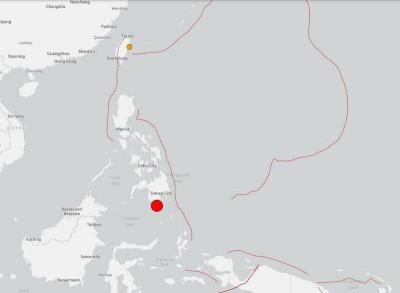
A magnitude 7.8 earthquake struck off the southern coast of Mindanao in the Philippines at 7:38am today, prompting the US Tsunami Warning System to issue an alert for neighboring countries, including Taiwan. The system issued a purple alert indicating a "tsunami threat." The potential threat zone includes Taiwan, the Philippines, Papua New Guinea, Yap and Palau. Philippine authorities were assessing the damage from the quake, with the office of civil defense seeking to verifying initial reports that 15 people had been killed and 129 injured in the region, mostly from falling debris. Arlene Hollero, disaster chief of Maasim town in the Philippines' Sarangani Province,

‘GRAY ZONE’ PRESSURE: Beijing’s activities are intended to create the deceitful impression that China has jurisdiction over the area around Taiwan, the CGA said Taiwan’s rights over its territorial waters and exclusive economic zone must not be violated by any country, the Mainland Affairs Council said yesterday, adding that it will not accept any unprovoked actions. The council issued the remarks in response to the China Coast Guard conducting maritime enforcement drills near eastern Taiwan and claiming to fully exercise China’s maritime administrative law enforcement authority. The Coast Guard Administration (CGA) has been closely monitoring the situation and is taking concrete steps to defend the nation’s sovereignty and secure its waters, the council said. China has no sovereign rights over the waters off eastern

RESILIENCE: Taiwan plays a key role in semiconductors, energy, information infrastructure and advanced manufacturing, AIT Director Raymond Greene said Taiwan’s continued investment in deterrence and resilience remains vital, especially in uncrewed systems and other emerging technologies, American Institute in Taiwan (AIT) Director Raymond Greene said yesterday. Greene made the remarks at the annual National Strategic Summit on Supply Chain Resilience held by the Research Institute for Democracy, Society and Emerging Technology (DSET), a government-backed think tank. As Taiwan last year became the US’ fourth-largest trading partner and supply chain security is becoming more important, cooperation in emerging technologies continues to deepen between the two countries, he said. The US is committed to accelerating innovation, building key infrastructure, strengthening cooperation

RIGHT DIRECTION: Taiwan’s efforts to prevent forced labor include a proposal to ‘fully prohibit’ employers from withholding workers’ documents, an official said Taiwan is to establish a mechanism to restrict imports of goods linked to forced labor, the Executive Yuan said yesterday, after the US proposed imposing additional tariffs on Taiwanese goods over labor concerns. “The Ministry of Labor and the Ministry of Economic Affairs are to establish an interministerial review procedure,” Executive Yuan spokesperson Michelle Lee (李慧芝) said at a news briefing in Taipei. “The government is to use the Foreign Trade Act [貿易法] as the legal basis to restrict imports of goods produced with forced labor” and bring its supply chain governance more in line with international standards on human rights, resilience


 RSS
RSS