


With the change in leadership yesterday in the Ministry of Justice's Investigation Bureau (MJIB), the bureau's future stance toward the Cabinet-proposed establishment of an anti-corruption administration has raised public concern.
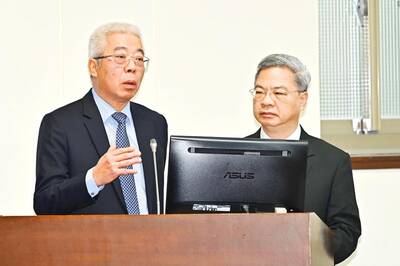
Asked by the media after his swearing-in ceremony about his stance on the issue, the bureau's new director Yeh Sheng-mao (
To be sure, whether or not the planned anti-corruption agency will materialize depends ultimately on the legislature. Indeed, in recent months controversy has raged about allegations that the investigation bureau has conspired with opposition legislators to resist the government proposal.

PHOTO: LIAO RAY-SHANG, TAIPEI TIMES
The draft of the anti-corruption administration law was still being reviewed in committee when the last legislative session ended in June. Before that it had been blocked several times by KMT lawmakers from even being discussed at the committee stage of the review process.
MJIB personnel are concerned that the bureau would be weakened by a new agency.
Former bureau director Wang Kuang-yu (
Though never clearly stating that he or the bureau were against the proposal, Wang obviously embarrassed his boss, Minister of Justice Chen Ding-nan (
Analysts differed as to whether the new bureau director would be supportive of the government's proposal.
Hsieh Li-kung (謝立功), a bureau investigator-turned scholar and associate professor at the Central Police University, said that since Yeh has better relations with President Chen Shui-bian (陳水扁) than Wang had, resistance from the bureau would be minimal "if President Chen is determined to set up the anti-corruption administration."
But supporters and opponents of the proposal disagree about the president's attitude.
A senior official at the justice ministry's Department of Government Ethics (
to fighting corruption must be
established.
"And this is the Cabinet's policy," he said. The draft was passed to the legislature last October by the Executive Yuan.
However, Su Yu-chi (蘇玉麒), spokesman for the Investigators' Reform Association (調查員改革協會), which is against the proposal, speculated that the president's intention is still not clear.
Members of the association believe that it is more important to reform the investigation bureau and promote its efficiency in fighting corruption than it is to establish a new organization doing a similar job.
Acknowledging that resistance from investigators may be a problem, however, the government ethics department is making efforts to convince opposition legislators.
A government ethics department official, who declined to be named, said they expected the draft to pass the legislation in the new legislative session that begins next month.
The key to changing the attitude of opposition lawmakers would be an amendment to the current draft, the ethics official said.
"Some opposition lawmakers oppose the establishment of anti-corruption administration because they may have committed corrupt acts in the past," he said.
"Now we are considering creating an article [of the bill] specifying that the new agency only deals with crimes committed after its establishment."
"This would neutralize the opposition's worries that the newly established agency might become a government instrument for purging its political foes," the official said.
Of course, he said, other law enforcement agencies, such as the bureau, could still investigate past cases. "This would also lessen the resistance from the MJIB."
However, he said, it would not be proper for the government itself to propose the idea. The ministry would seek the cooperation of DPP lawmakers to hold public hearings and propose the insertion of the article, he said.
"We hope the public hearings will be held before Sept. 18, the day the next session starts."
The nearness of the year-end elections, he said, would serve as an advantage to advocates of the anti-corruption administration. "Public opinion will strongly favor the anti-corruption plan," he said.
Hsieh agreed. "The question of whether or not to establish an anti-corruption administration is a more complex issue than whether we should fight corruption -- the public tends to simplify issues."
"Under the circumstances I think few politicians would strongly oppose the proposal," Hsieh said.
Taiwan has arranged for about 8 million barrels of crude oil, or about one-third of its monthly needs, to be shipped from the Red Sea this month to bypass the Strait of Hormuz and ease domestic supply pressures, CPC Corp, Taiwan (CPC, 台灣中油) said yesterday. The state-run oil company has worked with Middle Eastern suppliers to secure routes other than the Strait of Hormuz, through which about 20 percent of the world’s oil and liquefied natural gas typically passes, CPC chairman Fang Jeng-zen (方振仁) said at a meeting of the legislature’s Economics Committee in Taipei. Suppliers in Saudi Arabia have indicated they
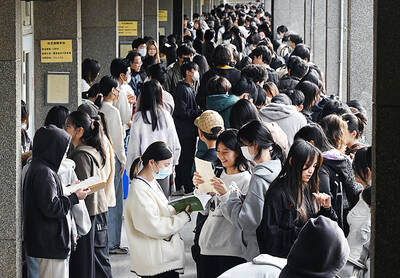
A global survey showed that 60 percent of Taiwanese had attained higher education, second only to Canada, the Ministry of the Interior said. Taiwan easily surpassed the global average of 43 percent and ranked ahead of major economies, including Japan, South Korea and the US, data from the Organisation for Economic Co-operation and Development (OECD) for 2024 showed. Taiwan has a high literacy rate, data released by the ministry showed. As of the end of last year, Taiwan had 20.617 million people aged 15 or older, accounting for 88.5 percent of the total population, with a literacy rate of 99.4 percent, the data

CCP ‘PAWN’? Beijing could use the KMT chairwoman’s visit to signal to the world that many people in Taiwan support the ‘one China’ principle, an academic said Chinese Nationalist Party (KMT) Chairwoman Cheng Li-wun (鄭麗文) yesterday arrived in China for a “peace” mission and potential meeting with Chinese President Xi Jinping (習近平), while a Taiwanese minister detailed the number of Chinese warships currently deployed around the nation. Cheng is visiting at a time of increased Chinese military pressure on Taiwan, as the opposition-dominated Legislative Yuan stalls a government plan for US$40 billion in extra defense spending. Speaking to reporters before going to the airport, Cheng said she was going on a “historic journey for peace,” but added that some people felt uneasy about her trip. “If you truly love Taiwan,

South Korea has adjusted its electronic arrival card system to no longer list Taiwan as a part of China, a move that the Ministry of Foreign Affairs said would help facilitate exchanges between the two sides. South Korea previously listed “Taiwan” as “Taiwan (China)” in the drop-down menus of its online arrival card system, where people had to fill out where they came from and their next destination. The ministry had requested South Korea make a revision and said it would change South Korea’s name on Taiwan’s online immigration system from “Republic of Korea” to “Korea (South),” should the issue not be


 RSS
RSS