


In addition to helping prevent mudslides, the government's Plains Land Afforestation Project hopes to give Taiwan's endangered ring-necked pheasant back its habitat, forestry officials said yesterday.
The ring-necked pheasant, also known as the "Pearl of the Grasslands," is a protected species under Taiwan's Wild Animals Protection Law (
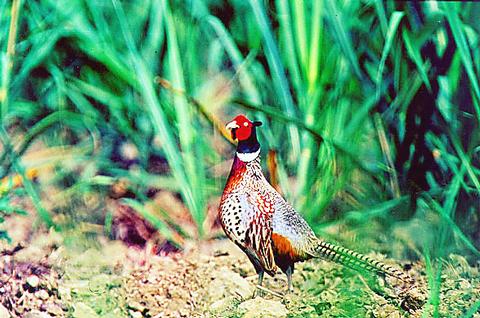
PHOTO COURTESY THE COUNCIL OF AGRICULTURE
As its living space continues to shrink, its population has diminished to 1,400, 516 of which live in Hualien County.
"Development on the plains over the past four decades has destroyed the habitat of the ring-necked pheasant," said Y Star Huang (
"In addition to its ever-shrinking habitat, contamination from pesticides as well as human encroachment has made sightings of the Taiwan ring-necked pheasant rare."
The ring-necked pheasant has a red face and a white ring around its neck.
There are 29 Asian pheasant species, of which Taiwan's ring-necked pheasant is one.
Taiwan's rare variety of the species lives mostly on the island's plains and near sugar cane.
They mostly eat insects, leaves, crops and seeds.
Taiwan ring-necked pheasants can be found in eastern Taiwan, in Taitung and Hualien, and the sugar-cane area of Tainan in western Taiwan.
The disappearance of the ring-necked pheasant's habitat is particularly severe in western Taiwan, due to the changing use of cultivated land, Huang said.
In Taiwan, large areas of sugar-cane land have been converted into industrial areas, schools and hospitals.
The construction of highways and railways are also responsible for the destruction of the pheasants' habitat.
The main difference between the Taiwan ring-necked pheasant and foreign varieties of the bird is the white feather on its abdomen near the side of its wings. The plumage of the bird's barred tail is olive green and its stripes are wider than that of other species of Asian pheasant.
Interbreeding between non-Taiwanese Asian species has also affected the existence of the Taiwan ring-necked pheasant, Huang said.
Non-Taiwanese pheasants from the US are sometimes imported to Taiwan for manufacturing plume products.
"Mating with foreign species that have gone wild has destroyed the purity of the Taiwan variety and made the it vulnerable to extinction," Huang said.

A signaling system malfunction disrupted high-speed rail (HSR) services beginning at 8am today, with trains temporarily reduced to three northbound and three southbound trains per hour as authorities conduct inspections. The malfunction occurred on a section of track in Miaoli County during pre-operation checks early this morning, forcing northbound and southbound trains to use a single track, the HSR operator said. The regular schedule has been replaced with three hourly trains offering only nonreserved seating in each direction, stopping at every station, it said, adding that business class cars would still have reserved seating. Departures from terminal stations are scheduled at the top

DRONE CENTRAL: Taiwan aims to become Asia’s democratic hub for drones, with most exports focused on high-quality military-grade models, an official said Taiwan’s drone industry is expected to expand significantly by 2030, producing 100,000 units per month and exporting half of them, the Ministry of Economic Affairs said yesterday. Current drone production capacity is about 15,000 units per month, but the industry can quickly scale up as demand increases, Industrial Development Administration Director-General Chiou Chyou-huey (邱求慧) told a news conference in Taipei. Taiwan’s drone output grew 2.5-fold last year to NT$12.9 billion (US$408.3 million) under a government program to develop the uncrewed vehicle sector, he said. The Executive Yuan in October last year approved plans to invest NT$44.2 billion into domestic production of uncrewed aerial
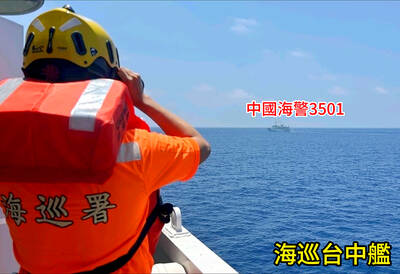
VERBOSE VESSELS: A CGA cutter and a China Coast Guard exchanged verbal barbs for more than a day in Taiwanese-controlled waters before the Chinese vessel left The Taiwanese and Chinese coast guards had a standoff near the strategically located Pratas Islands (Dongsha Islands, 東沙群島) in the north of the South China Sea, the Coast Guard Administration (CGA) said yesterday. The two sides engaged in intense radio exchanges over sovereignty claims during the 33-hour standoff. China Coast Guard vessel 3501 eventually left the restricted waters, 26.6 nautical miles (49.2km) west of the Pratas Islands, at 5pm yesterday, the CGA said. Lying approximately between southern Taiwan and Hong Kong, the Taiwan-controlled Pratas are seen by some security experts as vulnerable to Chinese attack due to their distance — more than

Taiwan is still in the process of assessing the possibility of recruiting workers from Eswatini, the Ministry of Foreign Affairs said yesterday, adding that its goal is to help Eswatini upgrade its vocational training centers. If there are plans to recruit workers from Eswatini, safeguarding national security, protecting public health and ensuring the employment rights of Taiwanese would be prerequisites, Department of West Asian and African Affairs Director-General Yen Chia-liang (顏嘉良) told a news conference. Key considerations would also include filling labor shortages in specific industries, and fostering bilateral professional and technical exchanges, he said. Yen was asked about the progress of labor


 RSS
RSS