


The five-day visit of former South Korean president Kim Young-sam to Taipei was clouded with confusion and misunderstanding yesterday. Nevertheless, the improvement of bilateral ties was still the focus of Kim's meeting with President Chen Shui-bian (
Kim cancelled his press conference scheduled for 3:30pm at the Grand Hotel yesterday after his delegation and the Presidential Office failed to map out the final wording of a written statement.
"The Presidential Office intended to insert a few words into our drafted press release while we wanted to keep it as simple as possible," said Kang Myeong-sang, director of the Institute of China Relations at Korea's Kyungnam University and a member of the 17-strong delegation.
"That [referring to the press conference] was only what we had hoped for. Whatever we do must be agreed by your Presidential Office," said Chung Jey-moon, a member of Korea's National Assembly from the Grand Nation Party, another member of the delegation.
The drafted statement urged the resumption of direct air links to take place as soon as possible "in order to enhance substantive ties between the two sides."
In the statement, both sides agreed that working-level negotiations between the two governments should commence in the near future.
Such negotiations would discuss substantive as well as technical matters related to the resumption of direct air links.
Kang and Chung denied a report in yesterday's Liberty Times that claimed that former president Lee Teng-hui (
"We haven't contacted him and he hasn't contacted us," said Chung. "We'd like to pay a visit but there is no arrangement."
Seoul severed ties with Taipei in August 1992 under then-president Roh Tae-woo as part of its policy to move closer to Beijing and Moscow so as to gain an upper hand in its relations with Pyongyang.
Eugune Chien (簡又新), deputy secretary-general to the president, also denied a Liberty Times report which alleged that Kim "apologized" to Chen for what he saw as the improper process leading up the severance of ties between the two countries.
Kim met Chen for a second round of bilateral talks yesterday morning, which was followed by a lunch banquet hosted by Chen at the Taipei Guest House. Kim met Chen four times during the past two days.
During the meeting yesterday morning, Chen reportedly said it was "brave" of Kim to visit Taiwan because of pressure from China.
Chung confirmed that Kim had sent prior notice to China's embassy in Seoul about his planned visit to Taipei.
The enhancement of bilateral ties included the restoration of annual meetings between economics ministers from the two sides, to "fight against pressure from China to some extent," as well as the improvement of economic ties, Chen said.
Chen also reiterated that three conditions must be met before direct air links can be resumed, sources said.
Taipei would accept the restoration of air links if Taiwan's "national dignity" is respected, and if "substantial benefits" and "parity" are guaranteed to both sides, Chen said.
Chen made clear the three conditions for the first time during his initial meeting with Kim on Thursday.
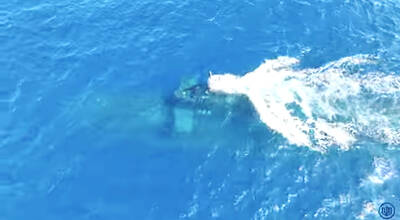
CSBC Corp, Taiwan (台灣國際造船) yesterday released the first video documenting the submerged sea trials of Taiwan’s indigenous defense submarine prototype, the Hai Kun (海鯤), or Narwhal, showing underwater navigation and the launch of countermeasures. The footage shows the vessel’s first dive, steering and control system tests, and the raising and lowering of the periscope and antenna masts. It offered a rare look at the progress in the submarine’s sea acceptance tests. The Hai Kun carried out its first shallow-water diving trial late last month and has since completed four submerged tests, CSBC said. The newly released video compiles images recorded from Jan. 29 to
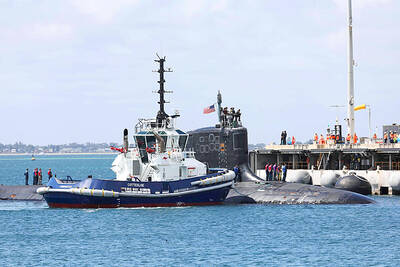
DETERRENCE EFFORTS: Washington and partners hope demonstrations of force would convince Beijing that military action against Taiwan would carry high costs The US is considering using HMAS Stirling in Western Australia as a forward base to strengthen its naval posture in a potential conflict with China, particularly over Taiwan, the Wall Street Journal reported on Saturday. As part of its Indo-Pacific strategy, Washington plans to deploy up to four nuclear-powered submarines at Stirling starting in 2027, providing a base near potential hot spots such as Taiwan and the South China Sea. The move also aims to enhance military integration with Pacific allies under the Australia-UK-US trilateral security partnership, the report said. Currently, US submarines operate from Guam, but the island could
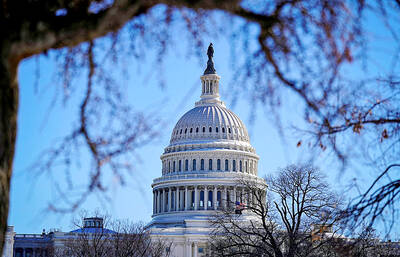
RESTRAINTS: Should China’s actions pose any threat to Taiwan’s security, economic or social systems, China would be excluded from major financial institutions, the bill says The US House of Representatives on Monday passed the PROTECT Taiwan Act, which states that Washington would exclude China from participating in major global financial organizations if its actions directly threaten Taiwan’s security. The bill, proposed by Republican Representative Frank Lucas, passed with 395 votes in favor and two against. It stipulates that if China’s actions pose any threat to Taiwan’s security, economic or social systems, the US would, “to the maximum extent practicable,” exclude Beijing from international financial institutions, including the G20, the Bank for International Settlements and the Financial Stability Board. The bill makes it clear that China must be prepared

Taiwanese trade negotiators told Washington that Taipei would not relocate 40 percent of its semiconductor production to the US, and that its most advanced technologies would remain in the nation, Vice Premier Cheng Li-chiun (鄭麗君) said on Sunday. “I told the US side very clearly — that’s impossible,” Cheng, who led the negotiation team, said in an interview that aired on Sunday night on Chinese Television System. Cheng was referring to remarks last month by US Secretary of Commerce Howard Lutnick, in which he said his goal was to bring 40 percent of Taiwan’s chip supply chain to the US Taiwan’s almost


 RSS
RSS