


A load of whale dolphin meat weighing over 1000kg was discovered by inspectors in a truck that arrived at the Chiayi City fish market on Saturday evening. This is the largest seizure of dolphin meat since the implementation of the Wildlife Conservation Law.
Acting on a tip, inspectors searched the truck at 9:30pm as it waited to deliver its cargo.
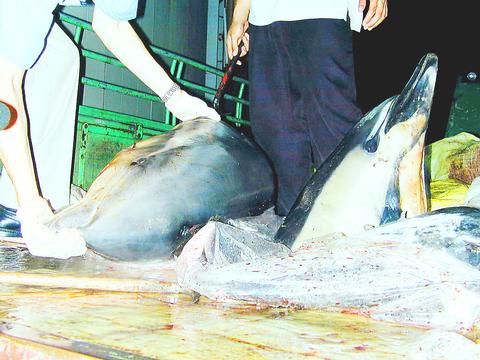
PHOTO: TSAI MIN-YI, TAIPEI TIMES
According to the driver, 23-year-old Huang Yi-hsiung (
By the time they were discovered, the dolphins had been cut into 32 large pieces, each individually wrapped in a burlap bag. One enormous head section appeared to have been freshly cut and was spattered with blood.
Both Huang and the owner of the truck, Chen Wen-yang (
They were told to expect a phone call after arriving in Chiayi and never knew the identity of the intended recipient.
The two men, together with a worker who helped to package the meat, await charges for violating the Wildlife Conservation Law.
In the past, dolphin meat was often sold by fishermen in Chiayi County. Now, however, most are wary of selling even those dolphins caught unintentionally. Only one or two fish vendors will hawk the meat, usually by wrapping a large chunk with a towel and driving around with it on a motorcycle while calling for customers. Sales are poor, and trading in large volume is rare.
Dolphin meat is pitch black with a strong "fishy" taste. The only way it can be suitably prepared is by stir-frying thin slices of the meat with the skin attached at high temperature. Ginger, rice wine, and basil are added to suppress the fishy flavor.
The resulting dish is entirely black and generally appeals only to afficionados or the gastronomically adventurous. It is occasionally available in restaurants for NT$200 to NT$250 per dish.
Dolphin conservation enjoyed an upsurge of popularity in Taiwan almost a year ago when a Risso's dolphin nicknamed "Uncle A-Tung" (阿通伯) was returned to the sea after beaching himself near Miaoli county's Tunghsiao township.
Extensive coverage by local media helped to rally conservationists in support of Uncle A-Tung and the dolphin's saga took an unexpected turn when he beached himself yet again within hours of his release.
Yet another release and yet another return prompted cetacean experts to wonder if Uncle A-Tung had become dependent on an easy life in their tanks and the 20kg of squid per day he enjoyed during his periods of recuperation.
Finally, on being released a third time, Uncle A-Tung became the first dolphin in Asia to successfully return to the sea after running aground.


Japan has deployed long-range missiles in a southwestern region near China, the Japanese defense minister said yesterday, at a time when ties with Beijing are at their lowest in recent years. The missiles were installed in Kumamoto in the southern region of Kyushu, as Japan is attempting to shore up its military capacity as China steps up naval activity in the East China Sea. “Standoff defense capabilities enable us to counter the threat of enemy forces attempting to invade our country ... while ensuring the safety of our personnel,” Japanese Minister of Defense Shinjiro Koizumi said. “This is an extremely important initiative for

MORE POPULAR: Taiwan Pass sales increased by 59 percent during the first quarter compared with the same period last year, the Tourism Administration said The Tourism Administration yesterday said that it has streamlined the Taiwan Pass, with two versions available for purchase beginning today. The tourism agency has made the pass available to international tourists since 2024, allowing them to access the high-speed rail, Taiwan Railway Corp services, four MRT systems and four Taiwan Tourist Shuttles. Previously, five types of Taiwan Pass were available, but some tourists have said that the offerings were too complicated. The agency said only two types of Taiwan Pass would be available, starting from a three-day pass with the high-speed rail and a three-day pass with Taiwan Railway Corp. The former costs NT$2,800

NEW LOW: The council in 2024 based predictions on a pessimistic estimate for the nation’s total fertility rate of 0.84, but last year that rate was 0.69, 17 percent lower An expected National Development Council (NDC) report expects the nation’s population to drop below 12 million by 2065, with the old-age dependency ratio to top 100 percent sooner than 2070, sources said yesterday. The council is slated to release its latest population projections in August, using an ultra-low fertility model, the sources said. The previous report projected that Taiwan’s population would fall to 14.37 million by 2070, but based on a new estimate of the total fertility rate (TFR) — the average number of children born to a woman over her lifetime — the population is expected to reach 12 million by
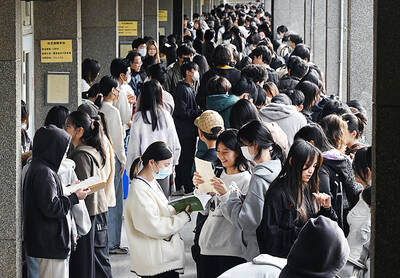
A global survey showed that 60 percent of Taiwanese had attained higher education, second only to Canada, the Ministry of the Interior said. Taiwan easily surpassed the global average of 43 percent and ranked ahead of major economies, including Japan, South Korea and the US, data from the Organisation for Economic Co-operation and Development (OECD) for 2024 showed. Taiwan has a high literacy rate, data released by the ministry showed. As of the end of last year, Taiwan had 20.617 million people aged 15 or older, accounting for 88.5 percent of the total population, with a literacy rate of 99.4 percent, the data


 RSS
RSS