


After decades of negotiation that eventually ended in compromise, the Taipei City Government yesterday demolished the city's oldest public market.
Efforts to tear down Hsimen Market (
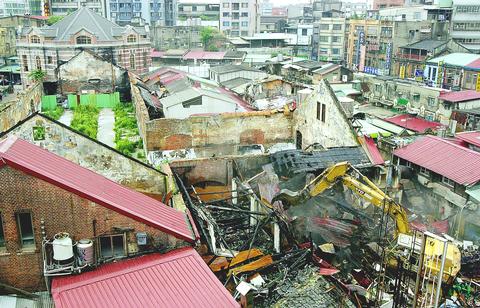
PHOTO: CHEN CHENG-CHANG, TAIPEI TIMES
The city is taking down part of the 104-year-old market in order to reconstruct the historic building -- a crucifix-shaped, one-story Japanese style building -- that will house 262 grocery stores.
The NT$600 million project, which is scheduled to be completed by next July, is part of an effort to revitalize the city's older communities.
One day before the demolition, Hsu Yang-lan (
A check for NT$110,000 was all she had to show after a decade of protests with other vendors and negotiations with the city government.
Hsu, 88, originally from Sha-nghai, had sold noodle soup at the Hsimen Market when she and her late husband relocated to Hsimenting in 1949.
When her husband died some 20 years ago, Hsu closed down the store and has since been living alone at the shop.
However, a devastating fire last year forced her to move out of her home and rent a room at a nearby apartment complex.
"I've lost my home and don't have enough money to eat," said the gray-haired grandmother in a heavy Shanghai accent.
Compensation complaint
Her grand daughter, Lee Ya-ling (
Like those shop owners whose stores were destroyed during last year's fire, Hsu has received NT$15,000 in compensation for the losses.
She is also entitled to NT$1.12 million since she does not intend to move back to the reconstructed market to continue with her business.
Vendors intending to move back, on the other hand, are entitled to NT$660,000 in compensation.
Rich history
The Hsimen Market in Hsimenting, Wanhua District, was built in 1896 during the Japanese colonial era and was the city's first public market.
The wooden building was reconstructed in 1908 and came to consist of two main buildings: a two-storey red-brick octagon-shaped structure and a one-storey red-brick crucifix-shaped building.
According to Huang Yung-chuan (
The crucifix-shaped building was used as a market for selling fresh groceries, dried food and daily items. Twenty-six more shops were built in 1928 to the east of the octagon-shaped building.
Two years after KMT forces retreated to Taiwan after loosing the civil war in China, the octagon-shaped building was renamed the "Taipei Book Market" (
In 1956, the octagon-shaped building was renamed the "Red Theater" (
buildings erected
To feed hungry movie-goers, more buildings were erected and more street vendors gathered to the west and south of the theater during the 1960s and 1970s.
Business for these vendors, however, has gone downhill since 1991, when the nearby Chunghua Market was demolished to make room for Chunghua Road.
In 1997, the city government designated the theater as a third-class historic relic and launched a remodeling project to make it into a movie museum.
The fire of July 22 last year, however, almost flattened the market and destroyed 129 stores to the south and west of the theater.
deeply disappointed
As Huang watched the excavator demolish the buildings opposite his florist shop, he said he still couldn't help feeling that the revitalization plan was unfair for the shop owners.
"The city claimed that their buildings were illegally constructed, but they had been around long before the KMT forces came over," said Huang, whose shop was spared because it was considered "legal."
A women by the name of Chen, who was busy emptying her shop opposite Huang's on Wednesday afternoon, said that she was very disappointed with the compensation offered by the city government.
"Ten years ago, I spent NT$3 million to purchase this place and have been paying NT$4,000 every month for the vendor's license. "The NT$1.12 million compensation is hardly enough to cover my losses.
"I don't want to move, but what else can I do?" she said.
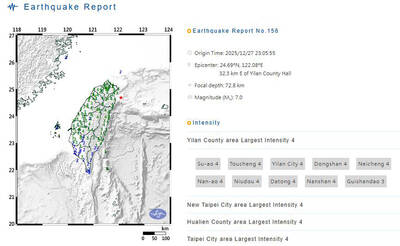
A magnitude 7.0 earthquake struck off Yilan at 11:05pm yesterday, the Central Weather Administration (CWA) said. The epicenter was located at sea, about 32.3km east of Yilan County Hall, at a depth of 72.8km, CWA data showed There were no immediate reports of damage. The intensity of the quake, which gauges the actual effect of a seismic event, measured 4 in Yilan County area on Taiwan’s seven-tier intensity scale, the data showed. It measured 4 in other parts of eastern, northern and central Taiwan as well as Tainan, and 3 in Kaohsiung and Pingtung County, and 2 in Lienchiang and Penghu counties and 1

FOREIGN INTERFERENCE: Beijing would likely intensify public opinion warfare in next year’s local elections to prevent Lai from getting re-elected, the ‘Yomiuri Shimbun’ said Internal documents from a Chinese artificial intelligence (AI) company indicated that China has been using the technology to intervene in foreign elections, including propaganda targeting Taiwan’s local elections next year and presidential elections in 2028, a Japanese newspaper reported yesterday. The Institute of National Security of Vanderbilt University obtained nearly 400 pages of documents from GoLaxy, a company with ties to the Chinese government, and found evidence that it had apparently deployed sophisticated, AI-driven propaganda campaigns in Hong Kong and Taiwan to shape public opinion, the Yomiuri Shimbun reported. GoLaxy provides insights, situation analysis and public opinion-shaping technology by conducting network surveillance
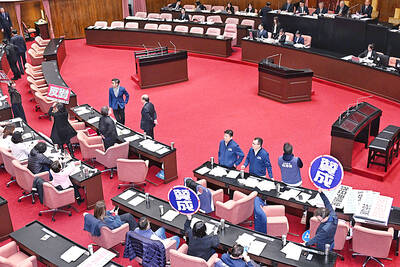
‘POLITICAL GAME’: DPP lawmakers said the motion would not meet the legislative threshold needed, and accused the KMT and the TPP of trivializing the Constitution The Legislative Yuan yesterday approved a motion to initiate impeachment proceedings against President William Lai (賴清德), saying he had undermined Taiwan’s constitutional order and democracy. The motion was approved 61-50 by lawmakers from the main opposition Chinese Nationalist Party (KMT) and the smaller Taiwan People’s Party (TPP), who together hold a legislative majority. Under the motion, a roll call vote for impeachment would be held on May 19 next year, after various hearings are held and Lai is given the chance to defend himself. The move came after Lai on Monday last week did not promulgate an amendment passed by the legislature that
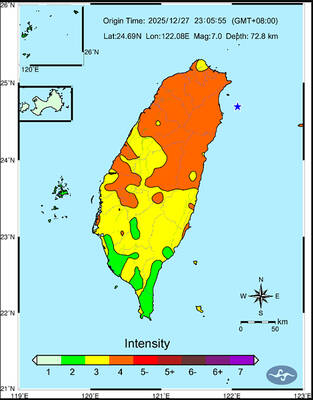
AFTERMATH: The Taipei City Government said it received 39 minor incident reports including gas leaks, water leaks and outages, and a damaged traffic signal A magnitude 7.0 earthquake struck off Taiwan’s northeastern coast late on Saturday, producing only two major aftershocks as of yesterday noon, the Central Weather Administration (CWA) said. The limited aftershocks contrast with last year’s major earthquake in Hualien County, as Saturday’s earthquake occurred at a greater depth in a subduction zone. Saturday’s earthquake struck at 11:05pm, with its hypocenter about 32.3km east of Yilan County Hall, at a depth of 72.8km. Shaking was felt in 17 administrative regions north of Tainan and in eastern Taiwan, reaching intensity level 4 on Taiwan’s seven-tier seismic scale, the CWA said. In Hualien, the


 RSS
RSS